Access to college classes in Illinois prisons is falling further behind demand, even as the state makes progress getting people into GED and literacy programs. That’s according to data published by the Illinois Department of Corrections at the beginning of September.
The number of people on educational waitlists significantly exceeds the number taking classes. Since last year, the number of people on the waitlist for college classes has increased by 80%.
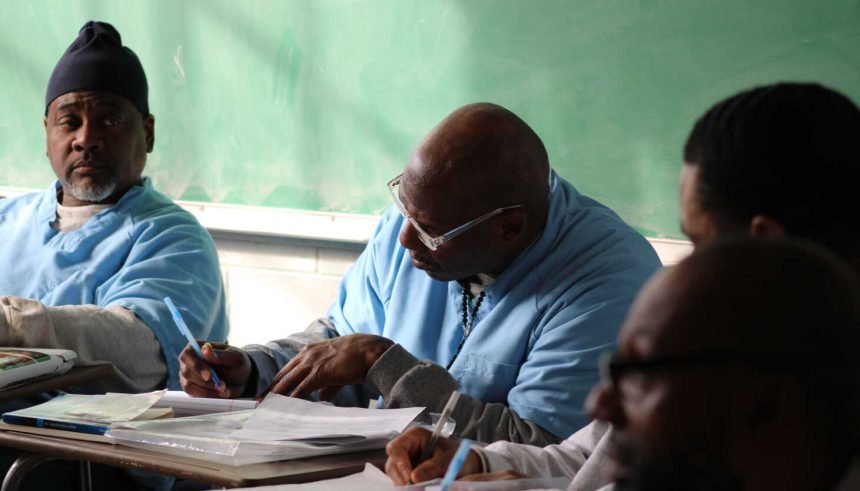
Around 2,600 out of the approximately 30,000 people incarcerated in Illinois are enrolled in higher education, while another 3,700 are on a waitlist, according to IDOC.
“That’s a pretty powerful indication that the challenge isn’t a lack of interest in education — it’s our capacity to meet that interest,” said Ashton Klekamp, policy and research director at the Education Justice Project at the University of Illinois Urbana-Champaign, which offers college classes at Danville Correctional Center.
Research shows that participating in education while incarcerated helps people find employment after release and reduces the likelihood they’ll return to prison. In Illinois, some people who complete educational programs can also earn credit toward an earlier release.
The state’s enrollment figures include both college classes and career and technical education, as well as around 750 people on supervised release — Illinois’ version of parole. It’s unclear if those on supervised release are studying at outside colleges, or if they are enrolled in programs behind bars.
This is the second year Illinois has published this data. In 2023, lawmakers passed legislation requiring the Illinois Department of Corrections to publish detailed data each yearabout enrollment, waitlists and spending on educational programs. It’s one of the few states that require corrections departments to publicly report such data.
Who’s studying behind bars in Illinois
White people are significantly overrepresented in higher education relative to the overall prison population, while Black and Hispanic people are underrepresented. White people make up over a third of the prison population but nearly half of those studying. Black people, by contrast, make up more than half of the prison population but only 43% of higher education participants. Hispanic people make up 13% of the prison population but only 10% of participants.
About 160 women are enrolled in prison higher education programs here, and their enrollment is roughly the same as their share of Illinois’ prison population. However, the number of women participating in education declined by about a quarter since last year.
The average person enrolled in higher education is 39 years old with about 4.4 years left on their sentence — consistent with the state’s practice of prioritizing people closest to release for educational programming.
“For a long time … we didn’t have a sense of where that access existed and who didn’t have access,” Klekamp said. “The demographic data is something that is really important…People are telling us very clearly that they want an education. The question for Illinois is whether we’re willing to build the capacity to meet that demand.”
Geography matters
Whether someone has access to higher education depends largely on geography.
“One of the things that jumps out immediately is how uneven access is across facilities,” Klecamp said. “It tells us that the experience of trying to access education can depend considerably on where someone is incarcerated.”
The average wait for a spot has dropped since last year, from about 1.3 years to roughly 324 days, a shift possibly driven by a surge of new applicants on lists. IDOC spokesperson Naomi Puzzello attributed the growth in applicants to more people successfully completing the academic placement test required for programs and therefore being eligible for higher education.
Danville Correctional Center now has the longest average wait in the system, at nearly 5.5 years. Logan, Illinois’ largest women’s prison which offers a bachelor’s degree through Northwestern University, follows closely at just under 4.9 years.
Several people in prison have been waiting years to get enrolled in prison higher education programs.
At Big Muddy River prison, one person has been on the waitlist since October 2006 — the longest wait Open Campus found in the data, at nearly 19 years. Several other facilities — including Dixon, Pinckneyville, Taylorville, and Western Illinois — have people who were put on waitlists between 2016 and 2019.
Many of the people with the longest waits remain at the bottom of the lists under the system’s release-based approach. The individual who has waited longest of all, at Big Muddy River, has no listed sentence length in the data — which typically indicates a life sentence or similarly indefinite term.
Some facilities have especially large waitlists because they host several college programs at once. Sheridan Correctional Center is the clearest example, where 78% of the population is either studying or waiting for a spot. Its waitlist has grown since the facility absorbed Northwestern’s bachelor’s program and other college offerings after Stateville’s 2024 closure.
Other facilities have no waitlists because they offer little to no higher education programming in the first place. Menard, in southern Illinois, has just 8 people enrolled and 8 on the waitlist; its only offerings are two career and technical tracks, in building and construction maintenance and small engine repair. Pontiac, in central Illinois, has no higher education programming at all and almost no one on its waitlist.
Puzzello said IDOC is “consistently working to expand academic opportunities” and remains open to partnering with higher education providers interested in offering programs at facilities like these.
Progress on GED and literacy programs and more funding for state colleges
The state appears to be making progress getting people into GED and literacy programs. The waitlist for these programs shrank slightly this year compared to 2025, even as participation held roughly steady. Puzzello said the decline is due to increased staffing, improved movement between facilities, and a higher GED pass rate.
Illinois lawmakers have begun directing state money toward public colleges and universities offering higher education in prison. The state’s 2027 budget included $250,000 for the Illinois Board of Higher Education to help fund bachelor’s degree programs in prisons, and another $250,000 for the Illinois Community College Board to help fund associate degree programs.
Currently, the majority of bachelor’s degree programs in Illinois prisons come through private universities — Northwestern, Lewis, Adler and Augustana all offer bachelor’s degrees. North Park Theological Seminary offers a master’s degree in restorative justice ministries.
The only four-year public institutions offering credit-bearing academic courses are University of Illinois Urbana-Champaign, which offers college credit but not a full degree, and Eastern Illinois University. Both operate at Danville Correctional Center. Community college programming, meanwhile, is overwhelmingly concentrated in career and technical education rather than academic coursework and offered by just three colleges.
Puzzello wrote that the department is “requesting that colleges reinstate academic courses using the appropriated funds.” She added that IDOC expects higher education staffing to increase as community colleges reinstate academic courses, though she did not specify which courses or facilities that refers to.
This story was produced in partnership with Open Campus, a nonprofit newsroom covering higher education. It’s published in partnership with WBEZ’s Prisoncast!, an audio journalism project made with and for incarcerated people and their loved ones.