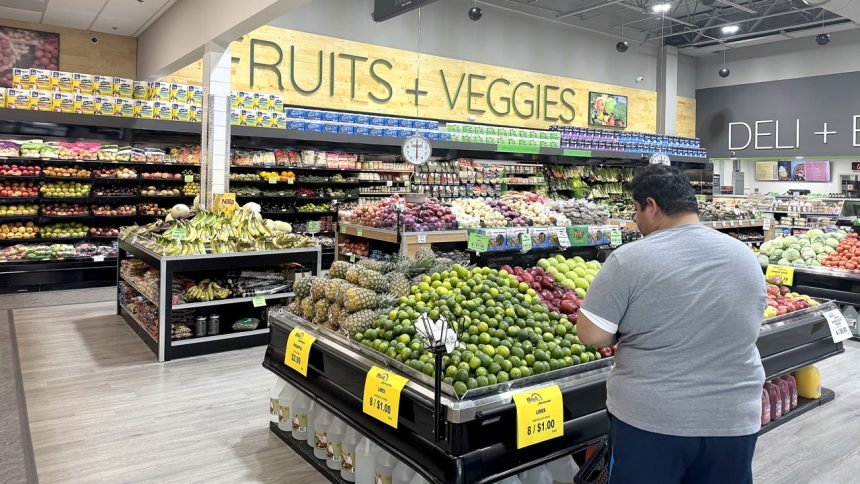
The region is unique and diverse.
Covering the Miami metropolitan area, the Everglades, and south to the Keys, South Florida, with its population well over 6 million, is a region famed for its Latin flavor, and proximity to Central America and the Caribbean as an import hub.
But while South Florida’s Latino population totals around 2.5 million, according to the UCLA Latino Policy & Politics Institute, it should be emphasized that it is far from homogenous. Of the estimated total population, only around 1.1 million are Cuban Americans; the rest of the region’s Hispanics have roots in Central and South America, and the Caribbean, covering a range of different countries.
According to Susie McKinley, director of marketing and development at the Tallahassee-based Florida Department of Agriculture and Consumer Services, South Florida’s sizable Hispanic population influences retailer produce departments across the state.
“There tends to be a wider variety of produce items, primarily tropical produce, that is common in many Hispanic cultures,” she says. “Many growers in the area provide tropical produce to the region, primarily in the summer.”
“There tends to be a wider variety of produce items, primarily tropical produce, that is common in many Hispanic cultures. Many growers in the area provide tropical produce to the region, primarily in the summer.”
— Susie McKinley, Florida Department of Agriculture and Consumer Services, Tallahassee, FL
Going by sheer numbers of locations, Publix, Winn-Dixie, and Aldi are the largest grocery retailers, not just in Southern Florida, but across the state as a whole, although Texan grocer Tom Thumb, budget operator Save A Lot, and Key Food all have substantial presences.
At the same time, successive waves of Hispanic immigration to the region have driven the growth of Hispanic-focused grocery retail chains, from Fresco y Más (a subsidiary of Southeastern Grocers) to Presidente Supermarkets, Sedano’s, and Bravo, among many others.
“Our great weather allows for year-round cultivation of a wide range of fruits and vegetables.”
— Denise Gomez, JC Tropicals, Doral, FL
“South Florida is a unique and diverse region for produce,” says Denise Gomez, marketing manager for Doral, FL-based packer, importer and marketer JC Tropicals. “Our great weather allows for year-round cultivation of a wide range of fruits and vegetables.”
On the homegrown side, JC partners with local producers in the Homestead area (south of Miami) to source a variety of fruits that can be cultivated in South Florida’s tropical climate, including dragon fruit, passion fruit, mamey sapote, avocados, mangos and more.
“South Florida is home to a diverse population, including large communities from Latin America and the Caribbean from countries like Cuba, Dominican Republic, Puerto Rico, Venezuela and Colombia,” continues Gomez. “This cultural diversity influences the types of produce that are in demand, particularly tropical fruits, root vegetables, and fresh herbs, which are staples in many Latin American dishes.”
THE LATIN CONNECTION
Although South Florida is a significant producer of tropical fruits, the region — and particularly the Miami metropolitan area — is famed as a gateway into the U.S. for Central and South American produce through Port Everglades and the Port of Miami.
And this seaborne trade is substantial. According to data from the U.S. Census Bureau and Observatory for Economic Complexity, fruit and vegetable imports to the Miami Customs District totaled $2.91 billion in 2023, an 8.98% increase from the year before.
Guatemala topped the list of source countries in 2023 — with imports valued at $515 million — followed by Peru ($494 million), and Ecuador ($235 million). Melons headed up the products table, with imports estimated at $228 million, followed by bananas at $190 million during the year.
Among the companies specializing in this trade is Miami-based importer-distributor Total Green Tropicals, which brings in a range of exotic fruits and vegetables, regularly delivered from nine countries, according to general manager Jorge Herrera.
Receiving an estimated 40 container loads per week, Total Green caters to Hispanic populations, not just in Florida, but across Texas, Arizona, California, New York, as well as Chicago, Philadelphia and Atlanta. It has also recently added North Carolina to the list with the November 2024 acquisition of Asheboro-headquartered El Niño Produce.
Given the business’ Hispanic focus, Total Green’s top imports lean heavily toward in-demand products from Latino consumers, from plantain (sourced from Ecuador and Guatemala) to specialties, such as yuca, malanga and chayote squash.
“Ethnic products are the basis of our business, and we have grown a lot in recent years,” says Herrera.
With locations across the U.S., as well as offices in Belgium, Peru and Guatemala, Coosemans has been a leading name in the specialty produce business for over 40 years. With a focus on products from Central and South America, as well as the Caribbean, Europe and Asia, Coosemans Miami imports a wide range of specialties that the company’s Alex Unger describes as “off-the-wall, not-so-well-known items. If it’s available, we’ll find it and sell it.”
These include products from rambutan, tamarillo, and kumquat to heirloom tomatoes and Red Fresno chiles, although the company does handle a full range of more conventional fruits and vegetables.
Coosemans has seen significant recent growth in edible micro-flowers, which chefs use for decorative purposes. “This is a big, new item that has grown over the last five years by 1,000% easily,” says Unger, adding that the micro-greens segment has also seen substantial sales growth.
OVERCOMING CHALLENGES
While unusual specialties undoubtedly help many importers stand out from the crowd, one factor that has united the industry has been the lingering difficulties since the COVID-19 pandemic.
One such challenge, according to Herrera at Total Green, has been high freight rates, which rose in the wake of the pandemic and have yet to decrease. As a result, he says companies like Total Green have to pass the extra costs on to customers in order to remain in business.
Gomez at JC Tropicals agrees that pandemic-era disruption continues to affect the South Florida produce industry. “The pandemic had a significant impact on a lot of us, leading to port delays, labor shortages, price fluctuations, and shifts in consumer behavior.”
“While some of these challenges persist, we’ve had to adapt by diversifying our sourcing strategies and increasing flexibility to meet market demands.”
“Costs are higher — in some cases, substantially higher than pre-pandemic, which leads to higher prices on the commodities coming in and higher prices for the end user unfortunately,” admits Unger at Coosemans.
“But you do what you can to cut costs as much as possible. For example, bringing products into Tampa and shipping them down is one way we can cut that cost, so there’s things we can do to keep us more competitive and keep the product more affordable for the end user.”
Another challenge affecting retailers in South Florida is fluctuation in prices due to seasonality, supply chain disruptions and weather events, according to Gomez.
She says the demand for variety and freshness can also be challenging, especially given the region’s diverse cultural preferences. “Retailers need to stock both mainstream items and exotic products, which can complicate inventory management and freshness.”
“For us as distributors, we have the same challenges. With products from 18 different countries, we must navigate logistical hurdles such as weather, crop delays, transportation issues and strikes.”
Given the challenges, Gomez says distributors are central to the produce market in South Florida, ensuring fresh produce reaches retailers and consumers in a timely manner with consistent quality.
However, looking ahead, Unger sees further consolidation on the horizon for Southern Florida’s produce industry. “I think we’re going to see a lot more consolidation with companies being bought up,” he says. “It’s a big trend, with venture capitalists coming in and buying a lot of the smaller companies, and squeezing out your traditional jobber and small produce guy.”