Overview:
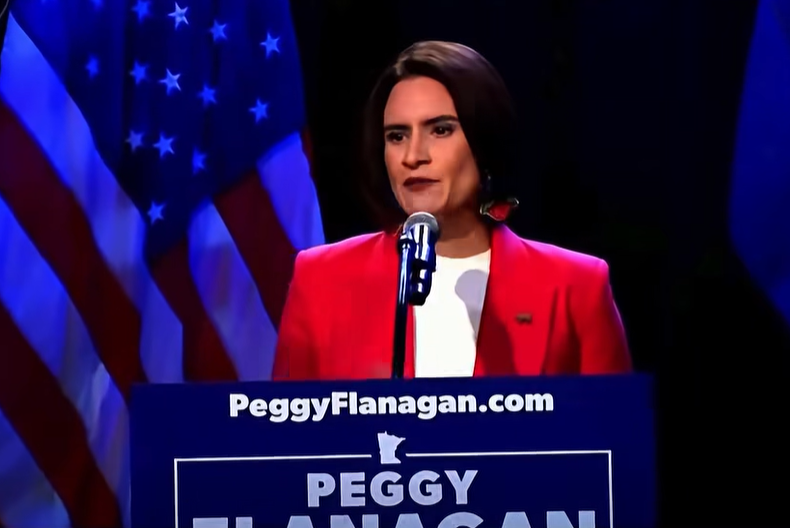
This analysis examines the potential influence of the Native vote in Minnesota’s 2026 U.S. Senate primary, particularly in the context of Lt. Gov. Peggy Flanagan’s campaign for the Democratic nomination.
The piece argues that while Native Americans represent about 1.2% of Minnesota’s population according to Census estimates, their political influence may be considerably greater because Native voters are concentrated in key counties and often prioritize candidates who support Tribal sovereignty, treaty rights, and the federal trust responsibility.
Analysis – Native Vote 2026
Shortly after the 2026 Michigan Senate Primary, former Assistant Secretary of the Interior Bryan Newland (Bay Mills Indian Community) shared some observations from the results of the Michigan Senate primary that suggest the Native vote can make a difference. I have some similar observations about the most recent Minnesota Senate primary results.
Many Native Americans, especially the Anishinaabe — Chippewa, Odawa, and Potawatomi — have a vested interest in Minnesota Lt. Gov. Peggy Flanagan (White Earth Band of Minnesota Chippewa) becoming one of the first two Native women to be elected to the U.S. Senate. The other Native woman is former U.S. Rep. Mary Peltola (Alaska, Yup’ik). In 2018, both Deb Haaland (New Mexico, Laguna Pueblo) and Sharice Davids (Kansas, Ho-Chunk) made history by becoming the nation’s first Native women elected to Congress. Perhaps the time has come for the U.S. Senate glass ceiling to be shattered as well.
Minnesota has a sizable population of Native Americans who live in their homelands. Of the total Minnesota population, estimated at 5.7 million in 2024, the number of Native Americans is estimated to be greater than 71,006 (1.2%). These estimates come from the 2020–2024 American Community Survey 5-Year Estimate and are likely an undercount, as Tribal enrollment counts consistently exceed U.S. Census counts. While 1.2% of the population may not seem significant, Natives often vote for candidates who run in support of a “Tribal Sovereignty Ticket” platform. While the Native vote is not monolithic, Natives have repeatedly shown a tendency to support those who support upholding treaty and trust obligations, regardless of partisanship.
While Minnesota voter registration does not require voter party identification, the Independent Voter Project estimates the following partisan lean among registered voters: 34.4% Democratic, 37.7% Republican, and 28.3% Independent.
Tribal affiliation is not recorded when we cast our ballots in local, state, and federal elections. While exit polling done on Election Day may provide a glimpse into how voters cast their ballots, it is unreliable when it comes to the Native vote. Additionally, exit polling on Election Day excludes mail-in ballots. Still, we can use proxies to estimate the impact of the Native vote by examining the counties in which the 11 Tribal Nations’ headquarters in Minnesota are located. The county seat is the main unit of measure for reporting by state secretaries of state.
What follows are three maps to be examined visually to get a sense of how Democratic primary victor Peggy Flanagan did in each county and across the state, versus how Republican victor Michele Tafoya did.
The first map shows approximations of where Tribal headquarters are located for each of the 11 Tribal Nations across counties in Minnesota:
Next is a map by Minnesota county showing how Peggy Flanagan did in comparison to her Democratic competitors, with the locations of Tribal headquarters superimposed:

The next map shows how the Republican candidates did.

Pulling from Minnesota Secretary of State data, there was an obvious enthusiasm gap. Of the total 1,104,751 votes cast, 291,105 more Minnesota voters cast their ballots for Democrats in the U.S. Senate primary.
Peggy Flanagan did an amazing job against her Democratic opponents in 7 of the 11 Tribal communities (Columns C, D, and F below).

The above chart shows Peggy winning in counties where the headquarters for the Bois Forte, Fond du Lac, Red Lake, Grand Portage, White Earth (Peggy’s Tribal Nation), and Mille Lacs tribes are located, and virtually tied in the county where the Leech Lake Band is located.
Using a theoretical matchup between Peggy Flanagan and Republican primary winner Michele Tafoya, using votes cast in their respective primaries, Peggy holds an advantage of 17,983 votes in five counties where Tribes are headquartered, by a sizable margin of 15,494 votes over those counties where her opponent secured more votes in the primary.
Switching from the primary to the November 3 general election, the total votes cast for Democratic candidates in the primary (21,200) in the counties in which Tribes are headquartered is far greater than the votes cast for Republicans (5,723) in the same counties — a 15,477-vote margin for Democrats.

A more reliable prognostication would be based on comprehensive exit polls conducted by a reputable Native American source to transcend Native voters’ reluctance to report their Tribal affiliation. Additionally, urban Native American populations are located at considerable distances from most Indian reservations and Tribal headquarters. As such, the above analysis does not take urban Native American voters into account, whether they are from the 11 Tribes in Minnesota or from outside of Minnesota.

The above three largest-population cities show landslide margins for Flanagan over the GOP candidate using votes cast, again in the primary within their respective party primaries. The same is true for the total votes cast for Democratic candidates versus Republican candidates in the primary.
Federal Indian policy of Relocation to urban areas for jobs in the 1950s and 1960s resulted in large proportions of Natives living and working in urban areas, which may add to the margin of support Flanagan enjoys in urban areas.
Dr. Aaron A. Payment (Sault Ste. Marie Tribe) has served in Tribal elective office for 24 years, including 14 years as Tribal Chairperson. He has served for over a decade on the National Congress of American Indians Executive Committee and on numerous National Tribal Advisories. He is a high school dropout who went on to earn a GED, a bachelor’s degree, three master’s degrees, and a doctorate. He is a self-professed nerd and quantitative social scientist.