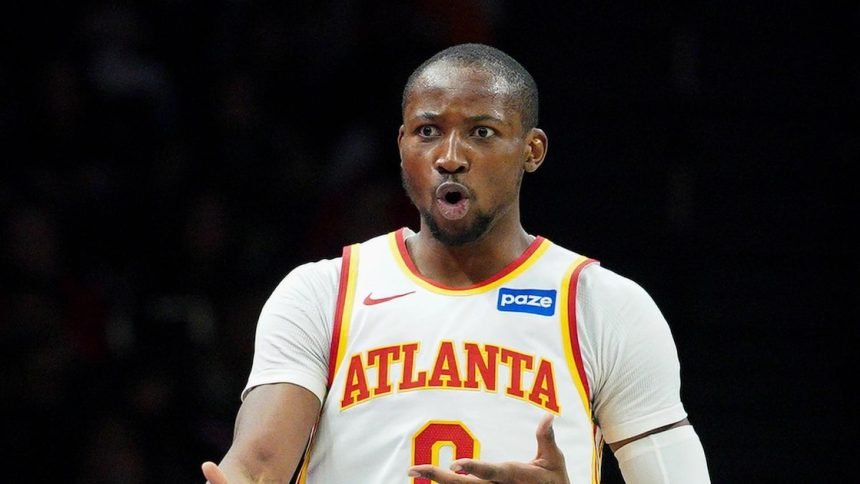
Kuminga and the Golden State Warriors weren’t on the same page when he hit restricted free agency in 2025, compromising on a two-year deal with a team option for 2026-27. Soon after, the Warriors dealt Kuminga to the Atlanta Hawks, where he averaged 13.7 points through a hard-fought six-game series against the New York Knicks.
Still, the Hawks declined Kuminga’s option, freeing over $24 million from the team’s cap sheet. Instead, Atlanta reinvested in CJ McCollum and Jock Landale, while trading for Lu Dort, Aaron Wiggins, Devin Carter, and Ryan Nembhard. Atlanta chose depth over Kuminga, which is why he’s in this predicament.
The Hawks still have his rights, but the roster is already at 17 players. Even if Mouhamed Gueye’s non-guaranteed $2.4 million is cut, Atlanta is only $6.5 million below the luxury tax threshold—historically, that’s a line the franchise has refused to cross.
If Atlanta is willing to help a suitor like the Los Angeles Lakers acquire Kuminga via sign-and-trade, the Hawks would need to absorb at least one or two players like Dalton Knecht, Jarred Vanderbilt, Jake LaRavia, or Jaden Harden. That’s an issue with roster count and luxury taxes. Additionally, a sign-and-trade requires at least a three-year deal. Kuminga isn’t going to lock in a long-term deal at the wrong price.
He faces a similar issue with the Cleveland Cavaliers, a team that would need to drop and stay under the first apron in a sign-and-trade. Whether a third team is interested in Dennis Schröder or Max Strus, or any of the Lakers listed above, remains to be seen. The Hawks could go into the tax, but can only add about $13.7 million in salary under the first-apron hard cap.
Alternatively, Kuminga could sign a short deal in Cleveland at the taxpayer mid-level exception, but $6.1 million is significantly less than what he has in mind.
With no home run answer yet, Kuminga will continue to wait to see if the market changes unexpectedly.