


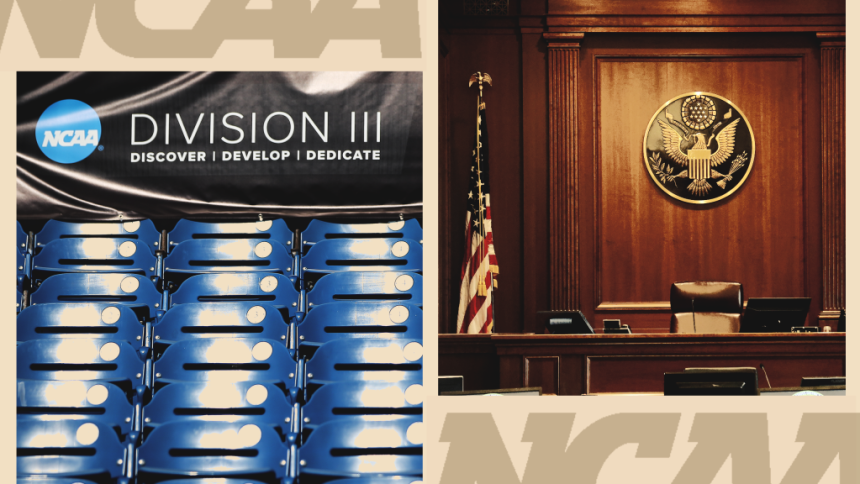
A putative class action lawsuit against the NCAA challenges the association’s prohibition on athletic scholarships at the Division III level, seeking to recover damages for athletes who have competed under the ban as well as an injunction barring its enforcement.
In a complaint filed Friday in the U.S. District Court for the Central District of California, a current D-III football player, former men’s basketball player and former dual-sport athlete seek to represent a class potentially comprising hundreds of thousands of athletes who have competed in the NCAA’s lowest division since Oct. 21, 2022.
“The NCAA has engaged in an ongoing conspiracy to fix the price of Division III athletic labor at zero by prohibiting every member of Division III, the NCAA’s largest division at more than 400 schools, from offering a single penny of athletic scholarship,” the complaint states.
The named plaintiffs are Jackson Hale, a senior defensive back at Pacific Lutheran University in Tacoma, Washington; Connor Printz, who played basketball at Claremont McKenna College in California from 2020 to 2024; and Chris Jennings, who swam and played lacrosse at the University of Lynchburg in Virginia from 2019 to 2023.
Their lawsuit takes aim at NCAA Division III Bylaw 15.01.3, which states that a member institution “shall not award financial aid to any student on the basis of athletics leadership, ability, participation or performance.”
The plaintiffs contend that, through this provision, “The entire NCAA membership prohibits more than 400 members of Division III, competitors in every meaningful sense, from offering one of the most common discounts on an American college education—the athletic scholarship.”
An NCAA spokesperson did not immediately respond to a request for comment.
In January, the University of Lynchburg reached a negotiated resolution with the NCAA over a “major infractions” case involving $155,325 in “improper” financial aid the school provided its athletes during the 2022-23 academic year. The lawsuit references the matter but does not say whether Jennings was among those who received the aid.
Printz, meanwhile, claims he prematurely quit basketball at Claremont McKenna early in the 2023-24 season so he could focus on his social media business. The lawsuit states that Printz’s decision was driven be economics, noting that he had to take out substantial student loans to cover the nearly $80,000 it cost for tuition, room and board that year.
“With even just a meaningful partial scholarship, Printz would have continued playing through his senior season because his basketball labor would have served to cover a part of the cost of his education,” the complaint states.
The lawsuit has a notable precedent. Thirteen years ago, a federal court in Indiana dismissed the D-III scholarship-ban claims in Rock v. NCAA, an antitrust suit that challenged other NCAA restrictions on athletic financial aid. That suit was litigated by attorney Steve Berman, who would later serve as class co-counsel in House v. NCAA.
In 2013, the court dismissed the Rock D-III claims at the pleading stage, reasoning the scholarship ban was presumptively pro-competitive. (The remaining litigation continued, but ultimately ended after the court denied class certification in 2016.)
Against that backdrop, the new D-III plaintiffs seek to revisit the issue amid a series of antitrust victories by athletes against the NCAA—most notably, the Supreme Court’s unanimous ruling in NCAA v. Alston—and the advent of the name, image and likeness era in college spots.
Their challenge also comes before a potentially more favorable federal circuit—the 9th—whose rulings in O’Bannon v. NCAA and Alston helped dismantle the NCAA’s longstanding restrictions on athlete benefits that ultimately culminated in the House settlement.
Even at the D-III level, the complaint states, Printz and Hale “routinely” received NIL compensation that “would have been plainly incompatible with the amateurism the NCAA professed to require for its survival just a few years ago.”
Printz claims to have received up to $50,000 in endorsement deals with Reebok, Clif Bar and other brands while playing basketball at Claremont McKenna.
The lawsuit leans heavily on Alston, citing the Supreme Court’s conclusion that agreements among NCAA conferences restricting athletic-related benefits are subject to antitrust scrutiny.
“The Division III prohibition on athletic aid is undeniably a multi-conference agreement in Alston’s own taxonomy,” the lawsuit states. “Division III schools remain free to differentiate themselves along every dimension that does not fix the price of the labor that sustains the marquee recruiting tools that are their athletic programs.”
If successful, the lawsuit could expose the NCAA to billions of dollars in damages, depending on the size of the class certified, the damages period and the court’s assessment of any antitrust injury. Approximately 210,000 athletes compete in D-III each year, according to the NCAA, and the plaintiffs are seeking treble damages under Section 4 of the Clayton Antitrust Act.
Hale, Printz and Jennings are being represented by Virginia attorney Michael Goldberg, the co-lead counsel in Ray v. NCAA, which challenged the ban on benefits or pay for volunteer D-I coaches; Title IX attorney Christine Brown, who currently represents Quinnipiac’s women’s rugby players in a sex-discrimination lawsuit challenging the school’s elimination of their team; Burns Charest lawyer Matt Strauser; and local counsel Andrew Purdy, a partner at Brown Neri Smith & Khan.