The NCAA announced on Monday a significant shakeup to how the women’s basketball tournament will be seeded moving forward.
Starting next season, the selection committee will no longer consider conference affiliation when placing the top 16 teams in the bracket. The top 16 teams will instead be distributed across the four regions based strictly on how the committee ranks them.
Advertisement
What does this mean?
In previous years, the committee would place conference rivals from the top 16 seeds in different regions, ensuring that they wouldn’t face each other prior to the Final Four. This would result in some teams being placed higher or lower in seeding from where the committee actually had them ranked.
For example, as the Associated Press reported, SEC rivals Texas (No. 3 overall), South Carolina (No. 4), LSU (No. 5) and Vanderbilt (No. 7) were among the top seven overall teams last season. But to avoid pre-Final Four matchups among them, the committee moved LSU from No. 5 to No. 7 and moved Vanderbilt from No. 7 to No. 8, keeping the four SEC teams in different regions.
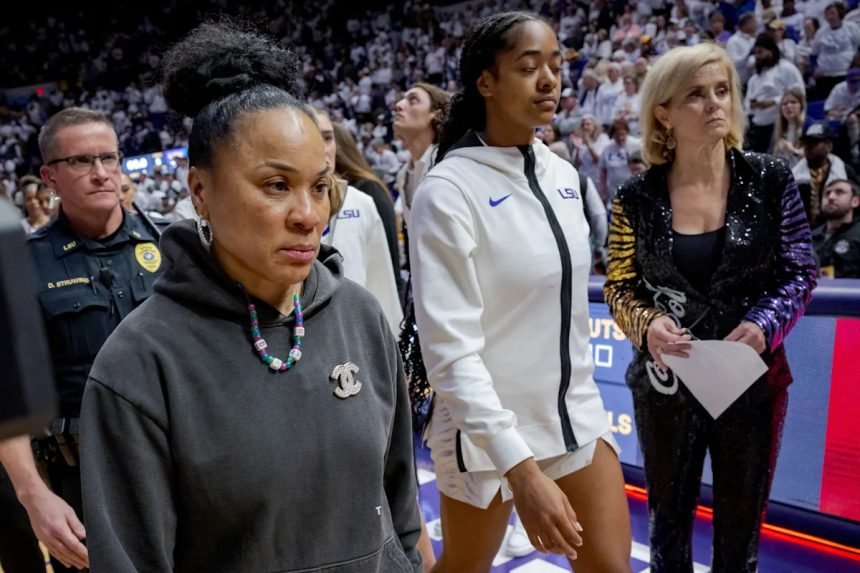
New NCAA tournament seeding rules mean that highly ranked South Carolina and LSU teams could face each other before the Final Four.
(USA TODAY Sports via Reuters Connect / REUTERS)
Now, theoretically, the top four teams in any given region could come from the same conference if that’s how the rankings play out. The selection committee touted this change as the fairest method.
“We put a lot of time into establishing those top 16 teams in the order they go in,” NCAA women’s basketball committee chair Amanda Braun told the Associated Press. “You’re splitting hairs to decide who has the edge and some of that is undone by those principles. To all of us, the work we did and the work those teams did justifies keeping them where they are in that group of 16.”
Advertisement
The NCAA is making the changes ahead of the tournament’s expansion from 68 teams to 76 starting next season.
The change won’t, however, be applied to the men’s bracket, which will continue to separate top 16 teams from the same conferences into different regions.