Sign up for Chalkbeat New York’s free daily newsletter to get essential news about NYC’s public schools delivered to your inbox.
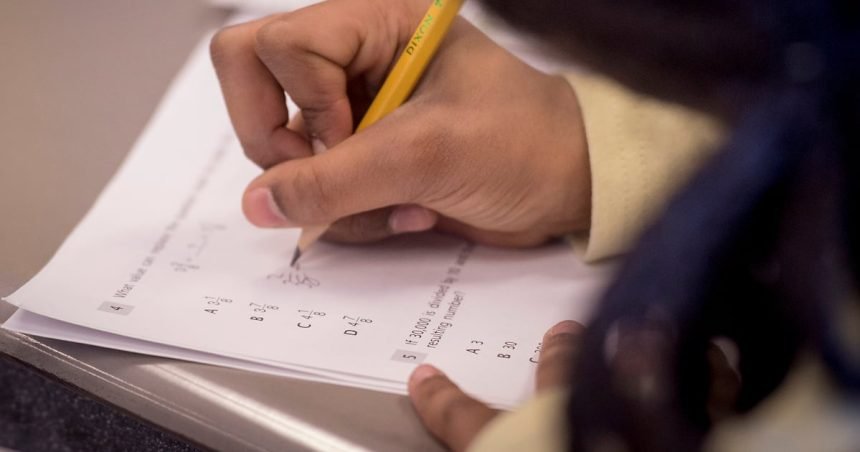
Reading proficiency plunged across New York state last school year while math scores ticked up slightly, according to preliminary state test results obtained by Chalkbeat.
About 48% of students across the state were proficient in reading on the 2025 state exams administered in grades 3-8, down 5 percentage points year over year. Meanwhile, 57% of students passed the math exams last school year, a modest gain.
The dramatic decline in reading proficiency raised eyebrows among multiple experts who noted state test scores tend to change gradually. The declines also appeared to be concentrated in grades 3-5. Fifth grade reading proficiency declined 14 percentage points last year, for instance, the largest drop of any grade level. The prior year, fifth grade scores soared 13 percentage points.
“Data doesn’t usually look like that,” said Emily Oster, a professor of economics at Brown University who has studied patterns in state assessment results. “Those are pretty big year-on-year swings.”
Oster noted that the math results are more consistent with other states that have seen incremental progress in the wake of pandemic-era declines.
The drop in reading scores comes as state officials have nudged school districts to embrace the science of reading, a longstanding body of evidence about how children learn to read. New York City, which enrolls nearly 40% of the state’s public school students, has mandated sweeping changes to elementary school literacy instruction to boost student achievement. (District-level results are not yet publicly available. Last year, the state and city reading scores both increased by roughly the same amount.)
State test scores are an imperfect measure of any single policy because many different factors influence student achievement. But officials often use the scores to bolster the case for their preferred policies — including New York City’s reading overhaul — and scores are typically considered a rough barometer of the school system’s performance.
“The Department takes this decline seriously and will conduct a detailed analysis to better understand where students are experiencing challenges, which student groups and communities have been most affected, and where additional support and resources are needed,” state Education Department spokesperson JP O’Hare said in a statement.
More detailed data is expected soon, though city and state officials did not confirm exactly when district-level scores will be available.
Multiple experts who reviewed the testing data at Chalkbeat’s request said the fluctuations could point to changes with the test itself.
“Seeing statewide numbers that are patterned in that way really leads me to worry about something unusual in the 2024 test and how it was scored,” said Aaron Pallas, a Teachers College professor who has studied school performance. “If we didn’t have 2024 data, we’d say things are pretty stable.”
State officials reduced the number of questions students needed to answer correctly to be marked proficient in 2024, raising questions from some observers about whether the test was easier. State officials previously stressed that the scoring changes were standard adjustments to account for the difficulty of the test questions and did not make the exam easier.
The state is also in the process of transitioning to computer-based assessments instead of paper-and-pencil tests. Experts were skeptical that would explain the fluctuations and state officials said they have extensively studied the question and said the effect is negligible.
Andrew Ho, a Harvard professor who serves on a panel of experts who are paid to advise New York on its state assessment system, said he believes the test reflects changes in student achievement but the exact magnitude may be noisy.
“The safe bet is that there was a real gain and a real decline,” he said, “but probably neither is as big as we’re seeing.”
Officials should pay close attention to a range of data sources, including federal tests that are often considered the gold standard, and consider data over multiple years.
“It’s always about triangulating information,” Ho said. “‘Don’t overreact to blips’ is the sort of statisticians’ mantra.”
Still, experts said policymakers should still take the drop in reading scores seriously, especially as many students have not fully recovered from pandemic-era learning disruptions.
“There’s a lot of kids who are not going to be able to go on and keep advancing in school,” Oster said. “It means that we need more tutoring” in addition to other support.
Alex Zimmerman is a senior reporter for Chalkbeat New York, covering NYC public schools. Contact Alex at azimmerman@chalkbeat.org.