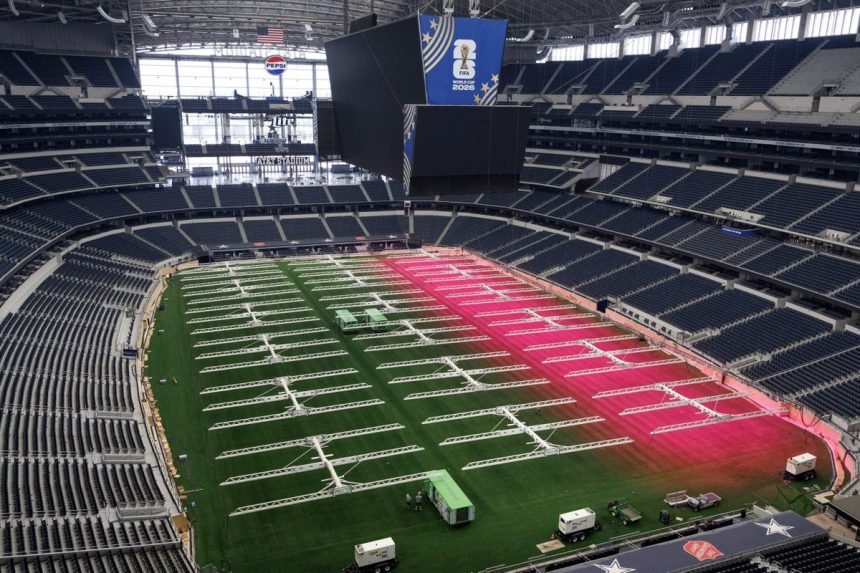
As the World Cup winds down ahead of Sunday’s final, NFL players are taking to social media to express their desire to play on the type of natural grass fields the tournament used throughout the summer.
Players across the league this week attached the hashtag “WorthTheCost” to posts asking why grass fields were used in World Cup games played in NFL stadiums, while they aren’t afforded the same surfaces in many of those same venues. Among the players who posted the hashtag on Friday: Chicago Bears quarterback Caleb Williams, Washington Commanders tackle Laremy Tunsil, Indianapolis Colts running back Jonathan Taylor, Pittsburgh Steelers linebacker Patrick Queen and New York Jets defensive lineman Harrison Phillips. Numerous other players added additional comments in their messages.
“If stadiums can make grass work for the World Cup, they can make it work for NFL players,” multiple NFL players posted on X. “We’re #WorthTheCost.”
Reached by The Athletic, the NFL Players Association pointed back to a statement the union put out in mid-June as the World Cup was set to begin.
“The temporary installation of natural grass fields for the World Cup is a choice by certain NFL team owners to do for soccer players what they refuse to do for NFL players,” the NFLPA said in a statement on June 10. “It’s no longer a question of capability: the technology exists, the expertise exists and the resources exist to install the high-level grass fields that our players overwhelmingly prefer.
“We have seen the meaningful investments made to meet the standard for international athletes and global events. NFL players — who regularly compete on these fields, help fund these stadiums, and whose work makes the league what it is today — deserve the same commitment to quality grass fields.”
NFL players vote this as their top priority to fix
As part of the statement, the NFLPA shared a poll it conducted with the union’s player members. According to the union, 92 percent of those polled — over 1,700 players, according to NFLPA executive director JC Tretter — preferred to play on natural grass while 6 percent said they don’t have a preference. Only 2 percent of players polled said they prefer synthetic turf.
“You want high-quality surfaces,” Tretter said earlier this offseason. “I think one thing is understanding what our players care about, and there is something there that the data hasn’t been able to spit back out at us … There is something about the feeling of being on grass, your body feels different. I think if you ask the coaches, just standing on grass versus standing on turf feels different. There is something there that impacts the body.”
As some stadiums began removing the grass fields used for World Cup games, the NFLPA reached out to its members and encouraged them to voice their opinions on social media.
“We’ve seen what’s possible,” Steelers cornerback Doneiko Slaughter and Arizona Cardinals cornerback Garrett Williams, among others, posted on X. “Now it’s time to make grass fields the standard. Players are #WorthTheCost.”
— Cam Heyward (@CamHeyward) July 17, 2026
The league is currently split down the middle on natural grass versus synthetic turf. Fifteen venues use natural grass while the other 15 use synthetic turf (the Los Angeles Chargers and Los Angeles Rams share SoFi Stadium, while the New York Jets and New York Giants share MetLife Stadium, making it 30 venues among the 32 teams). The Green Bay Packers play home games on grass, and Packers tight end Tucker Kraft voiced his support for the other half of the league to follow suit.
“Green Bay Packers are spoiled since we play on the greatest surface in the NFL,” Kraft posted on X. “Natural grass is the best, and should be the only surface we play on. We are #WorthTheCost.”
NFL players have consistently voiced their displeasure with synthetic turf in recent years. In a player poll conducted by The Athletic in 2023, 82.7 percent of the players polled anonymously said that the issue was a “real concern.”
“You wake up in the morning feeling 10 times better after you played on grass compared to when you played on turf,” one player said.
While players have pushed hard for natural grass across the board, ownership groups have expressed reluctance in making that happen.
“We don’t think we can have a quality natural grass in our stadium,” Dallas Cowboys executive vice president Stephen Jones said in 2023 about AT&T Stadium. “If you’ve got indoor stadiums, it’s just very difficult if you don’t plan on the front end … to roll the grass in. And then sometimes they get criticized for the condition of the field because it doesn’t grow as well as if they were growing it full time out there.”
Las Vegas Raiders owner Mark Davis, on the other hand, told the Los Angeles Times this month that he “always felt that football should be played on grass,” citing safety concerns and aesthetics.
Stadiums accommodating the World Cup by bringing in natural grass fields is just the most recent catalyst for this discussion. Injuries during the NFL season, such as a torn ACL suffered last year by New York Giants wide receiver Malik Nabers on synthetic turf at MetLife Stadium, often reignite the dialogue.
“We’ve made it clear that we prefer grass fields,” San Francisco 49ers tight end George Kittle said in a statement in June. “We know it’s better on our bodies. And clearly, we know it’s possible based on everything that went into putting down grass fields for the World Cup in each stadium.
“At this point, it comes down to the NFL making it a priority and choosing to invest in us as players, because our bodies are our business, which they get to capitalize on!”