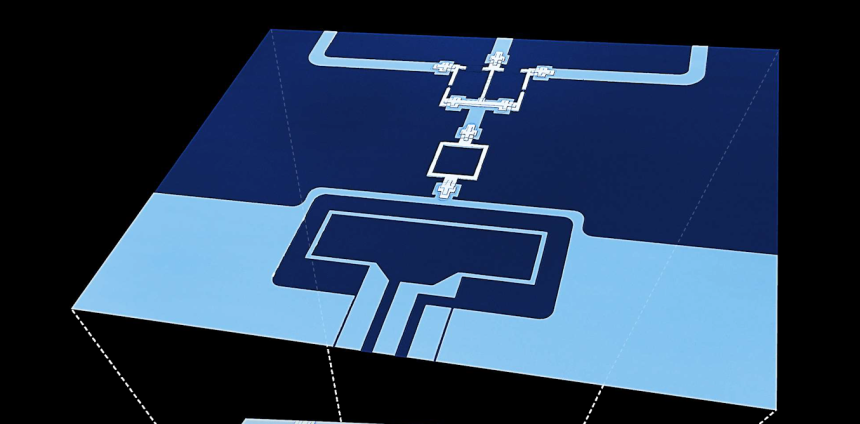
Quantum mechanics describes the weird behavior of microscopic particles. Using quantum systems to perform computation promises to allow researchers to solve problems in areas from chemistry to cryptography that have so many possible solutions that they are beyond the capabilities of even the most powerful nonquantum computers possible.
Quantum computing depends on researchers developing practical quantum technologies. Superconducting electrical circuits are a promising technology, but not so long ago it was unclear whether they even showed quantum behavior. The 2025 Nobel Prize in physics was awarded to three scientists for their work demonstrating that quantum effects persist even in large electrical circuits, which has enabled the development of practical quantum technologies.
I’m a physicist who studies superconducting circuits for quantum computing and other uses. The work in my field stems from the groundbreaking research the Nobel laureates conducted.
Big, cold, quantum
In their 1984 and 1985 work, then-Ph.D. student John Martinis, then-postdoctoral researcher Michel Devoret and UC Berkeley professor John Clarke showed that even large electrical circuits could exhibit quantum behavior. They used a circuit made from niobium and lead. When cooled to a few degrees above absolute zero, these metals become superconductors. A superconductor is a material that carries a current without generating any heat.
Martinis, Devoret and Clarke showed that in a superconductor, the voltages and currents are governed by quantum mechanics. The circuit has quantized – meaning discrete and indivisible – levels of energy, and it can be in superpositions of multiple states.
Any physical system can be described by a state, which tells you everything there is to know about that system. Quantum mechanics shows that a state can have certain quantized values of things that can be measured. An example is energy: A particular system could have energy 1 or energy 2, but nothing in between. At the same time, a quantum system can be in a superposition of more than one state, much like you can add different amounts of red/green/blue to get any color in a pixel of an image.
Importantly, the laureates showed that researchers can describe one of these superconducting circuits as if it’s a single quantum particle. This simple behavior is what makes superconducting circuits so useful as a technology.
U.S. Air Force Research Laboratory
Today, superconducting circuits are used to study fundamental quantum physics, to simulate other physical systems and to test protocols for ultraprecise sensing. For instance, the Devoret group recently demonstrated a near-ideal microwave amplifier based on a superconducting circuit. Microwave amplifiers are widely used in communications, radar and scientific instruments.
The Martinis group has used superconducting circuits to emulate a group of electron-like particles. This type of simulation is a key technique in studying fundamental physics.
In my own group, we recently used a superconducting circuit to demonstrate a protocol for measuring a magnetic field more sensitively than standard techniques. Quantum sensors measure physical quantities with extreme precision, from biological activity to gravity anomalies.
But by far the biggest application of superconducting circuits is as a platform for quantum computing.
Superconducting quantum computers
Multiple quantum systems can interact with each other and become entangled, so that they act like a single system. This combination of quantization, superposition and entanglement is what gives quantum computers their power.
In quantum computing technology, researchers use a quantum system – a quantum bit or qubit – that can be in only two states. Qubits need to be coherent. This means that if we put it in a particular state, we want it to stay there and not get randomly scrambled to another state. Qubits need to be controllable. This means that researchers should be able to get a qubit to change state as needed and get it to interact with other qubits. And qubits need to be scalable, meaning that we need to make a lot of them.
Many technologies show promise, such as arrays of atoms in a vacuum, trapped ions, trapped electrons in seminconductors, and photons controlled by optical circuits. But all technologies make trade-offs, sacrificing coherence, controllability or scalability to improve something else.
The simplicity and flexibility of superconducting circuits mean that by changing the design of the circuit, researchers can get almost any qubit behavior we want, and that behavior is easy to predict. This hits the technological sweet spot for quantum computing. More obviously quantum technologies, such as trapped atoms, are so small that they can be hard to control and interact with. Superconducting qubits are big enough to be easy to control, simple enough to be reliable and quantum enough to make the whole thing work.
Today, academic research groups like mine develop new types of superconducting qubits, look for ways to make them more coherent, try to improve our control of them, and develop techniques to make them easier to scale up. Companies and government labs take these academic results along with their own basic research and apply them, doing the difficult engineering to create large-scale quantum processors for practical use.
Superconductor pioneers
Unsurprisingly, the Nobel laureates made and continue to make huge contributions beyond their work in the 1980s. In addition to their academic work, Martinis formerly headed the Google quantum processor effort and now has his own company, while Devoret now assists with the Google effort. Clarke, now retired, also did much of his late-career work on quantum circuits. And they have had major impacts on my career and on so many others.
I had the privilege to do a panel discussion with Devoret on May 22, 2025. He made a memorable claim: Picking an academic adviser can be even more of a big deal than picking a spouse, because “you can’t divorce your adviser.”
It’s often joked that half the researchers in the field of quantum superconductors can trace an academic lineage to Clarke. I can do it twice: My Ph.D. adviser, Irfan Siddiqi, was advised by Devoret, and Clarke was my secondary adviser. And one of my proudest accomplishments as a grad student was not panicking when Martinis snagged me after I gave a talk to grill me on the details.
Today they are honored for their work, and tomorrow I and the other researchers they trained will do our best to continue it.