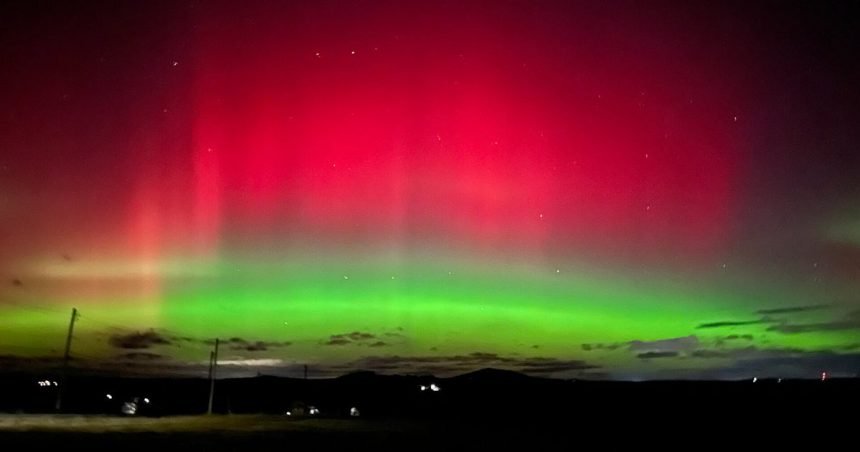
The northern lights were visible over parts of Massachusetts Tuesday night due to a severe geomagnetic storm.
According to the National Oceanic and Atmospheric Administration, G4 storm levels were reached after recent coronal mass ejections, or CMEs, from the sun. G5 is the highest and considered extreme.
Tammy Brooks
The geomagnetic storms can cause disruptions to communication infrastructure. According to NOAA, possible technology effects from G4 conditions include voltage control problems and anomalies to satellite operations.
Another chance on Wednesday
This is the biggest outbreak since last October, when a dazzling northern lights show was seen across New England.
The northern lights might be visible again on Wednesday night, although predicting the timing of when they will peak is near impossible, according to WBZ-TV meteorologist Eric Fisher.
How to see the auroras
To increase your odds of seeing the northern lights, find an area with the least amount of artificial light and a wide-open view of the sky and horizon. Despite the light pollution, the northern lights were visible in Boston in Tuesday night.
There has been a surge in northern lights activity in the past year as the sun has been in a period of solar maximum during its 11-year solar cycle.
Space Weather Prediction Center forecast coordinator Shawn Dahl told WBZ-TV last year that the ramped-up auroras could continue into 2026.
What causes the northern lights?
An aurora borealis occurs when large and dense solar ejections collide with the molecules in the Earth’s upper atmosphere. Earth’s magnetic field causes the particles to be largely re-routed toward the poles, which is why it is more typical to see the northern lights that farther north you live.
When there are large ejections and strong geomagnetic storms the lights can be visible farther south.