Seven months after launch, Pandora has officially begun its mission: to catch never-before-seen glimpses of worlds beyond our solar system and the stars they orbit. A team of engineers at the University of Arizona worked hard to prepare Pandora for its science mission, and the work of a team of U of A scientists is now kicking into high gear.

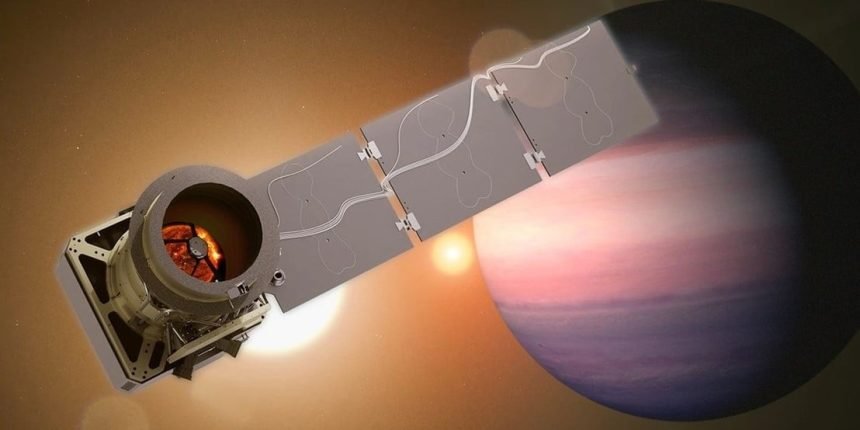
Artist’s concept of NASA’s Pandora mission, which will help scientists untangle the signals from exoplanets’ atmospheres and their stars. Image credit: NASA’s Goddard Space Flight Center/Conceptual Image Lab
Pandora, NASA’s newest exoplanet mission, will determine the atmospheric make-up of at least 20 exoplanets, including the presence of hazes, clouds and water. The U of A leads mission operations for Pandora, which is led by NASA’s Goddard Space Flight Center, and contributes to its science program under joint leadership of Daniel Apai, a professor for astronomy and planetary sciences at the U of A Steward Observatory and Lunar and Planetary Laboratory, and Nic Altamirano, Pandora’s MMOC manager and mission operations project manager. Lawrence Livermore National Laboratory provides the mission’s project management and engineering.
The first space telescope built specifically for detailed multi-color observations of starlight as it passes through the atmospheres of exoplanets, Pandora will study planets and their host stars simultaneously in both visible and infrared light. By staring at targets for a much longer time than flagship observatories like NASA’s James Webb Space Telescope can, Pandora will help interpret data both from ongoing missions – such as Webb – and previous missions like NASA’s Kepler Space Telescope.
“This is a big moment for our Pandora science team members here on campus,” said Apai, who leads the Pandora Exoplanet Science Working group. “Our U of A team, including astronomy students and early-career researchers, are taking their first looks at the atmospheres of worlds and their suns that have never been studied in such details before.”
The Pandora satellite consists of a telescope with an 18-inch, all-aluminum mirror and instrumentation that allows it to analyze light spectra and measure brightness to an extreme level of accuracy. Light spectra are like signatures that provide scientists with information about the chemical makeup of a star and the atmosphere of a planet that orbits it, while subtle dips in brightness are tell-tale signs that a planet is crossing in front of its star as seen from the observer.
Pandora is the first on-orbit NASA mission to be managed from the U of A’s Multi-Mission Operation Center, or MMOC, which is part of the Arizona Space Institute. Entering “steady-state operations” marks an exciting milestone for the mission, according to Altamirano.
“We have assembled a strong team of mission operation professionals and students who are equipped to support Pandora’s day-to-day operations, providing the experience and operational maturity needed to sustain the mission moving forward,” Altamirano said.
To turn the science calendar into executable spacecraft command sequences, U of A’s MMOC works closely with the Science Operations Center at NASA Goddard Space Flight Center and the Data Processing Center at NASA Ames Research Center.
“This involves taking planned observations and science activities, building the appropriate commands, validating them through our operational processes and coordinating with the SOC to ensure the final sequences are ready for uplink and execution,” Altamirano explained.
While many routine activities are automated, mission operations still require hands-on oversight and manual intervention when needed to respond to spacecraft state, operational constraints, anomalies or changes to the plan.
“Pandora is entering the most exciting phase of its journey: the science is beginning,” said Tomás Díaz de la Rubia, senior vice president for research and partnerships. “I had the privilege of being there for the launch, and now our researchers and students are beginning to study the atmospheres of worlds beyond our solar system. From our deep strengths in astronomy, planetary science and astrobiology to the mission operations expertise of our Multi-Mission Operation Center, the University of Arizona brings together the capabilities needed to help us better understand distant worlds and, ultimately, the conditions that could support life beyond Earth.”
Telescopes can sample a planet’s atmosphere in systems where the planet passes in front of its star as seen from our perspective. During this event, called a transit, some starlight skims the planet’s atmosphere before making its way to us. As this light interacts with atmospheric molecules, their chemical fingerprints become embedded in it. For each molecule, astronomers see brightness dips at characteristic wavelengths.
But Pandora’s instruments also see light from the whole star, not just what grazes the planet. Stellar surfaces aren’t uniform. They sport hotter, brighter areas called faculae and cooler, darker regions similar to sunspots. Both can grow, shrink, and change position as the star rotates.
“Water is one of the most important molecules we can measure to understand the composition and physical conditions of an exoplanet atmosphere,” said Benjamin Rackham, who obtained his doctoral degree in Apai’s research group and is now at the Massachusetts Institute of Technology. “But features on the star can distort the water signal we’re searching for. Pandora is designed to disentangle the signals from the planet and the star, helping us to understand the planets more accurately and laying the groundwork for the eventual study of planets that could harbor life.”
Over the course of its year-long primary mission, Pandora will observe at least 20 exoplanets 10 times with a long-duration stare covering 24 hours, with a transit included in each observation.
Source: University of Arizona