As 2025 drew to a close, Peru’s Ministry of Culture showcased a year marked by archaeological discovery, citizen engagement, and a renewed commitment to intercultural inclusion—highlighting culture not only as heritage, but as a living pillar of national identity and social cohesion.
Uncovering the Architectural Secrets of Cerro Miraflores
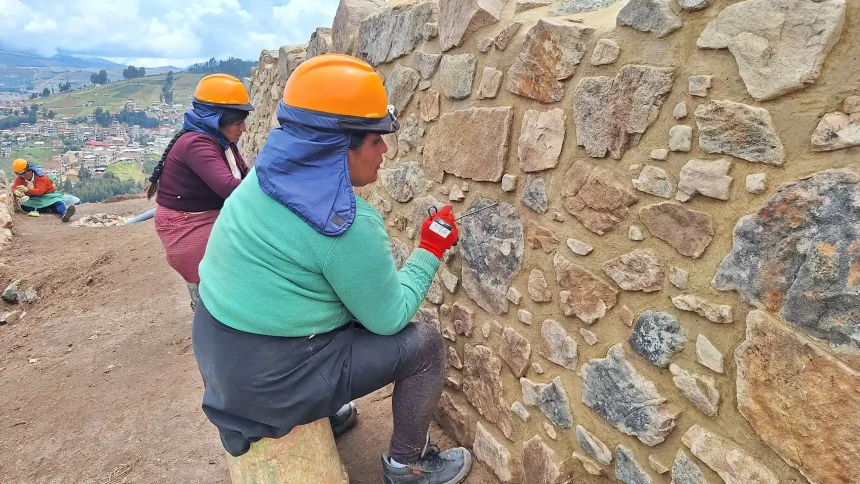
In the northern region of La Libertad, archaeologists completed the first season of an ambitious public investment project at the archaeological site of Cerro Miraflores, located in the province of Sánchez Carrión. With an investment exceeding 1 million soles, the intervention focused on the recovery of the site’s Upper Walls subsector, bringing to light the sophisticated engineering of the pre-Inca Huamachuco civilization.
Over 57 days of fieldwork, more than 150 workers—most from nearby communities— restored and stabilized nearly 335 square meters of perimeter walls and additional internal structures. Researchers documented 18 distinct walls, including defensive, containment, and dividing structures, as well as a complex drainage system and six access openings.
One of the most significant findings was the identification of the “cellular construction technique,” a pre-Inca method using large and medium carved stones surrounded by smaller stones (pachillas), arranged in irregular courses that have withstood centuries of time. Excavations also yielded 25 lithic artifacts, 294 ceramic fragments, and 332 human bone remains from five burials, offering new insights into ancient funerary practices in Peru’s northern highlands.
The Ministry described the project as “the rebirth of an ancestral legacy,” underscoring its dual value as a source of cultural identity and a driver of sustainable tourism in Huamachuco.
Citizens as Guardians of Cultural Heritage
Beyond excavation sites, the Ministry expanded its reach through people-powered preservation. In 2025, more than 4,000 citizens across Peru’s 25 regions were trained through the “Defenders of Cultural Heritage” program, a national initiative designed to empower communities to protect and promote cultural heritage.
Organized into 305 citizen groups, participants—ranging from secondary school teachers and students to university learners and civil society members—received specialized training in cultural heritage protection, communication strategies, and action-plan design. The results were tangible: 328 heritage-related actions were carried out nationwide, benefiting nearly 50,000 people.

Twenty-five standout groups received national recognition for their leadership and commitment. The program itself earned national accolades, including certification as a “Good Practice in Public Management” from Ciudadanos al Día and recognition from Peru’s national public service quality awards.
The initiative aligns with Peru’s National Culture Policy to 2030 and the National Youth Policy, reinforcing citizen participation as a cornerstone of cultural sustainability.

Bringing the State to Indigenous Communities—In Their Own Languages
Cultural inclusion also took center stage through intercultural public service delivery. Throughout 2025, the Ministry of Culture provided intercultural assistance to nearly 49,000 people living in Indigenous and rural communities across Loreto, Ucayali, and Puno, using the Itinerant Social Action Platforms (PIAS).
Through these river-based and mobile platforms, intercultural facilitators delivered more than 57,000 services in Indigenous languages, including Quechua, Aymara, Shipibo-Konibo, Asháninka, Wampis, Achuar, Matsés, and others. Services ranged from general medicine and dentistry to identity documentation, health insurance registration, and financial services.

In total, residents of 410 Amazonian and highland localities—290 of them Indigenous or campesino communities— accessed public services in their mother tongues, strengthening trust in the State and reinforcing fundamental rights.
The campaigns also included anti-racism workshops, reaching communities along the Amazon basin and Lake Titicaca, and more than 1,000 informational meetings to ensure communities were informed about service routes and schedules.

Community Engagement Around Archaeological Sites
At the local level, the Ministry deepened ties with communities living near archaeological heritage. In December, cultural officials held a heritage awareness workshop in Sazón Alto, near the Cerro Sazón archaeological site, emphasizing shared responsibility in preserving cultural assets.
Residents and local authorities participated in dialogue sessions focused on identity, collective memory, and sustainable heritage management. According to César Pérez Muñoz, head of the Marcahuamachuco Executive Unit, involving nearby communities is essential.
“We promote the active participation of communities living near archaeological sites so they become partners in the protection, enhancement, and social use of Peru’s pre-Hispanic heritage,” he said.

A Broader Vision of Culture
Together, these initiatives reflect a broader vision: culture as excavation and education, but also as participation, language, and inclusion. By combining archaeological recovery with citizen empowerment and intercultural service delivery, Peru’s Ministry of Culture closed 2025 reinforcing the idea that heritage protection is most powerful when it is shared—by communities, across generations, and in every language of the nation.
 Latina Republic is a nonprofit, independent media platform dedicated to telling the stories that shape Latin America and the Caribbean. Our cultural coverage highlights heritage, arts, identity, and community-driven initiatives—from archaeology and Indigenous knowledge to contemporary cultural expression—placing culture at the center of social memory, resilience, and regional transformation.