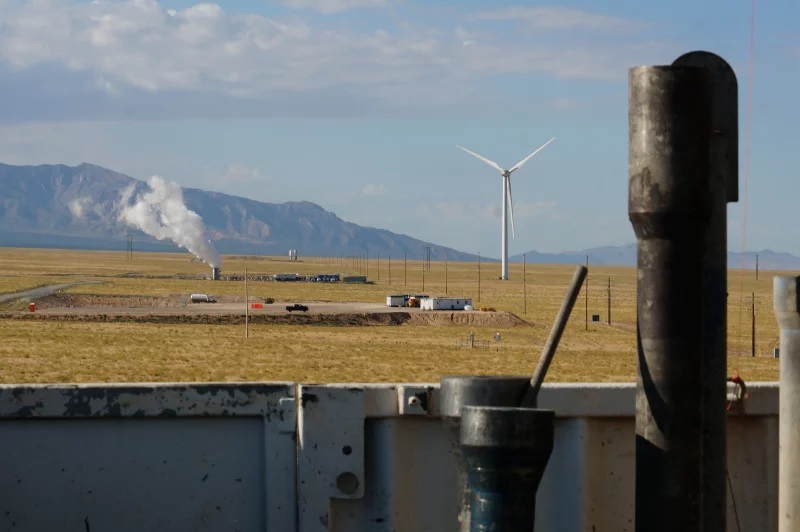
There’s a valley in rural southwest Utah that’s become a hub for renewable energy. Dozens of tall white wind turbines whoosh up in the sky. A sea of solar panels glistens in the distance.
But the new kid on the block is mostly hidden underground.
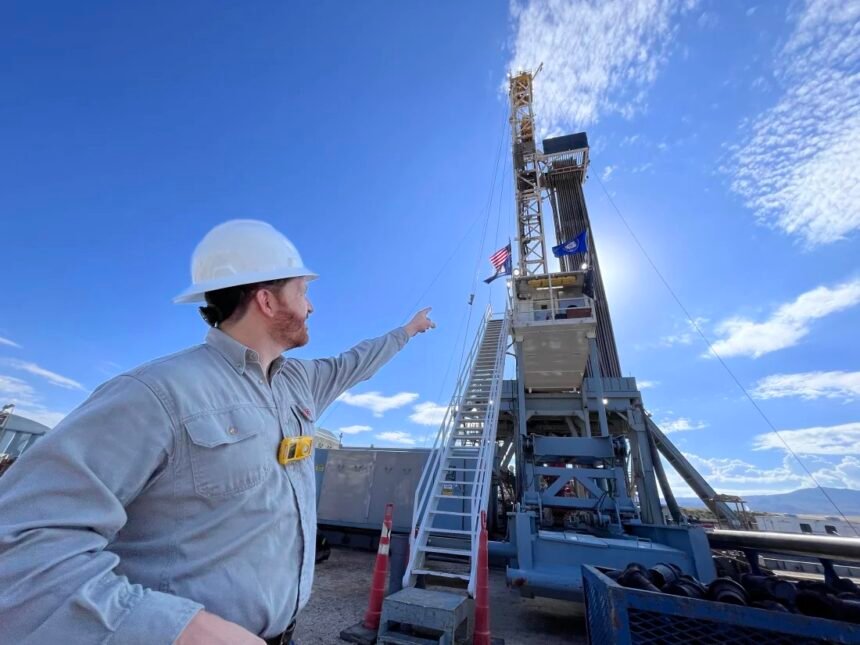
From the surface, Fervo Energy’s Cape Station looks more or less like an oil derrick, with a thin metal tower rising above the sagebrush steppe.
But this $2 billion geothermal project, which broke ground last year, is not drilling for gas. It’s drilling for underground heat that CEO Tim Latimer believes holds the key to generating carbon-free power — lots of it.
“Just these three well pads alone will produce 100 megawatts of electricity. Around-the-clock, 24/7 electricity,” he said.
Latimer stood overlooking the project, which is currently under construction, on one of the drill rig’s metal platforms 40 feet off the ground. This well is one of the 24 Fervo is in the process of completing at Cape Station to harness the Earth’s natural heat and generate electricity.
Not your father’s geothermal energy
This isn’t the type of geothermal that’s already active in volcanic hot spots like Iceland or The Geysers project in California. It’s called an enhanced geothermal system.
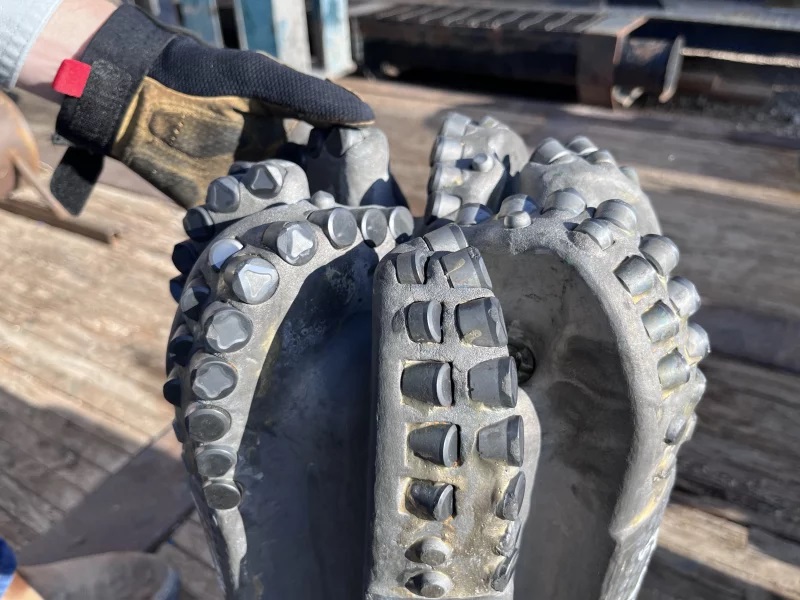
Cold water goes down into a well that curves like a hockey stick as it reaches more than 13,000 feet underground. Then the water squeezes through cracks in 400-degree rock. The water heats up and returns to the surface through a second well that runs parallel to the first. That creates steam that turns turbines to produce electricity, and the water gets sent back underground in a closed loop.
This horizontal well technique has been pioneered at a $300 million federal research project called Utah FORGE located in this same valley, which has paved the way for private companies to take the tech and run with it.
Carbon-free mandates stimulate demand
California leaders set a mandate in 2018 requiring the state to have 100% renewable electricity by 2045. So, SoCal Edison spokesperson Reggie Kumar said adding geothermal makes sense.
“For California to achieve its decarbonization goals by 2045, the grid must expand faster than ever before. This means we need to take bold actions,” Kumar said.
The U.S. Department of Energy’s long-term goal is to multiply domestic geothermal capacity nearly 25-fold by 2050 — to a level that could power more than 65 million homes. The federal government is investing millions in geothermal projects to speed up geothermal’s deployment nationwide. The local geology in southwest Utah makes it a prime spot for tapping underground heat, but recent mapping from the National Renewable Energy Lab shows potential for enhanced geothermal to work across much of the West and even in some eastern states, such as Mississippi, Iowa and Pennsylvania.
Geothermal does currently cost more per megawatt hour than wind or solar, but those more-established renewables require big batteries to keep power flowing around the clock. Geothermal, on the other hand, has the potential to ramp up and down as needed to fill the gaps when it’s not sunny or windy, said Alexandra Gorin, who manages the carbon-free electricity team at sustainability think tank RMI.
“Theoretically, it offers a firmer, clean fuel source,” she said, “and so for utilities and grid operators that are concerned a lot about reliability and resource adequacy, geothermal has the potential to provide … closer to 24/7 renewable.”
The fact that a giant utility like SoCal Edison made this type of deal sends a message to the broader energy market about geothermal’s viability, said RMI senior principal, Uday Varadarajan.
“It’s saying something that they feel they need geothermal, even though they have so much wind, solar and storage. So I think it is a big deal,” Varadarajan said.
We won’t know for sure if geothermal can be a reliable utility-scale power source until it actually happens, Varadarajan said, but he’s cautiously optimistic. And if the Fervo project works, he said more companies could begin building additional geothermal projects for other utilities within just a few years.
“We do hope we will have other [renewable energy] options in the next decade, but geothermal is something that can start scaling by the end of this decade,” he said. “That few years can make an enormous difference for competitiveness [and] for climate.”
Enhanced geothermal has potential to scale quickly, in part, because it borrows a lot of tech and know-how from the industry many would like to see it replace: fossil fuels. Fervo is even based in Houston — Oiltown USA — and a majority of the company’s employees came from the fossil fuel industry.
Scalable with off the shelf technology
Eric Williams, for example, spent decades working in oil and gas but now oversees safety at the Fervo project in Utah. Switching industries didn’t change his daily tasks, he said, but it did change the way he feels about his job.
“You say you work in the oil and gas industry, sometimes people go, ‘Ehhhh.’ But when you say geothermal and when you say renewable, sustainable … a lot of people go, ‘Wow,’” Williams said. “So when I do tell people about what I do out in the world, I’m proud.”
That illustrates another reason why geothermal could help the U.S. chart a path to a cleaner energy future, said CEO Tim Latimer. A lot of fossil fuel operations will be phased out to fight climate change. And a lot of oil and gas workers will need a landing spot.
Geothermal could help with both transitions, he said, if the project in Utah is the start of something bigger.
“When we stand here 10 or 20 years from now, our hope is not only was this a successful project, but it was a template for something that we could repeat dozens and even hundreds of times all over the world,” Latimer said.