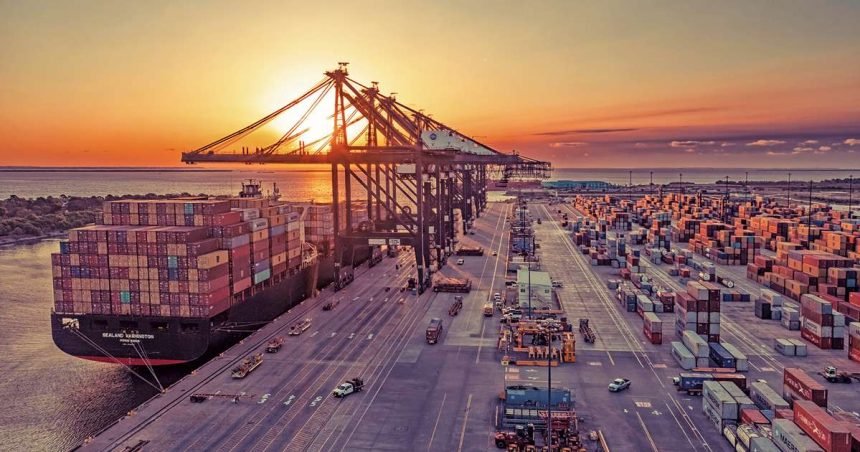
A container terminal at Port Houston. (Business Wire via Associated Press)
Key Takeaways:
- U.S. port container volumes slowed in November with year-over-year declines at major gateways, but several ports remained on pace for one of their strongest years on record.
- The ports of Los Angeles and Long Beach reported double-digit and mid-single-digit November declines yet still expect top-tier or record annual volumes, citing smooth operations despite trade policy uncertainty.
- Other ports including Oakland, Houston, the Northwest Seaport Alliance and South Carolina also saw monthly drops, with several warning weaker volumes could extend into 2026.
[Stay on top of transportation news: Get TTNews in your inbox.]
U.S. port container volumes were on track to close out a strong year in November despite activity slowing toward the end.
The Port of Los Angeles is aiming for its third-best cargo year on record despite that slowdown in activity. The port reported that container volume in November decreased 12% from the previous year to 782,249 20-foot-equivalent units from 884,315. There was also a sequential decline of 7.8% from the 848,424 units reported in October. The port has handled 1% more containers at 9,447,731 TEUs during the first 11 months of this year compared with 2024.
“Even with all the trade uncertainty, we’ll finish 2025 north of 10 million TEUs, putting this year firmly in our top three of all time,” Port of Los Angeles Executive Director Gene Seroka said at a media briefing. “All that cargo moved without congestion and not a single ship backed up. That’s a credit to our longshore labor, truckers, terminal operators, rail partners and every stakeholder who keeps this complex system running smoothly.”
The Port of Long Beach is on course to have its busiest year on record. The port reported that container volume declined 7.5% year over year to 817,561 units from 884,154. This marked the second-busiest November for the port right behind last year. There also was a sequential decline of 2.6% from 839,671 units.
“Cargo moved at a steady rate with no congestion or disruptions at the Port of Long Beach as consumers, businesses and supply chain partners endured an extraordinary amount of uncertainty caused by shifting trade policies throughout 2025,” said Port of Long Beach CEO Mario Cordero. “We will continue to move trade smoothly through the end of the year, and look forward to a moderate increase in cargo for 2026.”
The Port of Oakland reported that volume declined 4.1% to 174,239 containers from 181,721. The results also were down 4.7% from the previous month. The port had not released commentary by press time.
The Northwest Seaport Alliance noted that combined volume between the ports of Seattle and Tacoma, Wash., decreased 12.6% to 253,532 units from 290,210. But this represented an 8.4% increase from the prior month. The port noted that tariffs and elevated retail inventories continued to weigh on container volume. Year-to-date volume declined 3.9% to 2,918,676.
Port Houston is on track for a record year despite monthly volume recently slowing. It reported that volume decreased 9% to 335,275 containers from 369,361 for November. Port volume also decreased 8% sequentially from the 365,773 units reported in October. Year to date, volume at this point has increased 5% to 3,971,643 containers from 3,799,573.
The South Carolina Ports Authority reported that container volume decreased 6% to 197,942 TEUs. Intermodal remains a strong point for the ports. Inland Port Dillon even posted record December volume with 4,466 rail moves. The port started to track a slowdown in volume recently like others, with that expected to continue into 2026.
“We’re preparing to see weaker volumes continue into 2026 but remain hopeful that the industry will stabilize sometime next year,” SC Ports President Micah Mallace said. “Regardless of market conditions, SC Ports remains focused on growing above-market and delivering meaningful solutions for customers’ toughest supply chain needs.”
The Port of Savannah, as well as the Port Authority of New York and New Jersey, did not have their monthly numbers available at press time.