The saga continues.
Members of the Salt Lake City Council unanimously rejected a proposal Tuesday that would’ve set the stage for a seven-floor, 145-room boutique hotel on the edge of Sugar House Park. The vote adds to the already years-long drama surrounding the privately-owned parcel — which has now seen three separate development attempts that have all been rejected or fizzled out. The site is the former home to a Sizzler restaurant, which was torn down in 2024.
The proposal would have rezoned the 0.82 acre-parcel at 2111 S. 1300 East from MU-3 zoning to MU-8. The MU-8 zone includes hotels as a permitted use and carries a maximum height of 90 feet. The MU-3 zone does not have hotels as a permitted use and limits heights to 40 feet depending on the building form.
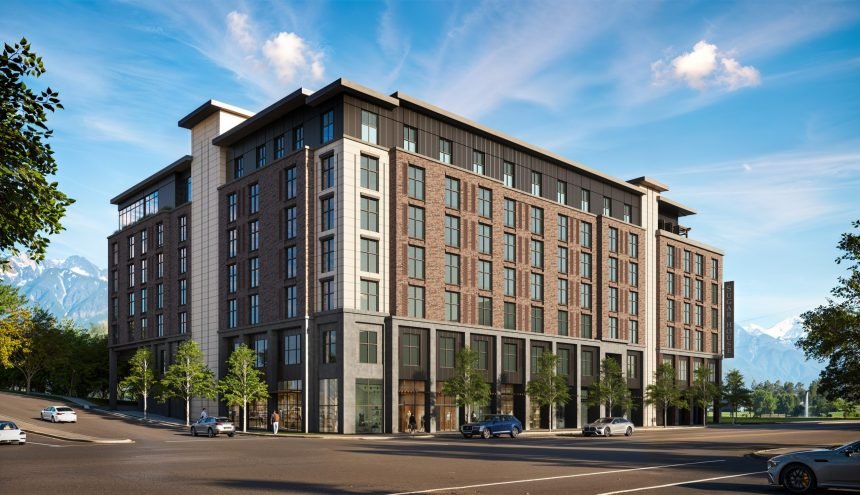
Included in the boutique hotel plans were 145 rooms, a coffee shop, three retail spaces and a rooftop restaurant. The latter feature was in question when initial plans came out, though a bill approved during the latest Utah Legislative session loosened state restrictions and gave cities the power to approve alcohol licenses for hotel bars and restaurants near parks.
Council Member Sarah Young, who represents the Sugar House neighborhood, led the motion to reject the pitch, and her fellow council members followed suit. Following the vote, Young said her decision was reflective of the community’s adamant stance opposing the hotel, citing groups like the Sugar House Community Council that were firmly against the project.
Many of the concerns previously voiced by the community council, as well as other local residents, included traffic impacts, the hotel’s height obstructing views and environmental impacts to the park and local watershed.
“My vote to reject the request today reflects a concern about precedent expanding the business district beyond what is outlined in our adopted community plan, particularly when our updated mixed use zoning is still in its first year, feels premature,” Young said during the meeting Tuesday. “We have not yet seen the full potential of development within the existing business core, and I believe we should allow that work to take shape before considering expansions of the business district that could have long term implications for Sugar House.”
Young thanked the developer behind the project, Magnus Hotel Management, for the work and effort that went into the project, calling the company a “class act.” But those efforts weren’t enough to get the upzone across the finish line, as the Tuesday vote will likely mean the parcel will remain vacant for some time.
“Our community is stronger when people care, and this process has clearly demonstrated how much our residents value the future of our city and especially cherished public spaces like Sugar House Park,” Young said. “I’m proud to represent this community and look forward to continued engagement as we build our future together.”
Council Chair Alejandro Puy spoke after Young, thanking her for her work and echoing her thoughts behind the proposal.
“Thank you all for the work that you’ve done to help us understand the community sentiment about this, but also understand the issues on the ground and how it felt for park users and how it will feel for those utilizing the site,” Puy said to Young.
John Potter, founder and CEO at Magnus Hotel Management, could not be immediately reached for comment.
In October, the upzone proposal was given a favorable recommendation by the Salt Lake City Planning Commission, which voted 7-1 on the proposal. Commissioner Amy Barry was the lone no vote, saying during the meeting that she had major concerns with the traffic study that found the hotel would only have minor impacts on the surrounding roads.
Over the years, pitches for the vacant Sizzler location included multifamily housing and a gas station, though neither came to fruition. The hotel plan was the third pitch for the site.
Salt Lake City tested its land use authority in 2023 when it denied a conditional use permit for a Kum & Go convenience store and gas station after intense pushback from the neighborhood. The city largely cited concerns about groundwater as a primary reason for denying the permit at the time.
Tuesday’s rejected proposal also sought to change the Sugar House Community Master Plan Future Land Use Map from a mixed use-low intensity land use to business district mixed-use – town center scale.
The mixed use-low intensity land use generally allows for, “an integration of residential with small business uses, typically at ground floor levels. Height limits generally include one- and two-story structures,” according to the neighborhood’s master plan, which was last updated over two decades ago. Meanwhile, the town center scale land use is aimed at permitting, “retail, commercial, and office uses with a broad mix of small and large tenants.”
It’s not clear what the future could hold for the parcel, which will carry its MU-3 zoning into the foreseeable future. The zoning allows for solely residential and commercial uses, as well as mixed-use projects, though heights are capped at 40 feet.
The move to reject the hotel comes at a time when Sugar House is seeing a large and consistent amount of growth. Between a new tower along Highland Drive and the impending expansion of the S-Line streetcar, the neighborhood is slated for a number of changes in the coming years, but the old Sizzler parcel might not be one of them.
A rendering of the walkway between the proposed Sugar House Hotel and Sugar House Park. Image via Magnus Hotel Management and FFKR Architects