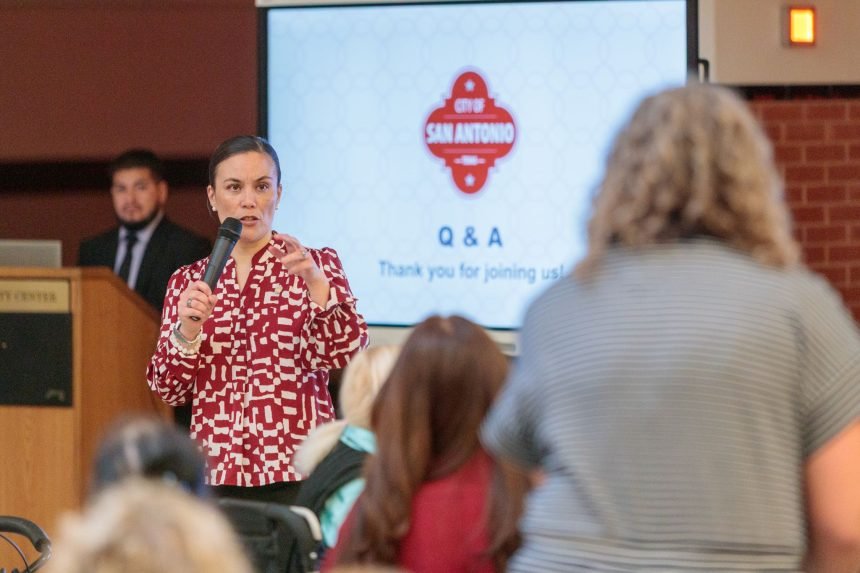
Mayor Gina Ortiz Jones speaks with community members at a town hall at Thomas Edison High School on Wednesday.
Blaine Young/For the Express-News
Mayor Gina Ortiz Jones warned more than 100 town hall attendees Wednesday night that looming budget cuts could be deeper than anticipated as she touted her recent proposals to fill the gap, including tapping job-training funds and asking business leaders to essentially take over city grants to a handful of nonprofits.

It’s unclear whether Jones will garner enough community and City Council support to put her ideas into action.
Article continues below this ad
San Antonio is facing a $158 million budget deficit over the next two years largely because of shrinking property tax revenue and slowing sales tax collections.
City budget writers told council members in June that without a property tax rate increase, the city may have to eliminate hundreds of positions and cut services.
Jones said she spoke with City Manager Erik Walsh about the budget hours before she arrived at Thomas Edison High School for her monthly town hall.
“We know it’s not going to be pretty,” Jones said. “Some of the cuts are going to be even more severe than what we were presented with last time.”
Article continues below this ad
City Council will get its first look at the proposed budget on Aug. 13. Council will vote on next year’s property tax rate and budget on Sept. 17.
City staff has recommended raising property taxes for the first time in three decades to prevent severe budget cuts. Jones has said she sees a tax hike as “a last resort.”
“We have to be thinking a little bit differently — or a lot differently — than how we’ve done things, which is why I put some ideas on the table that we might not have thought of previously,” Jones said. “But I think when we’re talking about raising people’s property taxes for the first time in 30 years, we owe it to you all to go and do the intellectual exercise to say, ‘Hey, what about…? ‘ Because I am not raising people’s property taxes if we haven’t cut all the fat out of the budget.”
Article continues below this ad
Late last week, Jones asked area business and philanthropic leaders in a letter to consider “a three-year funding commitment” to match what the city has given 15 organizations this fiscal year. The organizations received a combined $6.5 million this fiscal year, which ends Sept. 30.
Jones said she hasn’t heard back from any of the letter recipients yet. She said the CEOs of Whataburger, Valero, USAA, San Antonio Area Foundation and Spurs Sports & Entertainment received the letter, among others.
“That was an open letter, just to be very clear,” Jones said. “The way I was raised, you don’t have wait to be asked to do the right thing. If you can do the right thing and you can help, you just do that.”
The biggest recipient listed in the mayor’s letter is the San Antonio Education Partnership’s scholarship and outreach program, which got $2.4 million from the city this fiscal year. The nonprofit works to help low-income students graduate from college.
Article continues below this ad
It is unclear why Jones chose the 15 nonprofits she identified in her letter since the city funds several dozen such organizations.
The San Antonio Book Festival, which was on Jones’ list, took the letter as a sign that the organization was on the chopping block and launched a petition to keep its city funding.
Jones is also calling to divert funds from the city’s struggling job-training program, Ready to Work, to cut into the deficit. But her proposal drew a warning from City Attorney Andy Segovia.

Community members attend a town hall hosted by Mayor Jones at Thomas Edison High School on Wednesday.
Blaine Young/For the Express-News
He said in a memo last week that Texas code limits how sales tax dollars collected for the Ready to Work program can be used. The program’s remaining balance — more than $120 million — can only be spent on job training, early childhood development, after-school programs, college scholarships and literacy programs, he said.
Article continues below this ad
That hasn’t deterred Jones, who said using the funds on programs that qualify under state law could free up money for core services, such as drainage and public safety.
Jones said she has asked Walsh to produce a list of which programs could be eligible to received Ready to Work dollars. She told reporters she thinks the diverted funds could cover “north of $15 million” in the budget.
But Jones said — in a memo to council in which she outlined her Ready to Work idea — that it would require a public vote.
The next election in Bexar County is in November — after City Council has adopted next year’s budget and property tax rate.
Article continues below this ad
Jones said she’s open to amending the budget down the road if City Council agreed to put the measure on the November ballot and voters approved it.
The city devoted 1/8-cent of its sales tax it collected from December 2021 through December 2025 to Ready to Work. Nearly 17,000 people have enrolled in the program, which is expected to have funding through 2029.
Since Ready to Work began accepting applicants in 2022, it has yet to achieve its goal of placing 80% of participants into jobs paying at least $15 an hour within six months of finishing their city-funding training, which entails completing a bachelor’s degree or an industry-recognized certificate.
Jones’ proposal could put her at odds with a majority of her City Council colleagues.
Article continues below this ad
Five council members — Sukh Kaur, Phyllis Viagran, Edward Mungia, Teri Castillo and Ivalis Meza Gonzalez — have said they’re opposed to diverting Ready to Work funds, while Misty Spears and Marc Whyte back the idea.
Councilwoman Marina Alderete Gavito has said she’s open to the proposal, but doesn’t want to make sweeping changes without hearing from constituents.
Councilmen Jalen McKee-Rodriguez and Ric Galvan haven’t weighed in.