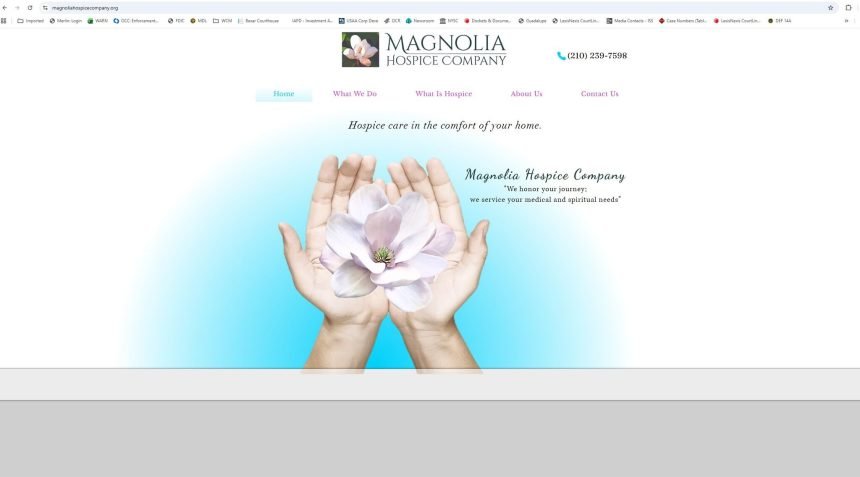
A federal judge ruled this week that San Antonio’s Magnolia Hospice Company Inc. must stop using its name while a trademark lawsuit proceeds after finding likely confusion with another hospice provider. Shown is a screenshot of the company’s website.
Screengrab
A federal judge has temporarily barred a San Antonio hospice provider from using its current name, concluding the company likely is infringing on a Texas hospice’s federally registered trademark.

U.S. District Judge Xavier Rodriguez issued the preliminary injunction against Magnolia Hospice Company Inc. of San Antonio after finding its nearly identical name had caused confusion among patients and health care providers while the businesses marketed the same hospice services in overlapping markets.
Article continues below this ad
Tuesday’s order stems from a lawsuit filed by RHI Magnolia of North Texas LLC, which has operated in the state under the Magnolia Hospice name for more than a decade and obtained a federal trademark registration in 2024.
The injunction takes effect immediately and remains in effect while the lawsuit proceeds, meaning the San Antonio hospice cannot continue using the name unless the order is later lifted. Rodriguez has not issued a final ruling on the trademark dispute.
San Antonio Express News Logo
Make us a Preferred Source on Google to see more of us when you search.
Add Preferred Source
Wayne Colton, a San Antonio lawyer representing Magnolia Hospice Company, said his client was reviewing the order and evaluating all options.
Article continues below this ad
It is “not really ready to go into any strategies,” he said.
New Orleans attorney Mark Ackal, who represents RHI Magnolia, said his client spent years sending letters to Magnolia Hospice Company in an effort to settle the dispute out of court.
“It’s a pretty straightforward case,” Ackal said. “We were there first in that area of Texas using the exact same name that the defendants use for the exact same services.”
RHI Magnolia argued it and its predecessor have used the Magnolia Hospice name in Texas since 2013 and that the San Antonio company’s use of Magnolia Hospice Company caused repeated confusion among patients and healthcare providers, leading to misdirected calls, referrals and medical communications. RHI Magnolia has locations in San Marcos, Burnet and Pflugerville, as well as Arlington, Brady, Granbury and Temple, its website shows.
Article continues below this ad
Donnie Maberry, an RHI Magnolia co-owner and executive vice president, testified at a June 16 hearing on its motion for a preliminary injunction.
“We want to clean up the market confusion so that our patients, they know when they call Magnolia Hospice they are calling us and getting the best service they can,” Maberry said.
Magnolia Hospice Company countered that it independently adopted its name in 2020 without knowledge of the plaintiff, built its reputation in the San Antonio area and has the right to continue using the name because it says it was the first to establish trademark rights in the San Antonio market, where it says the plaintiff had not yet developed a presence.
Article continues below this ad
Colton said RHI Magnolia filed its federal trademark application “way after” both companies were using the name.
“So the question is whether or not our adoption of the mark was in good faith and was in a remote territory. We contend that it was,” he said. “All of this confusion in 2022, 2023, 2024, that’s infringing upon us.”
Magnolia Hospice Company wants the name for Bexar County and the seven counties surrounding it, Colton said.
“They have no right to be using our mark in San Antonio,” RHI Magnolia attorney David L. Patrón responded. “If you do what they are saying, and allow them to stay in San Antonio area, the confusion is not going to stop.”
Article continues below this ad
In his 20-page order, Rodriguez found RHI Magnolia was likely to succeed on its trademark infringement claim because the companies offered the same hospice services under nearly identical names in overlapping markets and because evidence showed patients and healthcare providers had mistaken one company for the other.
Rodriguez rejected Magnolia Hospice Company’s contention that it had developed independent rights to the name in the San Antonio area, finding the companies’ markets were not geographically separate because the plaintiff already served patients and cultivated referral relationships in counties north of San Antonio before the defendants adopted the name.
The judge described the Magnolia Hospice trademark as “relatively weak” because “Magnolia” is widely used in healthcare, but said that factor weighed only slightly against finding a likelihood of confusion given the companies’ nearly identical names, overlapping markets and evidence of actual confusion.