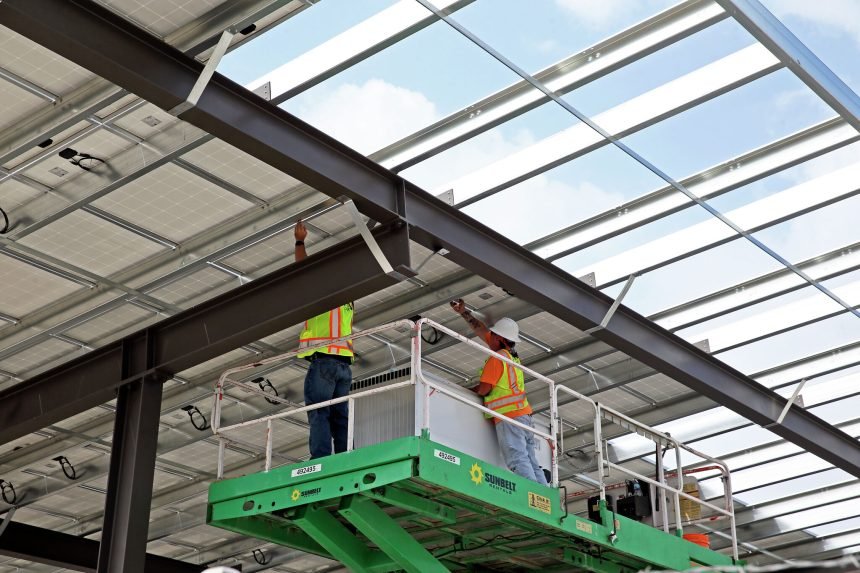
The 997-kilowatt rooftop solar installation is going on the Ron Darner Parks and Recreation Headquarters, boosting renewable energy resources in District 6. Assistant City Manager Jeff Coyle said the project demonstrates how sustainability can be integrated in the city’s long-term strategies and benefit the community. The city’s goal is to be at zero net energy with all municipal buildings by 2040.
“You pull into a library or community center that used to be a blazing hot asphalt parking lot,” Coyle said. “Now, there’s covered parking with solar panels on the roof that are powering the building.”
The city’s municipal solar program was the first in Texas and remains the largest in the state, the city said. It was approved by City Council in November 2023. At that time, there were only 10 city buildings topped with solar panels.
Now, there are more than 50 rooftop and parking canopy solar systems at city-owned facilities spread across San Antonio, for a total of 13 megawatts. That’s enough energy to power 3,250 homes on a hot summer day.
The project has been a collaborative effort between the city of San Antonio, CPS Energy and Big Sun Solar, who got the 15-year contract in 2023 to install the systems. The city contract says the San Antonio-based solar company will install and maintain the panels for up to 25 years. The contract can be extended for two additional five-year terms.
The Ron Darner installation on the West Side is also Big Sun Solar’s largest solar installation, according to the city. The system is projected to generate $130,000 in annual utility savings.
“Every dollar that we save generating electricity from these panels are utility costs our taxpayers don’t pay,” Coyle said.
He said the city’s Department of Resilience and Sustainability was able to offset some of the costs by taking advantage of the federal tax credit from the Inflation Reduction Act. The federal government is still honoring its payments, with the department receiving a $1.2 million rebate payment just the other day, Coyle said.
Coyle pointed out that the project is an example of intergovernmental partnership: federal tax credits and low-interest loans from the State Energy Conservation Office helped finance it, while local government has been on the ground implementing it.
Once the program is fully deployed, the city estimates it will produce around $1.8 million in annual savings, offsetting 11% of the city’s annual electricity use. It’s also expected to reduce municipal emissions by 18%.
The focus to reduce energy demand and emissions comes at a time when a surge of large energy users such as data centers are flocking to Texas.
The program initially was expected to be completed by this fall, said Doug Melnick, assistant director of the city’s Department of Resilience and Sustainability.
But site evaluations and a decision to boost the total number of projects from 42 to 52 has pushed that finish date to the end of 2027. Melnick added that the department also is looking into whether to integrate battery storage into these sites.