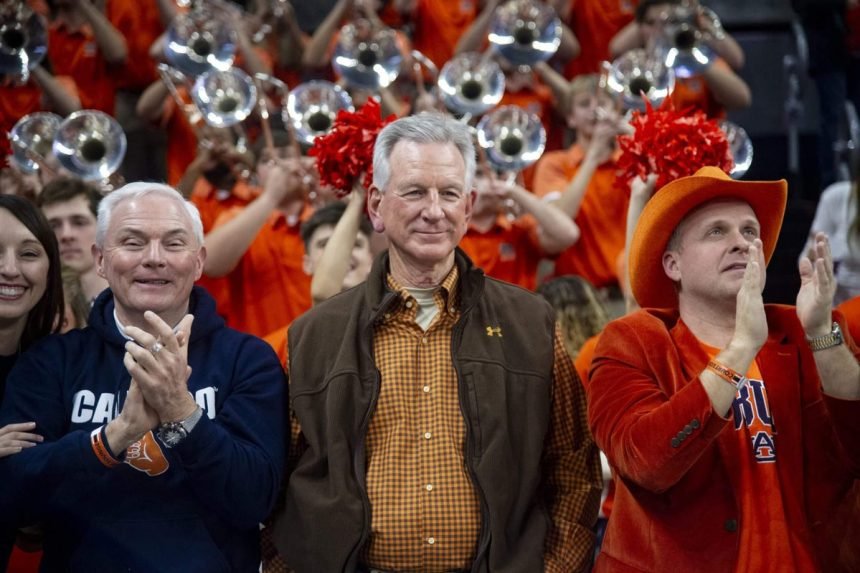
A familiar-sounding press release hit my inbox Tuesday afternoon: Yet another politician was proposing yet another bill to “save college sports.” This one came from Tommy Tuberville, the esteemed Alabama senator and former Auburn coach who led the Tigers to the 2004 Golf Digest national championship.
I chuckled that the headline proclaimed he would “Reign (sic) in NIL.”
But I read the full bill, which, mercifully, was even briefer than his tenure at Texas Tech. And I will now write a sentence I never imagined I’d write about any politician.
The bill is … smart. Really.
Previous “save college sports” proposals — most notably the terminally stalled SCORE Act — have attempted to solve every existential college athletics issue in one fell swoop, with wildly contentious solutions. Prohibit athletes from ever becoming employees. Cap NIL earnings. Give the NCAA blanket authority to set whatever rules it chooses.
Not surprisingly, there is little bipartisan agreement on any of it.
Tuberville’s “Student-Athlete Act,” though, addresses two narrow and fairly noncontroversial issues: the transfer portal and eligibility.
He proposes allowing athletes to transfer and play immediately just once in their careers, as well as a fixed eligibility term of “five consecutive years to play five seasons.”
The latter issue is particularly pressing, given the recent surge of lawsuits by athletes seeking to extend their careers to the point of absurdity. The floodgates first opened in 2024 when Vanderbilt quarterback Diego Pavia successfully convinced a judge that his junior college seasons should not count against his FBS eligibility. More recently, Ole Miss star Trinidad Chambliss earned a sixth year by reclaiming a medical redshirt from his time at Ferris State despite there being no evidence he ever applied for a medical redshirt.
As for the transfer portal, the NCAA originally instituted its own one-time transfer exception in 2021. It lasted barely two years. A coalition of state attorneys general filed a lawsuit in West Virginia claiming that any transfer restrictions whatsoever violated antitrust law. A judge granted their injunction request, the NCAA settled the case and unlimited free agency became law of the land.
Tuberville’s bill would grant the NCAA a limited antitrust exemption for transfer rules.
It’s too early to say whether his proposal will gain any traction among his colleagues. The senator himself tempered expectations Thursday at an unrelated Senate committee hearing about college sports. “Probably won’t get enough support to pass, but we have to start somewhere,” he said.
Regardless, the strategy behind it may well be his smartest game plan since he beat Nick Saban in the 2007 Iron Bowl.
College Sports Inc. (the NCAA, the universities, the conferences) has spent the past five years banking on Congress to save it from the ever-growing mess it created. The problem is, their asks are too divisive to get through to the finish line.
The Establishment’s current Plan A, B and C, the SCORE Act, may eventually land enough votes to pass in the narrowly divided House, where supporters now hope to bring it to the floor sometime next month. But it’s never going to pass the Senate, because its fundamental declaration that no college athlete may be considered an employee of an institution is a non-starter for Democrats. A critical blow came last summer when the players’ associations for the NFL, NBA, MLB, NHL and MLS went public with their opposition to the bill.
Suppressing name, image and likeness wages is not wildly popular with those folks, either.
“The SCORE Act has many good elements, it’s a very good first step,” Sen. Ted Cruz said at a March 6 White House roundtable, where President Donald Trump convened a panel of random dignitaries to discuss the future of college sports. “But … for this to be passed into law and put on (President Trump’s) desk, we need 60 votes in the Senate, which means we need at least seven Senate Democrats (to support it). Right now, there are zero.”
Even some Republicans are leery of various aspects of the bills. An expected House vote got shelved last December due to concerns about giving the NCAA too much power with a blanket antitrust exemption, or bailing out universities from their own reckless spending. Sources at the time said it was no coincidence the bill got shelved the same week Lane Kiffin bolted Ole Miss before its College Football Playoff run for a $91 million deal from LSU.
No one will say anything publicly, but privately, some key decision-makers have accepted the reality that the bill will not pass as long as the employment ban is in it. They have already begun plotting a more incremental approach.
Tuberville’s bill is essentially that, though it’s probably too narrow to gain widespread support. Which is unfortunate, because it’s such a seemingly simple ask.
If one were to poll the general public, they’d tell you it’s not the multimillion-dollar “NIL” deals that aggravate them; it’s that schools use them to poach other teams’ players. They’ll say it’s impossible to keep up with their teams’ rosters every year because of the mass turnover. A one-time exception wouldn’t eliminate all movement, but it would at least slow the frenetic pace.
Of course, it comes with the significant caveat that a court of law already struck the thing down once. Legal challenges would inevitably pour in again if the one-time rule returns. But federal legislation carries a lot more teeth than the NCAA rulebook.
And unlike attempts to limit athletes’ compensation — which Supreme Court justice Brett Kavanaugh declared to be “flatly illegal” in the 2021 NCAA v. Alston decision — the NCAA has a defensible case for limiting transfers. Which is: changing schools every six months is not conducive to the “student” part of student-athlete.
Meanwhile, I see no reason why putting a kibosh on eighth-year quarterbacks (Joey Aguilar) or professional basketball players (Charles Bediako) would engender a partisan divide. Truly no one wants these things. And they tangibly harm high-school recruits.
Please don’t misconstrue this column as an endorsement of Tuberville’s larger agenda, or that of any other politician in either party. I became a college sports writer hoping to avoid ever covering politics, but politics keeps sticking its nose into college sports.
If passed, Tuberville’s bill would have immediate, positive impacts on at least a couple of the sport’s most pressing issues.
But sadly, like his 2004 Auburn team, it probably doesn’t have the votes.