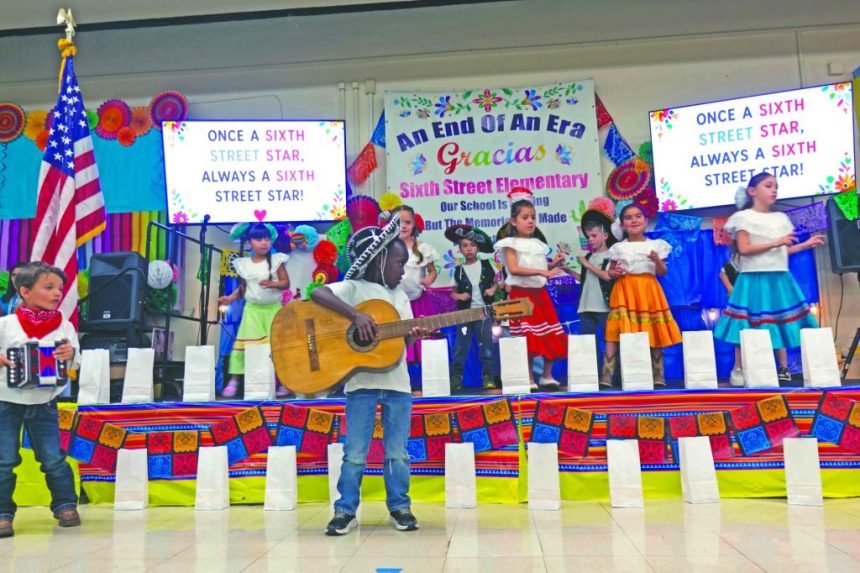
Kindergarten students at Sixth Street Elementary School perform a folklorico dance during the school’s farewell fiesta on Friday in the school cafeteria.
Sixth Street Elementary School can claim an astronaut, the sitting lieutenant governor and all manner of community and state leaders among its alumni, and its current staff and students celebrated its 144-year legacy of education Friday in a farewell fiesta in the school cafeteria.
The school’s kindergartners presented cultural folk dances and an alphabet of careers school alumni had achieved, including A is for astronaut — Harrison Schmitt — and L is for lieutenant governor — Howie Morales, who was one of several speakers at the fiesta.
Morales and others called it a bittersweet moment as Silver Consolidated Schools prepares to close the elementary school at the end of the school year on May 29, part of an effort to consolidate and make better use of classroom space across the district. But, they noted, its contributions to education will continue, as Western New Mexico University is planning to purchase the property for its New Mexico Center of Excellence for Early Childhood Education.
The university will move not just its early childhood education center but the entire College of Education into the building, after some renovations. The center is set to open in fall 2027.
Javier Marrufo, curator at the Silver City Museum and a former student at the school, talked about the history of the Sixth Street site. He noted that the town’s 1878 charter from the Territorial Legislature granted it the ability to raise taxes to establish public schools.
“That made us the very first publicly funded independent school district in New Mexico,” he said. “We never talk about that. I don’t know why we don’t talk about that one. We should be screaming that from the rooftops.”
The first school building in Silver City was constructed where the east end of the Sixth Street playground is now, he said. Completed in 1882, it was the first brick school building in the territory of New Mexico, making the property the oldest continually occupied educational site in the state.
The town began to outgrow that building in the early 1900s, Marrufo said. A new building, the Central Building, was constructed in 1911, and included drinking fountains and brand-new blackboards.
“It was, I guess, state-of-the art for the time,” Marrufo said.
A third building, the Washington Building, was built next to the Central Building in 1926.
The current building was constructed in the late 1930s. Marrufo said a little-known fact is that it was originally named for the first school superintendent in Silver City, Lela Manville.
“Talk about radical for her time. The very first thing that she instituted was having a full-time staff person to watch the children while they were on the playground. Before that, there was no supervision of children while they were playing during school hours,” he said, getting some chuckles from the audience.
However, Manville also oversaw what was then a segregated school system, in which most Hispanic students attended classes several blocks away at Lincoln School. That building now houses the main campus of El Grito Head Start.
In the 1940s and 1950s, the labor for digging parts of the current Sixth Street School basement was provided by students, including Steve Aguirre, who would become Grant County’s first Hispanic sheriff, Marrufo said.
In the 1960s, Maria Spencer began the first cultural appreciation and bilingual programs in Silver Schools at Sixth Street, he said.
“If you know anything about the history of language and cultural inclusion in New Mexico, you know Spanish wasn’t always included in the schools,” he said.
Manuela Baca Jenkins talked about the days at Sixth Street before Spencer’s programs. She was a student there in 1955.
“I didn’t know I was Hispanic,” she said. “There was none of the beautiful programs that you put on today. We didn’t have them.”
She said Hispanic students were segregated, but they were not allowed to speak Spanish. Jenkins said there was one rebel in her class, however — Henry Morales.
“I can tell you the lieutenant governor’s father … he was a little troublemaker,” she said. “He was a little rebel. He was a leader.”
Howie Morales spoke of his years at Sixth Street, noting how back then, the cafeteria seemed much larger.
“Sixth Street was able to be a home for so many, and as we see the children here, so beautifully prepared and the education that they’re able to earn here, I think is a testament to the education system that we have within the Silver Schools systems,” the lieutenant governor said.
Morales gave credit to Superintendent William Hawkins and WNMU interim President Chris Maples for their work to ensure the building will be able to continue its educational legacy.
“We said the one thing we don’t want to see is we don’t want this building boarded up. We don’t want it to be sitting there and not used. And then came in Western New Mexico University,” he said.
Morales presented a state proclamation to Hawkins, with Priscilla Lucero, executive director of the Southwest New Mexico Council of Governments and another Sixth Street alumna, reading it to the audience.
District 39 state Rep. Luis Terrazas said that he, his wife, Mandee, his brothers and sisters and his children all attended Sixth Street. He praised Hawkins, Maples and other state and local leaders who contributed to the effort to continue the school’s legacy with WNMU.
“The most beautiful thing that is happening is that we’re still going to hear children in this building,” he said.
“They say that all good things come to an end. I don’t know that I believe that,” Hawkins said in his remarks. “They just live on in a different form through legacy, through who we are, through the stories we tell.”
Speaking to the past and present staff, he commemorated their dedication, passion and commitment to shaping generations of students.
“Your impacts that you made through these walls live far beyond this building,” Hawkins said. “They live in the lives of the children we’ve touched, the families throughout the community you’ve supported, and the community that you have helped to strengthen.”
—JUNO OGLE