



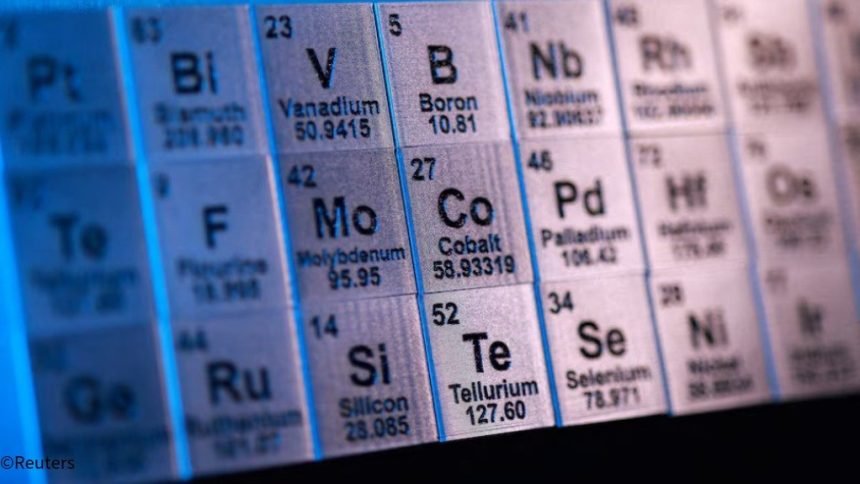
Critical minerals have become critically important because of the development of technology and of global political rivalries in recent years. So pointed out specialist market supply and demand analysis and intelligence research consultancy Project Blue founder and director Dr Nils Backeberg. A UK-based South African, he was addressing the 2026 Southern African Geophysical Association conference, being held in Cape Town.
Criticality was defined by scarcity, risk, and the lack of alternatives, he explained.
The world, he highlighted, was moving from globalisation to “interdependent fragmentation”. The world was becoming multipolar, the strength of the US dollar was less important, while China had become more important.
While the global security order is still unipolar, in that the US remains the single dominant military power, the global economic order is now multipolar. However, there is now also a global digital order and, although this is also multipolar, it is composed, not of States, but of corporations. And there is the global resources order which, by definition, is multipolar (but China is “leading this discussion”).
A key event in these processes has been the Covid-19 pandemic. That has been a huge shock. Since then, all the major economies have been trying to secure the supply of their key inputs, such as metals and minerals.
The critical minerals issue was first brought to wider attention by climate change, he noted. Many of them were essential for the development of modern counter-climate change technologies (although they were already established as important inputs for consumer products such as mobile phones, laptops, and so on). And now, many of them were also essential for advanced aerospace and defence technologies.
Thus, technologies such as aerospace and defence, electric vehicles, renewable energy and energy storage, data centres and AI, are now driving minerals demand. The thing is, many critical minerals are found in low-grade deposits, and need a lot of processing to become useful. The economic viability of such operations depends on the target market – for example, is it purely commercial, partially commercial and partially subsidised, or is it a national government, willing to subsidise an uneconomic operation for reasons of national security?
China has invested hugely in minerals and metals refineries and now refines more than 50% of all the world’s minerals, including those not mined in China itself. This had, he observed, become a concern to Western countries. China had also invested a lot in mining and its associated infrastructures in especially Africa. The US and Europe were now doing the same.
This, he highlighted, was a huge opportunity for Africa. The continent had good relations with all the major global economies. It could become a kind of continental-scale Switzerland, friendly with all, aligned with none.
Although Project Blue is based in the UK, it has a major office in South Africa, at Stellenbosch. It also has a smaller office in China.