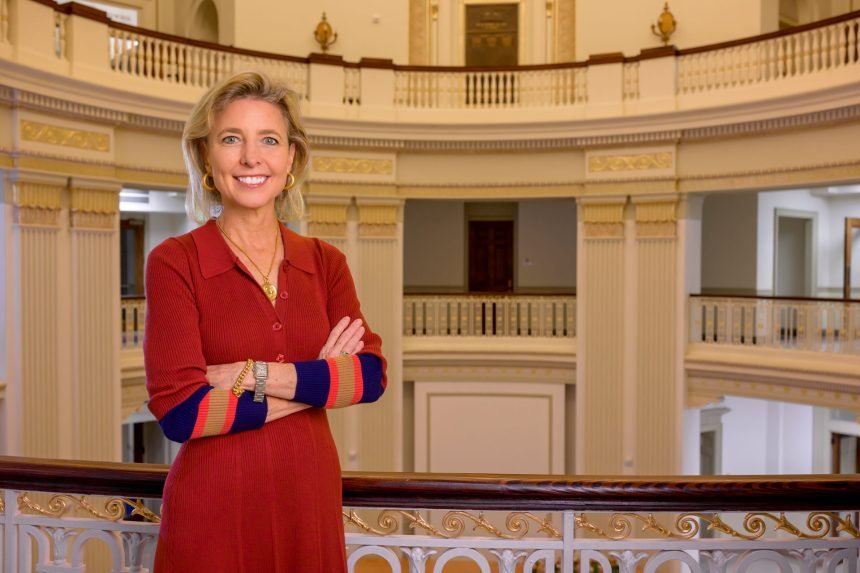
On April 22, SMU President Jay Hartzell introduced The Dallas Office, a university department dedicated to building connections with companies, civic leaders and more in Dallas, as well as its new CEO and vice president, Kit Sawers.
The announcement came from a press release and an email sent directly from President Hartzell. The Dallas Office begins operations on Aug. 3, the same day Sawers will assume her role. As a focal point of SMU’s new strategic plan, which is expected to roll out fully in the fall, The Dallas Office is part of the University’s mission to “connect Dallas to SMU and SMU to Dallas more intentionally.”
“This is a defining moment for Dallas and SMU,” Hartzell stated. “Universities in urban environments are winning, and Dallas creates greater differentiation and opportunity than virtually any city in America. Core to our continued ascent is our ability to be the best partner we can for all of Dallas and the region and to make it easier to engage with SMU, our faculty, our research and most of all, our students.”
Although the full details of the strategic plan have not been released to the public, President Hartzell sent an email to students on April 14 with an update on the strategic framework. One theme he said prioritized was “Dallas as the Engine.”
“There is a desire to further strengthen our relationship with the Dallas community, learning from and engaging with broader parts of the city,” Hartzell stated.
Dallas is the ninth-largest city in the United States, with a population of 1.3 million and 25.7 million visitors annually. In addition to being the home of 24 Fortune 500 companies, Dallas is the home of eight professional sports organizations and the largest urban arts district in the country.
“SMU’s Dallas Office will make engagement with Dallas more coordinated with easier access, increased alignment and exponential impact through business, community, sports and culture,” the press release states. “It will also make it easier to access the University’s academic programs, faculty expertise and student talent, opening new pathways for collaboration, innovation and workforce development.”
Student Body President Jazmin Darjean, who was sworn in on April 21, ran her campaign on the premise of connecting students to opportunities in Dallas. Darjean hopes there will be space to include the student voice in shaping the new office.
“I absolutely want to talk with Hartzell and Kit Sawers about how students can get involved,” Darjean said. “I would love to see more connections to the professional sphere, maybe potential collaborations with the Dallas Regional Chamber. Also, connection on the sports side and discovering ways for our students to engage with the many athletic teams we have.”
The press release referred to creating “exceptional experiences” for students, one of the pillars of the strategic plan.
Sawers, the soon-to-be CEO and vice president of The Dallas Office, is a graduate of SMU Dedman School of Law and the current CEO and president of Klyde Warren Park. In an interview with The Daily Campus, Sawers said making exceptional experiences begins with consolidation.
“One of the biggest opportunities we have is to make it easier for students to connect with what’s already happening in Dallas,” Sawers said in an email. “Instead of students having to navigate different schools, departments or relationships on their own, we will help connect the dots.”
Students are looking forward to more opportunities to connect with businesses in Dallas. The DFW area is a growing hub for finance, with giants like Goldman Sachs and JPMorgan Chase expanding their presence.
Junior marketing major Ella Dodson is working as a marketing intern for Heidelberg Materials in Irving, TX, this summer. Dodson said she applied for over 30 positions before getting her internship with Heidelberg Materials.
“It can be difficult to build meaningful connections,” Dodson said. “I think the new Dallas Office would have made the internship process easier, especially since it’s designed to serve as a connection point between students and companies.”
The Dallas Office is not just for Cox majors like Dodson– according to Timmie Hathorn, assistant dean for alumni and career success at the Meadows School of the Arts, students in all majors stand to benefit.
Hathorn has previously collaborated with the Hegi Family Career Development Center to connect Meadows students to Dallas partners. She also helped create a Meadows internship program that placed students with D Magazine, the Dallas Opera and the Nasher Sculpture Center, among other Dallas businesses.
“I can’t wait to learn more about the vision and priorities for the Dallas Office and to explore how Meadows might serve as a partner and collaborator in those efforts,” Hathorn said. “Dallas is a top-tier media market and a vibrant hub for arts and culture and we are only beginning to tap into its full potential with our existing internship program. There is an opportunity to build stronger employment pipelines.”
The press release also discusses the Office’s intent to enhance learning experiences by bringing “the expertise of Dallas leaders and organizations onto campus and into the classroom.” In addition to the highly regarded Tate Lecture Series, SMU has a well-established history of bringing notable speakers to campus through departments such as the George W. Bush Presidential Center or the Hart Center, or through student organizations such as the Alexander Hamilton Society.
Marta Krogh, Ph.D., is the director of the Hilltop Scholars Program, a first-year scholarship that serves high-achieving students in academics and leadership. One newer element of the program is the Storytellers Collective, a speaker series that has brought guests such as Pixar animator and writer Matthew Luhn.
“The Dallas Office could help centralize and amplify these efforts, making connections more consistent and expanding the reach of programs like the Storytellers Collective,” Krogh said in an email. “This would not only diversify the types of speakers HSP students interact with but also create more interdisciplinary conversations that tie together the arts, humanities and civic engagement.”
She also thinks Hilltop Scholars’ volunteering projects can be magnified with the help of The Dallas Office.
“This office could help strengthen partnerships with local nonprofits and community initiatives,” Krogh said. “Rather than participating in isolated volunteer efforts, HSP students would be able to engage in more coordinated, city-wide projects with greater impact.”
The Dallas Office will begin operations on Aug. 3. Sawers will step into her role on the same date, but students, faculty and potential partners can begin reaching out to the office via email.
“The Dallas Office will position SMU as a more engaged and strategic civic partner—one that’s not just part of Dallas, but actively helping to shape it,” Sawers said.