American cities are shaped by the accumulation of many small choices across time: to put a park here, to lay a sewer there, to rezone this commercial strip or redesign that roadway.
But every now and then, a momentous decision is made — to reverse the Chicago River, to construct the Dallas-Fort Worth airport, to move a highway underground in Boston’s Big Dig. And it changes what’s possible for years to come, altering a city’s growth, its economic prospects or the very nature of its public space.
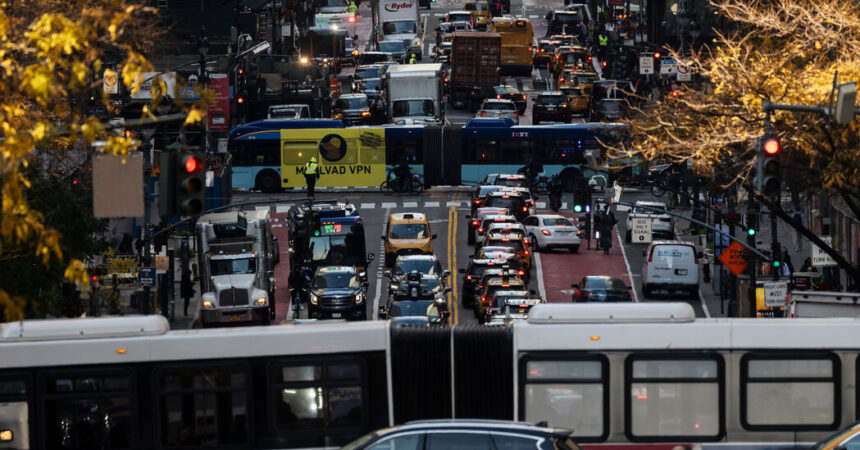
Congestion pricing could have been such a turning point in New York, according to proponents for whom the policy promised not just new revenue for mass transit, but also a fundamentally novel approach to reining in the cost of cars in an American city center.
Gov. Kathy Hochul’s decision to halt it may be remembered as a turning point, too.
“Manhattan south of 60th Street is essentially an invention for creating prosperity for the human race,” said Tom Wright, the chief executive of the nonprofit Regional Plan Association, which has pushed for congestion pricing. “It’s an engine of jobs and creativity, and what it does is it employs millions of people. And it grows.”
The number of jobs in Manhattan, most of them in the congestion zone, grew by 20 percent in the decade before the pandemic (that’s while the number of people living in Lower Manhattan grew, too).
“That growth,” Mr. Wright said, “can’t continue without continued investment in the transit system.”
Polling suggests that congestion pricing was unpopular, and even some backers say they would revise its details. But halting it doesn’t change the fact that it’s unrealistic for workers in the next 500,000 jobs — with the ideas they’d create, the income they’d earn, the families they’d support — to reach Manhattan by car. And that’s true even if many of them work from home several days a week.
Congestion pricing would also have marked a major change in the century-long relationship between American cities and automobiles. Over the last two decades, numerous cities have tried to make alternatives to driving, like buses and biking, more appealing. But they have seldom if ever tried to make driving less so.
“If there was any American city that was the right testing ground for congestion pricing,” said Margaret O’Mara, a historian at the University of Washington, “it is New York.”
A least for now, the death of that strategy in the place where it was most viable will make it less likely other American cities might attempt something similar.
Beyond New York, urban history tells of other moments that proved pivotal, often in ways that weren’t clear until years later.
St. Louis city leaders watched the approach of railroads in the 1850s and opted to stick with steamboat commerce on the Mississippi River instead, a decision that helped Chicago quickly surpass St. Louis as the Midwest’s economic epicenter. Chicago in 1900 successfully reversed the direction of its river, saving its Lake Michigan drinking water (and thus the region’s prospects) from the city’s sewage and industrial waste.
San Antonio in the 1930s began to re-engineer its flood-prone river bend downtown into a landscaped river promenade, laying the foundation for what became the city’s big tourism draw decades later. Dallas and Fort Worth, after a bitter rivalry, agreed to build a joint airport that opened in 1973, igniting the region’s growth and cementing its place as a node in the increasingly global economy.
Boston, at infamously vast time and expense, buried the elevated six-lane highway slicing through its downtown, covering it at street level with a remarkable upgrade in the Rose Kennedy Greenway. That project stitched back together parts of the city that had been divided by the highway. It boosted property values and helped revive the downtown. Buildings that once faced away from the unsightly highway now open their front doors to the park.
“It was utterly transformational,” said Anthony Flint, a senior fellow at the Lincoln Institute of Land Policy who covered the Big Dig as a longtime reporter at The Boston Globe. “We couldn’t have known that exactly in 1982, and some people still grumble and they’re very cynical about it all. But it’s a totally different city as a result of that decision going forward.”
The Big Dig also came to be, Mr. Flint notes, because of an earlier decision not to build something else. Planners in Boston in the 1950s and ’60s, as in many other American cities at the time, were lobbying to construct another highway belt inside the city. Gov. Francis Sargent of Massachusetts balked at the plan and pushed instead to shift federal highway funds to transit projects. Out of the region’s ensuing movement to rethink its transportation priorities, the Big Dig was born.
Not every urban turning point has been about transportation. Damming and diverting rivers for drinking water has also affected the destiny of cities, as have decisions to preserve signature open spaces. Some policies, distinct from physical infrastructure, have marked watershed moments, too, like California’s Proposition 13, adopted in 1978, limiting the property taxes that fund schools and shape the housing market.
But transportation recurs as a powerful force for shaping cities precisely because of its function connecting people — or cutting them off from each other. That’s fundamentally different in scale and effect from building a new stadium or convention center, said Mitchell Moss, a professor of urban policy and planning at N.Y.U.
This is also how congestion pricing might have made a difference beyond the new subway signals and station elevators its revenue would have funded. “I don’t think you can overstate the effect of public transit on New York,” the historian Kenneth T. Jackson said. “It’s why the city is exciting.”
Transit enables more people to come together — whether they’re working or dining or touring museums — than would be possible if everyone arrived by car.
Several historians noted that there are limits to finding historical analogues for the choice point New York has reached today, especially when considering the potential impact of Ms. Hochul’s move to halt the congestion pricing plan. Few of these other pivotal decisions were made by one person alone (although Chris Christie and the Hudson River tunnel project also come to mind). Many of them had a mastermind. Robert H.H. Hugman thought up the San Antonio River Walk; Fred Salvucci believed that the Big Dig could be done. But often, history turned on the will of more than one person.
It’s also easier with the passage of time to say what was so consequential about a highway that was built, or a river that was reversed. It’s harder to prove the effects of a policy abandoned, said Robert Self, a Brown University historian. He believes Ms. Hochul’s decision was shortsighted and will foreclose benefits for the city. And yet, we can’t know for sure, he added, because for now it’s a road not taken.