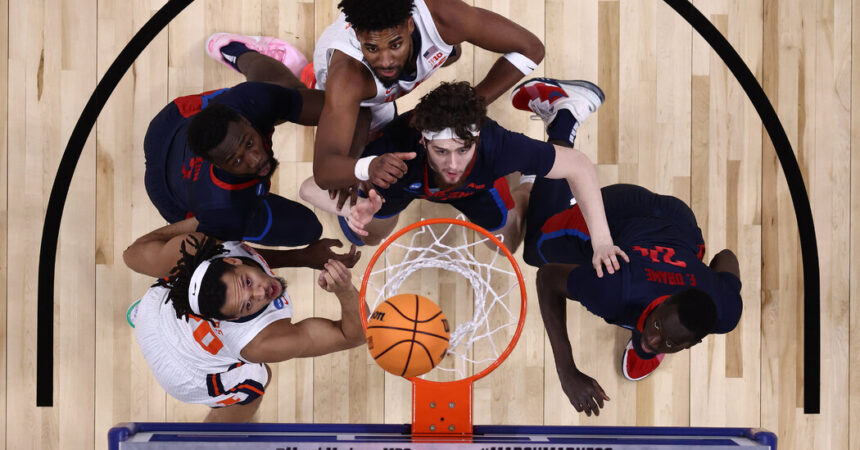
The immediate takeaway from the landmark $2.8 billion settlement that the N.C.A.A. and the major athletic conferences accepted on Thursday was that it cut straight at the heart of the organization’s cherished model of amateurism: Schools can now pay their athletes directly.
But another bedrock principle remains intact, and maintaining it is likely to be a priority for the N.C.A.A.: that players who are paid by the universities are not employed by them, and therefore do not have the right to collectively bargain.
Congress must “establish that our athletes are not employees, but students seeking college degrees,” John I. Jenkins, the president of the University of Notre Dame, said in a statement when the agreement was announced.
It is the N.C.A.A.’s attempt to salvage the last vestiges of its amateur model, which for decades barred college athletes from being paid by schools or anyone else without risking their eligibility. That stance came under greater legal and political scrutiny in recent years, leading to the settlement, which still requires approval by a judge.
On its face, the argument may seem peculiar. Over the past decade, public pressure and a series of court rulings — not to mention the reality that college athletics generated billions of dollars in annual revenue and that athletes received none of it — have forced the N.C.A.A. to unravel restrictions on player compensation. A California law that made it illegal to block college athletes from name, image and likeness, or N.I.L., deals paved the way for athletes to seek compensation, some of them receiving seven figures annually.
At the same time, college sports have become an increasingly national enterprise. Regional rivalries and traditions have been tossed aside as schools have switched conference allegiances in pursuit of TV money. Individual conferences can now stretch from Palo Alto, Calif., to Chestnut Hill, Mass., meaning many athletes in a variety of sports are spending more time traveling to games and less time on campus.
“I don’t know how you wouldn’t call them employees at this point,” said Adam Hoffer, director of Excise Tax Policy at the Tax Foundation and a former professor of economics at the University of Wisconsin-La Crosse. “The N.C.A.A. is going to look more and more like a professional league than it ever has before.”
But the stance fits into the N.C.A.A.’s long-running position that the classification of athletes as employees is a potential death knell for college sports. In February, the organization’s president, Charlie Baker, said Congress needed to enact legislation to protect the “95 percent” of college athletes who he contended would be harmed by a ruling that recognized them as employees. He said that many universities, those outside the so-called power conferences, lost money already on athletics and that spending more to pay players could lead some to eliminate teams.
A lot remains unclear about the settlement, which arose from an antitrust lawsuit. If a federal judge in California approves it, schools will decide how to divide up the revenue they set aside for sharing with athletes — as much as $20 million.
By settling, the N.C.A.A. is banking on receiving an antitrust exemption from Congress, which would protect it from further lawsuits over compensation that is says would hurt its ability to make its own rules. In recent years, the organization has spent millions lobbying the government to create an antitrust exemption similar to the one that professional baseball enjoys.
The settlement is also an N.C.A.A. attempt to cap the amount of money its institutions will have to pay athletes, said William W. Berry III, a professor of law at the University of Mississippi who has studied the issue of player compensation in college athletics. Under the formula laid out by the plaintiffs in the case, the settlement would pay players around 22 percent of future revenue. Mr. Berry noted that was much lower than the shares paid to players in professional leagues like National Football League and the National Basketball Association.
“What they’ve done with the settlement is they’re saying, ‘We’re going to share some of the revenue with you,’” Mr. Berry said, adding that a loss in court could have funneled even more money to the players and been financially ruinous for the N.C.A.A.
On the heels of the allowance of N.I.L., athletes have sought to collectively bargain. In February, a federal judge in Boston ruled that players on the Dartmouth men’s basketball team had the right to unionize and should be considered employees. Dartmouth is appealing the decision. At the University of Southern California, football and basketball players are seeking the right to unionize and to be classified as employees. The settlement could bolster those arguments.
“One of the hallmarks of employment is you get compensated for your services,” said Matthew Mitten, a professor of law at Marquette University and the executive director of the National Sports Law Institute.
But the settlement, by itself, is unlikely to bring about a sweeping push for unionization in college athletics. Dartmouth is a small, private school in New Hampshire, which has laws favorable to unionizing. Many football powerhouses, like the University of Alabama and the University of Georgia, are in right-to-work states, where unionization efforts face stiff legal and political roadblocks.
And compensation without unionization might be the preferred route for some athletes at the biggest revenue-generating schools.
“I think it’s pretty unlikely that the athletes at the Power Four schools are going to want to unionize,” Mr. Mitten said, referring to the Atlantic Coast, Big Ten, Big 12 and Southeastern Conferences.
But the N.C.A.A. is facing a sea change, even if its athletes aren’t called employees.
“The fact that schools will likely be required to pay these players means the existing business model has to change,” Mr. Hoffer said.