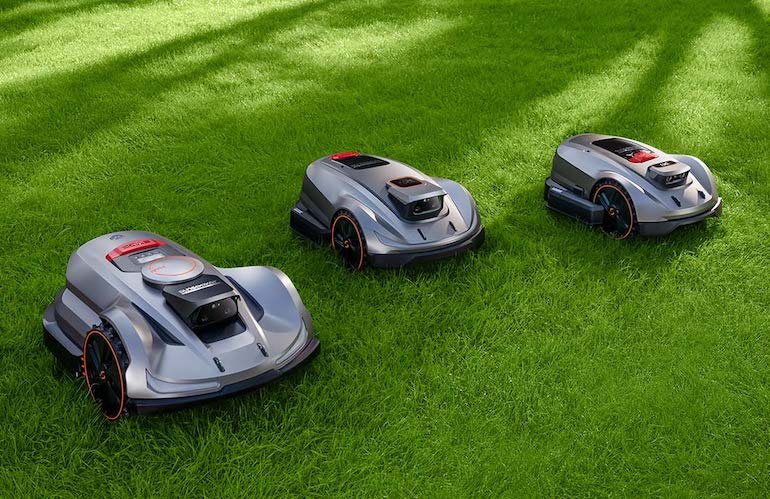
Robotic mowing is becoming more commercially viable because of vision and satellite guidance, AI planning, and autonomy. Source: Sunseeker Robotics
For years, robotic lawn mowers have been perceived as a niche technology: an interesting solution, but one limited by complex installations, wired systems, and performance that was not always suitable for larger and more demanding lawns. Today, that phase is over.
The evolution of artificial intelligence, satellite navigation, and autonomous systems is transforming robotic lawn mowing into a new automation platform for outdoor environments. This is not simply about improving an existing product. We are witnessing the emergence of a category capable of redefining the way millions of people maintain their lawns.
The momentum is reflected in the broader market. The global lawn mower market reportedly generated $35.2 million in 2025 and is expected to reach $63.2 million by 2033. This sustained growth reflects increasing consumer confidence in autonomous outdoor technologies and the rapid pace of robotics innovation.
I believe the industry is entering a phase comparable to the “iPhone moment” experienced by other technology categories. Based on our market analysis, we believe the U.S. robotic lawn mower market could approach 50% household penetration over the next eight years as costs fall, AI capabilities improve, and consumer awareness increases.
Beyond new products, this represents a structural shift in the relationship between technology and the maintenance of outdoor spaces.
The innovations changing the rules of the game
AI and satellite navigation are driving this transformation. Modern robotic lawn mowers are able to understand the layout of a lawn, adapt their mowing patterns, and avoid obstacles with minimal human intervention.
Realtime kinematics (RTK) technology provides centimeter-level positioning accuracy, while 4G connectivity enables continuous communication between the robot, cloud systems, and mobile applications.
In combination, these technologies enable greater levels of autonomy. Robots no longer simply follow predefined routes within wired boundaries; they make real-time decisions about coverage, route optimization, and obstacle avoidance. For homeowners, this means less time spent on installation and supervision. For the market, it means that the technology is finally ready to address the larger, more complex, and more diverse gardens that are typical across North America.
The integration of AI also enables continuous improvement of the user experience. Navigation algorithms can be refined and mowing patterns can be optimized. Robotic mowers can increasingly understand their surroundings, identify obstacles, and avoid them safely.
This continuous improvement cycle is one of the defining characteristics of consumer technologies that are destined to become mainstream.
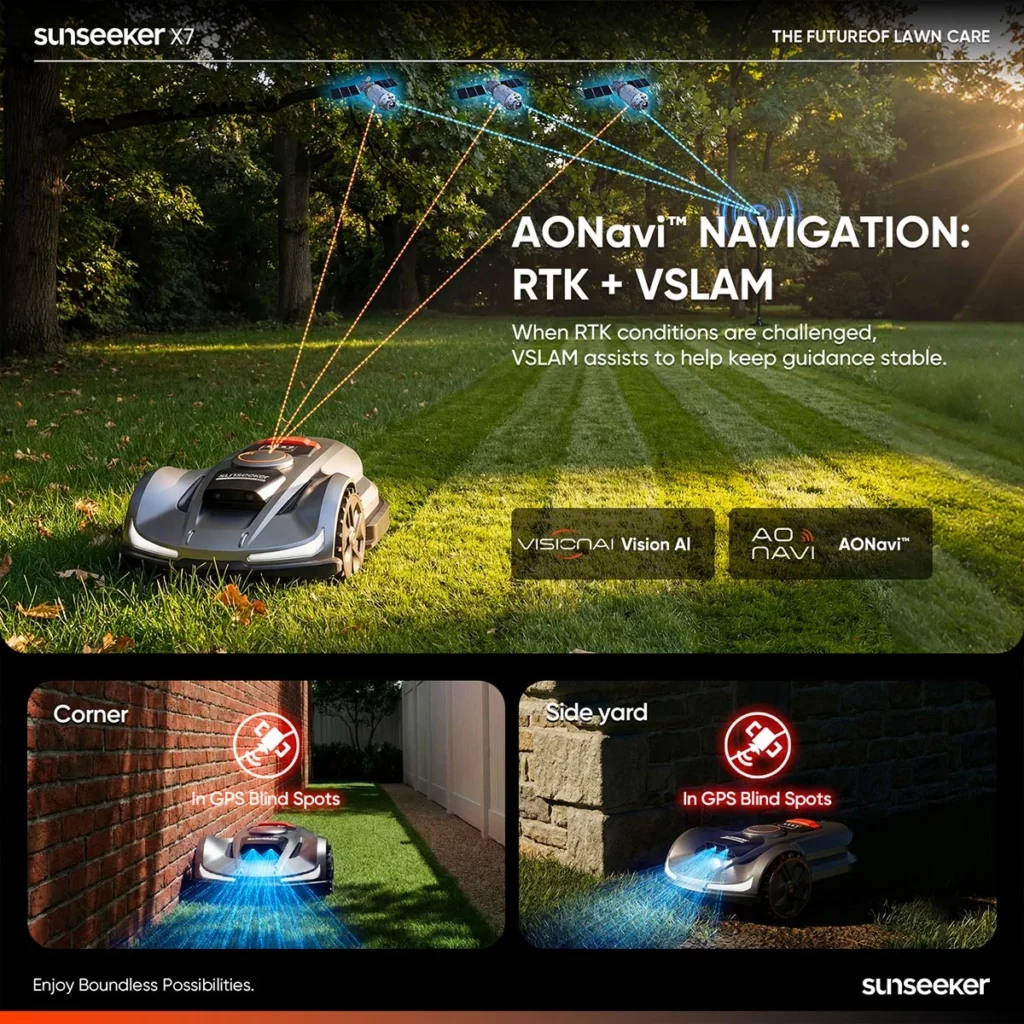
Sunseeker uses a combination of technologies for navigation in its lawn mowers. Source: Sunseeker Robotics
Challenge for mowers is no longer technological, but cultural
Despite the progress achieved, the main barrier to widespread adoption remains consumer awareness. Many homeowners still associate robotic lawn mowers with previous-generation models that required complex installation, frequent maintenance, or professional assistance.
Today, the reality is different. The product exists. What is missing is perception.
Wireless and satellite-based systems have dramatically reduced installation complexity and made the user experience much simpler and more accessible. The challenge now is to clearly communicate the capabilities of this new generation of products and demonstrate that robotic lawn mowers can operate with levels of autonomy, reliability, and precision far beyond what was possible in the past.
This dynamic is similar to what happened in other smart home categories. Technologies such as robot vacuum cleaners and smart thermostats initially attracted early adopters, before becoming mainstream products thanks to improved usability and greater consumer comprehension.
 Register now and save on your pass to RoboBusiness 2026
Beyond the home garden: the automation of landscaping
The potential of robotic lawn mowers extends far beyond the residential market. The commercial landscaping industry is expanding rapidly, with the U.S. market growing at an average annual rate of 6.5% between 2020 and 2025. As demand for professional landscaping services continues to rise, automation represents one of the sector’s greatest opportunities.
At the same time, landscaping companies face persistent labor shortages, seasonal spikes in demand, and increasingly challenging working conditions, particularly during periods of extreme heat.
The labor challenge is becoming increasingly significant. The U.S. landscaping services industry employs well over 1 million people, yet companies across the country consistently report difficulty recruiting and retaining workers, particularly for seasonal and physically demanding outdoor work. Automation offers an opportunity to help bridge this gap while improving operational efficiency.
Autonomous mowing systems can help address these challenges by taking over repetitive and labor-intensive tasks. Lightweight commercial models are already entering the market, while more robust systems are expected in the coming years. For landscaping professionals, this means greater productivity, reduced physical strain, and the ability to focus human resources on higher-value activities.
Safety is also a central consideration. By automating certain mowing operations, robots can reduce the amount of time workers spend operating heavy machinery in difficult weather conditions. This approach can improve working conditions and make the landscaping industry more efficient and sustainable.
Conditions ready for wide use of robot mowers
Robotic lawn mowers are emerging as one of the next major waves of home automation. Advances in navigation technologies, lower costs, increasing consumer awareness, and increasingly reliable performance across a wide variety of garden environments are already creating the conditions for large-scale adoption.
This trajectory does not represent only commercial growth, but also the beginning of a paradigm shift from lawn mowers as a mechanical tool to an autonomous service. From this perspective, the robotic lawn mower is not simply a more advanced product. It could be a new interface between people and the management of outdoor spaces.
Therefore, the most significant transformation is about how we understand the relationship between technology, time, and everyday work. When a repetitive task is entrusted to an intelligent system, the value of that recovered time changes. it becomes time for family, for rest, and for other activities with greater personal or professional value.
This is the deeper meaning of automation applied to outdoor spaces. In addition to replacing a tool with a more sophisticated machine, robotics and AI are turning lawn maintenance into a continuous, discreet, and reliable service. In other words, it means moving from a manual activity to an experience managed autonomously by technology.
 About the author
Terry Ma is the founder and CEO of Sunseeker Robotics, a leading innovator in outdoor power equipment and robotic lawn mowers. He holds a master’s degree from the University of Manchester and a bachelor’s degree from Shanghai University of Finance and Economics.
Since founding the company in 2009, Ma has led Sunseeker into outdoor robotics. Today, Sunseeker operates in more than 40 countries, is available in over 5,000 retail stores worldwide, and completed nearly RMB 500 million $74.3 million U.S.) in Series B funding in early 2026. Terry and the global team continue to drive innovation in physical AI technologies and enhance User Experiences, shaping the future of outdoor robotics.