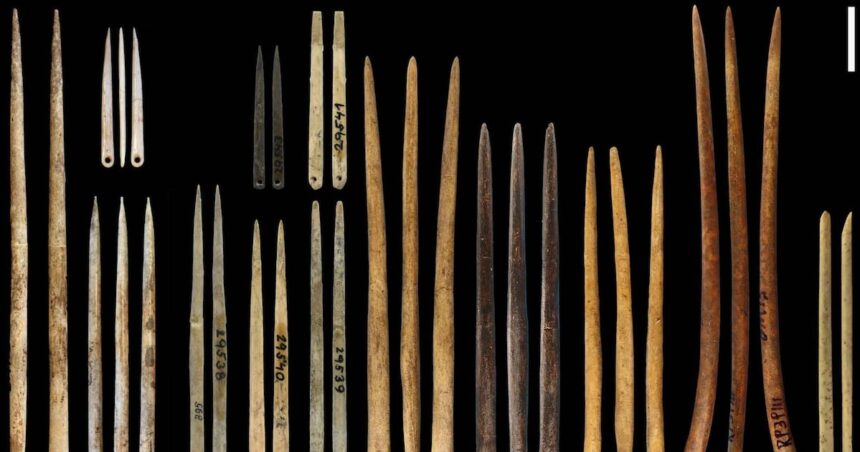
In the weeks before June’s couture shows, workers in European ateliers hunched over garments carefully sewing and ornamenting them with beads and other decorative flourishes, at times with little more than skilled hands and an eyed needle.
Some 40,000 years ago, a similar scene was taking place, for much the same reasons.
In a new paper that happened to coincide with the couture shows last month, an international team of researchers made the argument that the advent of eyed needles was connected to a “pivotal shift” in clothing and human history. Prior to that point, humans appear to have made the earliest tailored garments — ones that were actually fitted to the body, rather than just animal skins wrapped around it — by scraping hides, puncturing holes in them with bone awls and tying the pieces together with fibres or sinew in order to keep warm in chilly climates. Eyed needles let palaeolithic humans pierce holes and thread fibres simultaneously, which was more efficient and also allowed for more refined stitching.
With this ability, they could have started making underwear for added warmth, and importantly, decorating clothes by attaching fur trims, beads and other adornments, allowing clothing to become a means of expressing everything from group identity to social status.
“Eyed needles mark that transition in the function of clothing from a physical necessity in certain environments at certain times to a necessary social function at all times,” said Dr. Ian Gilligan, a researcher at the University of Sydney and lead author of the paper.
For that reason, eyed needles were a “technological advance” that marked “a tipping point in human prehistory,” Gilligan and the other researchers wrote.
The implication is that fashion and technology have been intertwined from the start. The relationship has often been symbiotic: Fashion in many ways wouldn’t exist as it does without technology, but technology wouldn’t be as it is today without fashion.
The need for faster ways to turn raw cotton into yarns and fabrics, for instance, powered much of the Industrial Revolution. A job that once largely entailed women spinning yarns at home on small wooden wheels or with a distaff and spinning bowl had evolved by 1860 into a mechanised industry where wage workers toiled on spindles powered by steam engines, as historian Sven Beckert detailed in his book “Empire of Cotton.”
“It was in cottons that the new modes of manufacturing first came about,” Beckert wrote. “The factory itself was an invention of the cotton industry.” (And as Beckert also noted, along with improvements in efficiency came problems like new kinds of labour exploitation that continue in much the same form to this day.)
Modern computing even owes a debt to the Jacquard loom, patented by the French weaver Joseph-Marie Jacquard in 1804. To produce his intricately patterned materials, Jacquard used punch cards that acted as a code controlling which threads were raised in the textile. The design inspired Charles Babbage, an English polymath, who borrowed the idea as the basis of his “Analytical Engine,” essentially a steam-powered computer capable of performing calculations. Babbage never built his machine but described its operations in great detail. It was with this framework in mind that Ada Lovelace, a friend and associate, wrote what is often called history’s first computer program.
Other creations such as nylon, used now in toothbrushes, seatbelts and much more, were initially applied to fashion. The material, created by DuPont researcher Wallace Carothers in the 1930s, was the first wholly synthetic fibre used in commercial items. The first product made from it was women’s hosiery. (Some small amounts were also used in toothbrushes.) The term “nylons” became synonymous with stockings.
Fashion isn’t known as the most technologically advanced industry today, but it’s among the fields quickly embracing generative AI (though customers aren’t always happy about it). It has adopted blockchain and augmented reality. It’s even been trying to get robots to sew clothing, though handling floppy fabrics has proved a difficult task for machines.
Against that backdrop we might not immediately think of eyed needles as a form of technology, but from an archaeological perspective, technology is any physical artefact that can be used to perform a function or manipulate objects. “It’s no different from us using a computer to communicate,” Gilligan said.
In that regard, the eyed needle is among humanity’s most enduring technologies. The earliest known examples appeared roughly 40,000 years ago in what’s today Siberia. A couple thousand years later they appear in the Caucasus, then show up in East Asia around 30,000 years ago. They made it to Europe by about 26,000 years ago.
They probably appeared out of necessity, according to Gilligan, as it’s unlikely hunter-gatherers would have spent the time crafting the delicate needles unless they served a useful function. Decoration of the body was vital to these groups. They would alter their appearances for ceremonies and other social purposes.
It was usually their skin that served as the canvas though. They would paint themselves and use tattoos and scarification to add permanent decorations to themselves. Clothes, meanwhile, appear to have come and gone over time. As the climate fluctuated, tools like hide scrapers appear in the archaeological record during glacial cycles when the climate grew colder but then disappear again as it warmed up, suggesting humans shed their clothes once the weather allowed. Then, around the end of the last ice age, something changed: Clothes didn’t go away.
“It was because clothing had acquired this necessary function of dress and that had never happened before,” Gilligan said.
As far as we know, clothes replaced adornment of the naked body. That’s also when eyed needles appeared.
Gilligan said this social function of clothing, which also came to include modesty, is the reason clothing has persisted and why we still wear clothes now. So next time you’re grateful to have clothes and not be delivering a presentation to a group or standing on a crowded bus or train naked, say a little thanks to the eyed needle.