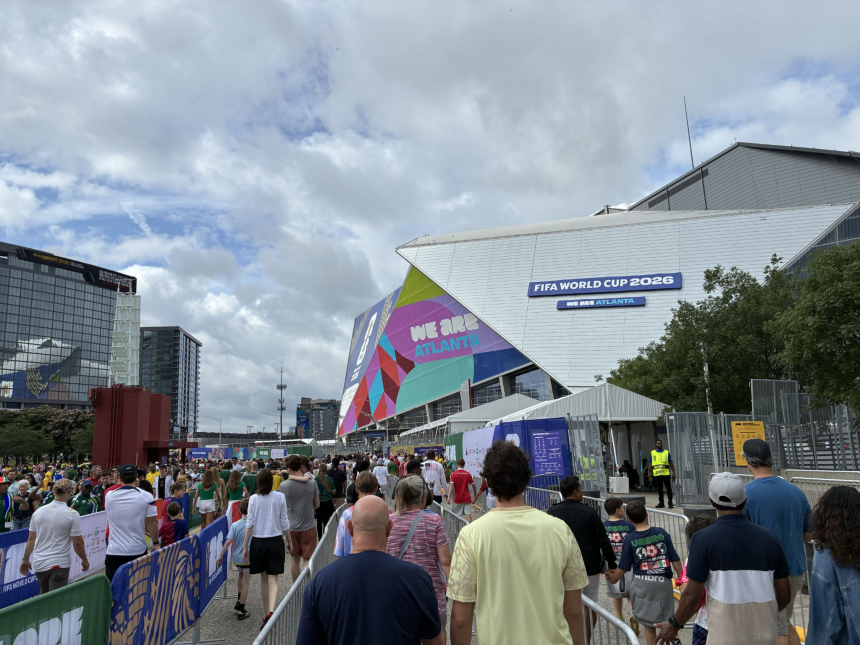
The 2026 FIFA World Cup was one for the record books in Atlanta.
According to the Atlanta World Cup Host Committee, the tournament featured eight matches, drew more than 500,000 visitors to the FIFA Fan Festival, and hosted over 150 community events and watch parties. Then, on July 19, Spain defeated Argentina 1-0 to be crowned World Cup champions in New York City.
With that victory, Spain ushered in the end of the World Cup fever across the globe and in Atlanta. Now that the tournament is over, it is time to evaluate just how impactful it was.
The local impact
In Atlanta, local government as well as civic and business leaders spent 18 months preparing for the tournament. This preparation included the repaving of more than 24 miles of roads, the restriping of 200 intersections, the installation of 150 new streetlights, and the repair of 14 miles of sidewalk. In addition to infrastructure improvements, some city leaders and local entrepreneurs anticipated an economic impact of $415 to $503 million.
Following the last game hosted in Atlanta, local outlets started covering how the influx of tourists impacted the city. As Atlanta News First reported, restaurants and hotels saw the largest surge in foot traffic, with one business owner seeing a 35 percent increase.
Despite this reporting, not every business saw the same results. At the beginning of the tournament, some local businesses that participated in the city-sponsored Welcome to ATL Experience reported losing thousands of dollars. One local business owner told the AJC he spent about $60,000 but only made $1,200 before leaving the Welcome to ATL event.
However, the economic record is only part of the story and the cultural impact is just as impactful. In a conversation with Debra Lam, the Founding Director of the Partnership for Innovation, a regional program focused on connecting governments with local, innovative organizations, she discussed some of the non-economic impacts.
“What I think is great about these types of events, whether it is the Olympics in ‘96 or the World Cup or the Super Bowl…[is that] it’s a great way for the city to come together and for them to celebrate the talent and achievements and find joy in [the] showcase,” she said.
As Debra emphasized, events like the World Cup provide a cultural and economic impact beyond the balance sheets.
The true economic and environmental impact
In an article published by NC State University, Professor Michael Edwards discussed who benefited most from the World Cup.
“Full hotels, busy restaurants and crowded fan festivals make compelling images, but they do not prove that the World Cup produced substantial new growth,” he said.

While major events can boost a city’s visibility and generate profits for certain businesses, these gains are often concentrated and not sustained over time. Once the event ends, demand and foot traffic return to normal. Equally important to the economic impact is the environmental impact.
Locally, the Mercedes-Benz Stadium acknowledges the importance of environmental sustainability. According to Andrew Bohenko, a sustainability employee at the Mercedes-Benz Stadium, the facility diverted 91 percent of food from landfills to be composted or recycled. During the tournament, the stadium also achieved LEED O+M v4.1 Platinum certification, which is the highest recognition for how sustainably an existing building operates. Across the entire tournament, though, the environmental impact is more concerning.
Before the tournament, researchers estimated that the 2026 World Cup would be the most polluting in history, generating around 9 million tons of CO2, with 8 million coming from air travel alone. This is roughly the same as Luxembourg’s and double Iceland’s annual emissions.
While FIFA pledged to make the 2022 World Cup carbon-neutral and halve emissions by 2030, forecasts for the 2026 World Cup have it doubling and potentially even tripling the emissions from its predecessor. With the next World Cup set to take place across Africa, Europe and South America, the future does not look much better.
What’s next?
Some businesses in the transportation, hotel, and restaurant industries undoubtedly saw a boost, while others farther from the event space may not have. Despite this mixed bag for small retailers, many tourism officials believe the tournament was a success and improved the city’s brand. As a result, major conventions and sporting events may be held more regularly in the city.
Even the pollution associated with air travel has its upsides: without it, there would be no Argentina fans swarming Underground Atlanta, and those gameday memories would never have been made. As Bohenko noted, “We have a great community of people in Atlanta that are always happy and helpful.”
However, with the buzz and momentum now gone, the city needs to continue taking care of its people by maintaining investment in public infrastructure like transit. It should not take another World Cup to provide the next upgrade or surge in tourism to local businesses. As Debra pointed out, it is easy to shine for a month or a weekend, but maintaining that shine for years to come is what is important.