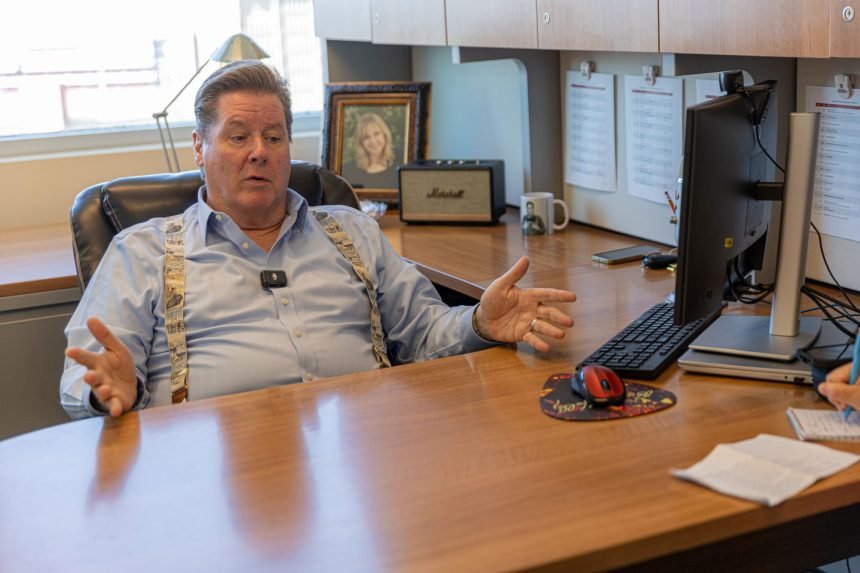
Tim Fullmer, a professor in the University of Utah Department of Finance, is now also the Academic Director of Undergraduate Finance Programs. Here, he will have an advisory role in what courses the David Eccles School of Business’s Department of Finance offers.
Fullmer began his new role on July 1, 2026 where along with recommending which courses to offer, he also oversees student clubs and internship opportunities in the Department of Finance. He said he is excited for this role and has been able to move toward making changes that faculty have been discussing for years. Fullmer is in his eighth year as a U instructor.
The student experience
Fullmer said in an interview with The Daily Utah Chronicle that he is focusing on helping to prepare students for their careers with classes applicable to the real world.
The Advanced Financial Analysis (AFA) minor and emphasis are being revamped after listening to industry partners and research, Fullmer said. “We got to listen to the people that are hiring. We see students as our product,” he said. “They come here as raw material, and our job is to convert them into something that can ultimately be hired by our customers. Our customers are the companies that are going to be hiring them.”
Fullmer said he’s also developing course tracks to increase students’ readiness for their specific field. What a student does next after college is a part of their student experience, he said. “You can have a great experience while you’re here at the U, but if you don’t get into a career, none of it matters,” he said. “It was just a fun educational experience.”
Fullmer says that one of the biggest regrets former U students have expressed to him is not getting involved in clubs or other extracurricular activities earlier. In his freshman and sophomore finance courses, Fullmer said that he pushes for students to get involved.
Goals and responsibilities
Improving student graduation rates is a priority of the finance department and the David Eccles School of Business, Fullmer said. Getting students into the U and graduating in “a timely manner” is the goal.
Another goal is to improve infrastructure, like classroom capacity, so that more students can attend the classes they want, Fullmer said. He wants to ensure “students are opting into online classes because they want to” and not because it’s the only option.
Improving infrastructure also goes hand in hand with the University’s goal of increasing enrollment to 40,000 students by 2030.
Connecting with students
Fullmer said some students are disappointed after hearing his ideas “because these changes won’t affect them,” he said. Many changes won’t be effective until 2027 or 2028.
Sabur Haider is a junior majoring in finance. Haider took Fullmer’s FINAN 3020, “Principles of Finance” class in the spring 2025 semester.
Haider said in an interview with the Chronicle that Fullmer is “someone who’s really passionate about the course he’s teaching [and] he puts a lot of effort into it.” He develops his own slides and utilizes his own lecture notes, according to Haider.
“I think the best thing that Fullmer did is he didn’t make anything seem complicated,” Haider said. He also said that Fullmer is “very good” at explaining how each step builds while “getting slightly more complicated each time.”
One change Haider said he is interested in seeing is how the finance department will change their curriculum to have more real-world applicability. Haider said that “Fullmer has a lot of great ideas” and “he’s going to push to get them done.” The question is how long those ideas will take to implement and if the rest of the Department of Finance “and the business school [will] be on board,” Haider said.
Vision
As director of undergraduate finance programs, Fullmer said that he is trying to elevate the finance program’s stature. These rankings are based on factors like research output and where students are getting jobs after graduating, according to Fullmer.
He said raising the stature “could be a three to five year process to get those rankings up.” This would mean “more attention” to the U, Fullmer said. “We have to attract the correct talent to teach and the correct talent to research because it requires both of those things to make a university function,” Fullmer said. “If all we did was research, we wouldn’t be a university; we’d be a think tank. And if all we did was teach, we wouldn’t be a university; we’d be a college.”
Fullmer says he’s at the U “because I love what I do.” He came to the U after retiring at 49 and wanting to find ways to fill his time at home. “So I’m here not because I have to be here. I’m not here for a paycheck. I’m here because I love what I do,” Fullmer said. “And as long as it’s fun, I’ll stay. I have no plans to leave.”