



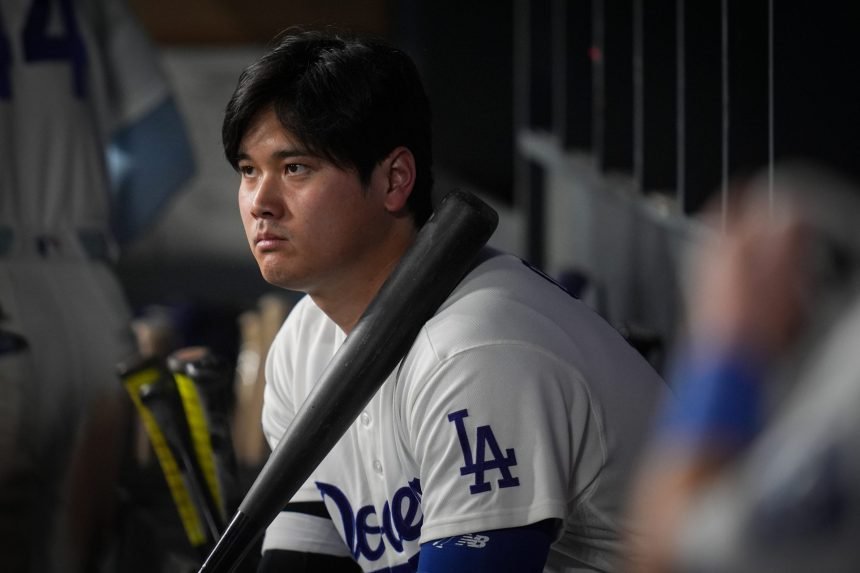
Around a week ago, I watched the Los Angeles Dodgers get absolutely destroyed by the Milwaukee Brewers in the MLB Playoffs. While I strongly dislike the Brewers, I despise the Los Angeles Dodgers even more for many reasons — the main one being how much they pay their players.
The Dodgers payroll for 2026 was $340 million. The other final three teams in the MLB playoffs — the Brewers, Cleveland Guardians and Tampa Bay Rays — had a combined $316 million for their 2026 payrolls.
There’s a lot of different numbers being thrown out there. But moral of the story: the Dodgers have the second highest payroll in the MLB, after the New York Yankees. The Brewers, Guardians and Rays are in the bottom 12 teams with the lowest payrolls.
Shohei Ohtani, considered one of the best players in MLB history, signed a 10-year, $700 million contract in 2023 with the Dodgers. He would get paid $70 million a year, but the Dodgers will only be paying him $2 million per year until his contract ends.
Starting in 2034, Ohtani will receive $68 million per year until 2043. That’s $680 million over 10 years, while Ohtani is only getting $20 million total until 2033, when his contract ends.
This was all agreed upon within the parameters of the Collective Bargaining Agreement, an agreement between the MLB and the players’ association, which states that there are no restrictions on how much money can be deferred.
I won’t lie, as someone who’s really into sports, this whole situation had me very confused. My dad and boyfriend both had to explain it to me like I was a third grader learning times tables for the first time. I had to hear it a handful of times before I was able to understand it.
My main question is: Will the Dodgers actually be able to pay Ohtani the money he is owed?
In 2024, the Dodgers were the first team in MLB history to generate $1 billion in gross revenue. There have only been three other sports teams in the world who have hit that benchmark: the Dallas Cowboys in the NFL, and Real Madrid and Barcelona in La Liga.
While it’s amazing that they made $1 billion dollars, what if they somehow don’t make up all of the money they promised to Ohtani?
Ohtani wasn’t the best this past season compared to the season when he signed his big contract. He had a batting average of .275 and got 144 hits this season, while in 2024 he had a batting average of .310 and got 197 hits.
He had many injuries this year, from his right bicep to his left knee. Playing both a pitcher and a hitter can be a lot on his body. So is it already taking a toll on him when he’s set to play another seven years?
While a team like the Dodgers pays their players millions and millions of dollars, some teams don’t pay their players a lot. The lowest paid team in the MLB is the Guardians, whose payroll is $74 million.
This past summer, there were lots of talks that if the Dodgers had a three-peat of winning the World Series, there should be a salary cap. Alongside the cap, there would also be a salary floor.
The MLB proposed that if there were to be a 2027 salary cap and floor, they would be set at $245 million and $171 million, respectively. Based on 2026 payrolls, there would be eight teams over the salary cap and 15 teams under the salary floor.
There’s a big possibility a salary cap won’t happen anymore since the Dodgers aren’t in the World Series. But it’s still shocking to me that teams can spend as much money as they want to.
I love watching baseball, but I’m always irritated that teams like the Dodgers can pay their players outrageous amounts of money. Because they do that, every MLB player wants to flock to their corner and get paid as well.
Sometimes it can seem like players only want the money and aren’t in it for the sport. Will there ever come a point that the MLB will make a salary cap, or will they not care as long as the Dodgers don’t keep on winning?
Related stories:
Support Student Journalism!
The DePaulia is DePaul University’s award-winning, editorially independent student newspaper. Since 1923, student journalists have produced high-quality, on-the-ground reporting that informs our campus and city.
We rely on reader support to keep doing what we do. Donations are tax deductible through DePaul’s giving page.