Electrical interconnects may very well be the unsung heroes of modern microchips.
These tiny wires – typically made of copper due to its high conductivity – string together the billions of transistors that drive our computers and electronic devices. But as the technology advances and additional transistors are piled on, the components must shrink to the nanoscale. And that’s when copper begins to fail.

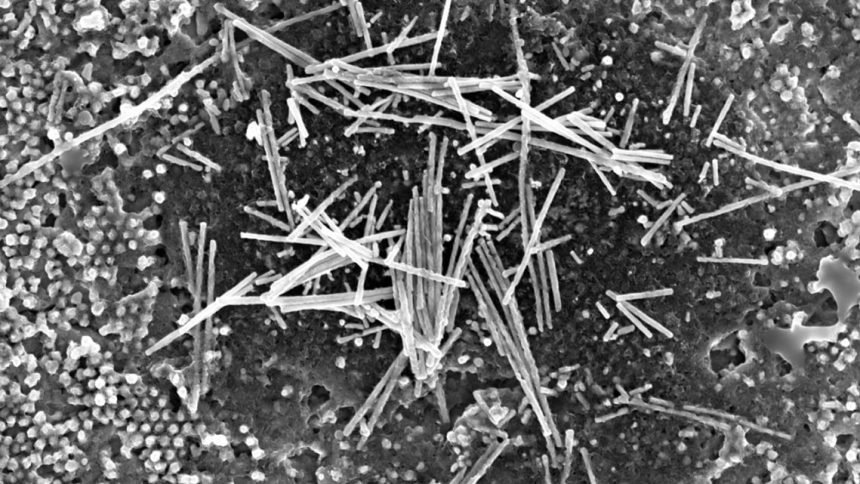
A scanning electron microscope image shows nanowires of niobium arsenide still attached to a bulk feedstock. Image credit: Cornell University
Cornell researchers have developed a potential replacement for copper interconnects: single-crystal nanowires of niobium arsenide. This topological semimetal paradoxically becomes a better conductor the thinner it gets, boosting electronic performance.
The findings were reported July 16 in Science. The lead author is doctoral student Yeryun Cheon. Judy Cha, the Rick and Betty Tsai Ph.D. 1981 Professor in Materials Science and Engineering in the Cornell Duffield College of Engineering, is the paper’s senior author.
For the last seven years, Cha and her lab have been exploring the potential of topological semimetals, which are enticing for material scientists and electrical engineers because extra electrons flow on the surface of the material in addition to the usual electrons in the bulk. This enables nanoscale material samples to exhibit different exotic properties at their surfaces and edges.
“Electrons that are flowing on the surface of the material travel really fast, and they do not scatter off as easily as electrons in the bulk. That’s the reason why copper is suffering, because copper only has electrons flowing in the bulk,” Cha said. “As you make them small, these electrons inside the copper wire start to see the surfaces and are constantly getting scattered off to different directions. That’s why it becomes electrically very resistive.”
In 2023, Cha’s team unveiled a topological compound, molybdenum monophosphide (MoP), that proved more stable than copper when scaled down, but its conductive qualities did not improve. Now, with niobium arsenide (NbAs), the researchers have found a material that satisfies both criteria.
For decades, there have been two conventional ways to make nanowires. In vapor-liquid-solid growth, metal particles are heated to molten temperatures and soak up vapor precursors that, once supersaturated, precipitate out as crystalline nanowires. In chemical vapor deposition, a precursor vapor is cooled and condensed into a solid crystalline film or nanowire.
The problem: Neither method provides control over the nanowire’s dimensions or morphology. So in order to develop these superior alternatives to copper, the researchers employed a very specific process: thermomechanical nanomolding.
With thermomechanical nanomolding, material is consolidated into a bulk feedstock, put into a porous aluminum-oxide mold and pressed at high temperatures for several hours. The mold is then etched away, and the resulting high-quality single crystal nanowire is deposited on a silicon wafer or other surface.
Cha compares the process to using a pasta maker.
“If you swap the front plate of your pasta maker, you can make fettuccine or angel hair,” she said. “We just take the bulk feedstock as our ‘dough’ and use different molds with different pore diameters. The key is you have to make topological semimetals small enough to maximize the surface properties to see the predicted effect. And we developed a synthesis method that gives us control over the diameter down to about 10 nanometers.”
Thermomechanical nanomolding is also very fast, which increases the number of materials the researchers can screen.
“It used to be that my group would study one or two material systems per year, and now we study one material system per month,” said Cha, the Lester B. Knight Director of the Cornell NanoScale Science and Technology Facility (CNF). “It’s like a tenfold increase in synthesis throughput. This synthesis is really what enabled us to study these compounds.”
Not only is niobium arsenide a better conductor than copper at the nanoscale, it also is surprisingly robust and remains so at room temperature. That’s important because quantum materials are often quite fragile and prone to oxidation.
“I feel like that is the real significance of the work, that one may not need the highest-quality pristine sample, and you don’t need to go to the lowest-temperature, noise-free environment to see these types of quantum mechanical effects,” Cha said.
Ultimately, niobium arsenide may not be a practical replacement for copper – arsenide is toxic, after all – but it is a useful proof of concept, Cha said, demonstrating that “topological semimetals are not just a toy model that physicists want to study, but they can be realistic, compelling systems.”
Source: Cornell University