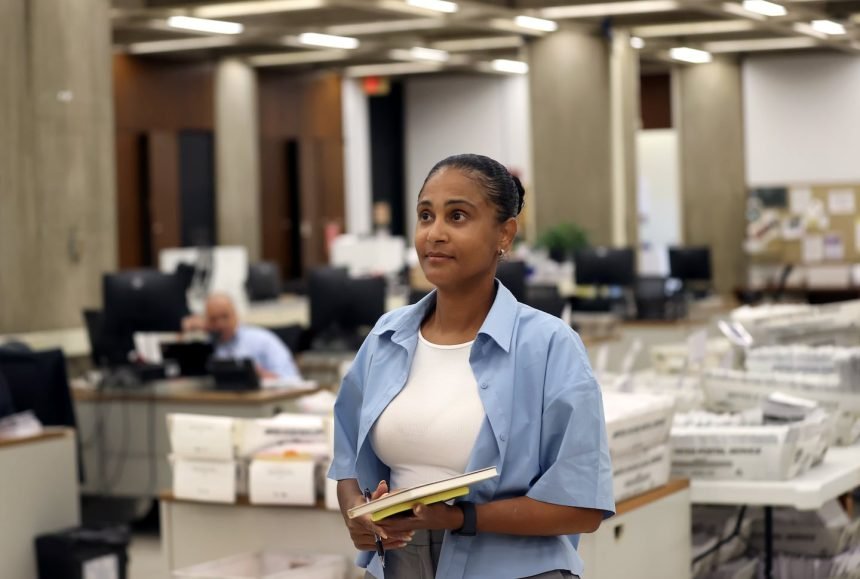
Paul Chong, the city’s registrar, is currently serving as acting election commissioner, Osaghae said. In a statement released by Wu’s office, Osaghae said Tavares led several initiatives during her tenure, including implementing early voting during the COVID-19 pandemic and overseeing four recounts.
Still, as of Tuesday afternoon, Tavares’ name is still listed at the top of the Boston Elections Commission website. Tavares made $145,000 in 2025, according to city data.
Secretary of State William F. Galvin placed the Election Department under state receivership early last year after the city stumbled amid “systemic,” “unacceptable” problems while administering the 2024 presidential election.
Galvin’s investigation into the city confirmed reports of widespread ballot shortages and voting machine failures at precincts around the city on Election Day that year. It also found the city’s Election Department did not answer more than a thousand calls it received from poll workers and residents who tried to report the issues, some of whom ultimately reached out to Galvin’s office for help. Boston police officers also had to rush additional ballots to affected precincts before polls closed.
Galvin last spring appointed Michael J. Sullivan, who previously served as the head of the state’s campaign finance regulatory agency for 25 years, to oversee Boston’s Election Department through this fall’s state elections.
Debra O’Malley, a spokesperson for Galvin, said the city notified the Secretary of State’s office in early February that Tavares would be leaving the commissioner role and the city would hire a replacement.
“After learning of her departure, our Director of Elections met with representatives from the City of Boston to ensure that operations at the Boston Election Department would continue to run smoothly during the search for a new Commissioner,” O’Malley said in a statement to The Boston Globe Tuesday.
Last summer, Galvin said the state’s efforts to restructure how Boston runs its elections had turned into “a much more intensive exercise” than he anticipated. He said his staff was also working to “insulate” the Election Department from Wu’s office amid her successful reelection campaign.
Galvin’s office pointed to several problems with how the city oversaw the 2024 presidential election. Though city officials initially attributed the ballot shortages to high voter turnout, Galvin’s office found election officials had “unilaterally” chosen to only send out enough ballots for 80 percent of each precinct’s registered voters who hadn’t voted yet. Then, the number of ballots that actually arrived at each precinct was even lower, due to what city officials called a calculation error.
The state uncovered other issues last year, including that the city accidentally sent multiple ballots to about 100 voters who had asked to vote early by mail for the city’s elections.
Galvin and city officials said they made several changes before the city’s election last fall, including creating a separate phone line for poll workers to report problems and enlisting 25 volunteers to man the line in three shifts alongside the department’s full-time staff. The city also sent tablets called “poll pads” to each precinct, which workers could use to search for residents’ voter registration information, and send text messages directly to Election Department staff.
The city did not report any major problems during November’s vote, when the mayor and every seat on the City Council were on the ballot. The department delivered all the required ballots to Boston’s 275 precincts, implemented electronic poll books, and answered nearly 1,600 calls for assistance, with an average wait time of seven seconds, a city spokesperson said Tuesday.
The city said it hired a national consulting firm called The Election Group to modernize the department’s communication processes, improve training for poll workers and volunteers, and adjust how the city calculates the number of ballots to send to each polling location. Wu said last year that she had moved the Election Department from the purview of the city’s Law Department to its People Operations and Administration Cabinet, which oversees human resources.
In a City Council hearing last May, Tavares assured councilors the department had taken steps to prevent a repeat of the issues it experienced in 2024.
“No one wants to fail, no one wants to fail publicly, but . . . we’re going to demonstrate to everyone why we are the Boston Election Department and why we are the best Election Department across the state and across the country,” Tavares told councilors.
Niki Griswold can be reached at niki.griswold@globe.com. Follow her @nikigriswold.