Last September, the Trump administration announced major cuts to Minority-Serving Institutions, including so-called Hispanic-Serving Institutions. There are 21 of those in Arizona.
Hispanic-Serving Institutions are designated by the federal government. They provide funding to support colleges and universities that enroll at least 25% Hispanic students at the undergraduate level. There are 615 of them across the country.
But Trump’s Department of Education said they are racially discriminatory and that their racial quotas are unconstitutional.
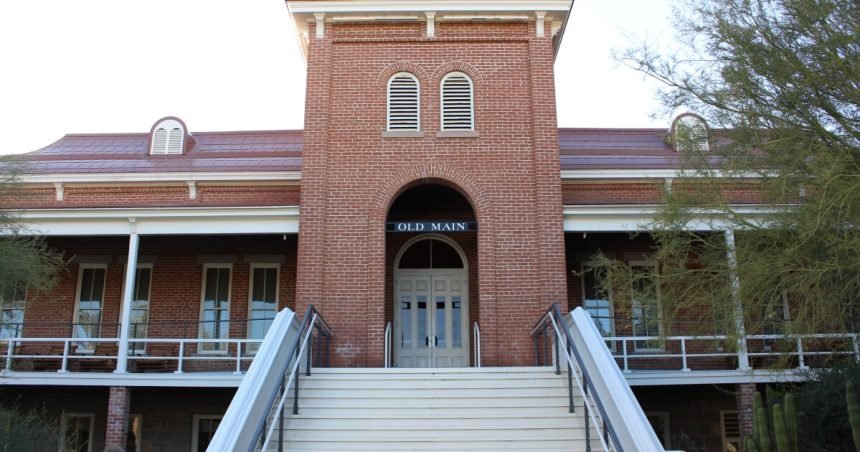
Marla Franco helped establish one of the first HSIs back in 2018, when she helped University of Arizona become the first four-year public university to get the designation.
Today, she serves as special advisor for Hispanic Serving Institution Initiatives at UA. She came into KJZZ’s studios to talk about what these cuts have meant for Arizona HSIs — and why she thinks it was important to become an HSI to begin with.
Full conversation
MARLA FRANCO: We have nearly 50% of the K-12 population in our state are Hispanic-Latinx. And when you think about, too, who is enrolled at community colleges, that percentage often exceeds 50% at most community colleges.
LAUREN GILGER: But it wasn’t true necessarily and probably isn’t still true at those four-year universities?
FRANCO: No, not at that level. So there’s still work to do, especially when you look at representation within K-12, at community colleges up and down the state. And wanting to see some parity, certainly in our enrollment of Hispanic-Latinx students at our four-year public universities in Arizona.
GILGER: Now in September, though, of last year, the Department of Education, under the Trump administration, announced it would end grant funding for minority-serving institutions like HSIs. And the administration, in its statement about this, said that it was doing this because they are racially discriminatory programs. That’s what they were called. The administration argued that the racial quotas in these HSI programs are unconstitutional. What’s your response to that?
FRANCO: Yeah, so that was definitely, I think, another marker in history for Hispanic-Serving Institutions. They were targeting Title III and Title V programs that are awarded out of the U.S. Department of Education. Now mind you, there is not one single penny that goes to any Hispanic-Serving Institutions just by way of the federal designation.
There often have been historically a variety of pots of funding at the federal level earmarked for minority-serving institutions to competitively vie for. So at the University of Arizona in particular, that immediate directive of termination, early termination of those grants, resulted in a loss of about $3 million pretty instantly.
But most notably, besides the funding, these grants as well do not have any criteria or specification on squarely serving the Hispanic-Latinx student population. So there’s no criteria that prohibited services from being accessed by any particular student. Those services were often available to all.
GILGER: So it sounds like you do not think that this is inherently racially discriminatory. You think that by creating this kind of parity in the university system, you’re benefiting the whole?
Amber Victoria Singer
/
KJZZ
FRANCO: Absolutely. I mean, we had empirical evidence. We had data that demonstrated that those programs and initiatives and efforts were already moving the needle around outcomes that we want to see increase for all students at the University of Arizona. So these were things that were demonstrating positive impact on student retention already.
And so even though we had this drastic cut, we really mobilized, though. Of course it was certainly a blow to direct student support that had been historically available. It also meant employment opportunities. I mean, these programs employed a variety of staff, included faculty as well as part of the initiatives. We really wanted to think critically about how we did not have our students experience abrupt disruption to the holistic support that they were experiencing.
And so I’m super excited that at the very least, we were able to work with our provost, who is really just exceptionally committed to success for all students. And so she was able to establish a pot of bridge funding in the tune of about $200,000 that these early terminated grant projects could apply for. So these were initiatives and programs that were maybe in year two or year three that had that track record and could say, “Look, here’s what’s at risk to students if we disrupt this particular initiative effort or student service.”
GILGER: OK. So it sounds like you were able to patch some of those programs together, at least for now. Did people lose their jobs?
FRANCO: Well, yes, and that was one of the really difficult set of circumstances kind of attached to some of these notifications is we had to figure out what the institution perhaps could consider absorbing and taking on on its own to commit to financially what we could patch up through the bridge funding, right? And then what types of expenses just simply far exceeded our ability to hold some of those things in place.
And so it did. And so not only was this an experience at the University of Arizona, but statewide with there being 21 Hispanic serving institutions, we actually worked with the governor’s office because she wanted to know what the statewide impact was. And so they were able to do some quick surveying across the institutions, and the total loss was about $18 million.
GILGER: $18 million, wow. So the Department of Ed, when they announced these cuts, also said they would work to “re-envision these programs to support institutions that serve under-prepared or under-resourced students without relying on race quotas.” Have you heard of any movement in that direction coming from the federal government?
FRANCO: There have been little to really no conversation really about what that is going to look like. But in the meantime, I think we’re having conversations at our own respective institutions. Also, as one of the founders of the AZHSI Consortium — that’s a community of practice that helps bring together the 21 Hispanic-serving institutions in the state of Arizona — collectively as a community, we’re having conversations.
And so, I think that there is undeniably across our institutions a collective commitment to this work. We have to position ourselves regardless to meet those dynamic, diverse student needs, because we’ve got to be a part of the state’s solution towards meeting workforce needs and to ensure a thriving citizenry across our state.
GILGER: So this all comes in this broader context of the Trump administration going after a lot of higher ed institutions for DEI — diversity, equity, and inclusion — practices, this probably would fall under that umbrella.
And this claim that they’re saying, that these programs are innately racist, essentially, because they favor groups like Hispanic students. I mean, what do you say to that? I mean, you are a first-generation college grad. Would this program or something like it have helped you?
FRANCO: Yeah, absolutely. I am a first-generation college graduate. You know, the in my family to have earned a bachelor’s degree, a master’s degree, and ultimately a Ph.D. And so having even experienced that myself, I can’t help but think about the 17-year-old version of myself who went off to college back in the day and all the things that I didn’t know about navigating college.
There were many opportunities where if someone hadn’t come along my way to point me in the right direction, to help me discover myself, to help push me academically, to provide the supports in place that ensured that I reached degree completion. I mean, with 615 HSIs, they actually represent 20% of all higher education institutions, but they enroll two-thirds of all Hispanic-Latinx students in the entire nation.
So if we’re not thinking and working intentionally with HSIs to be part of the driver towards, you know, kind of solution finding as we think about what our nation needs and what the state is needing, then we’ve potentially missed the mark.
KJZZ’s The Show transcripts are created on deadline. This text is edited for length and clarity, and may not be in its final form. The authoritative record of KJZZ’s programming is the audio record.