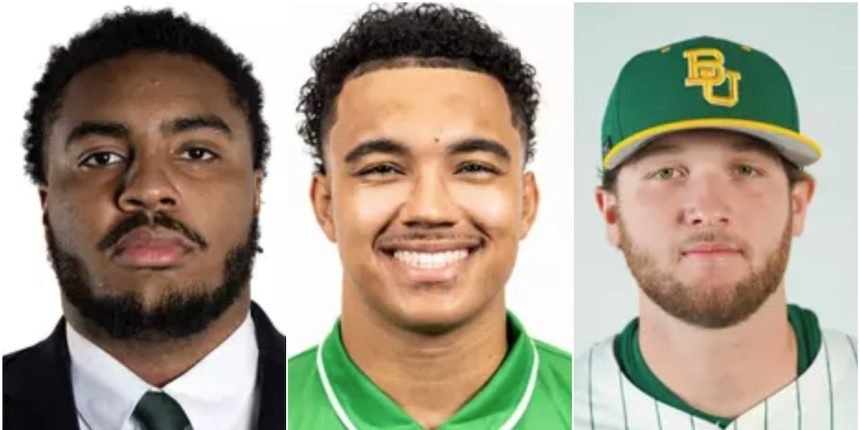
WACO, Texas (KWTX) – Two Baylor University athletes and a University of North Texas linebacker are suing the NCAA in McLennan County after the three were ruled ineligible to play in the upcoming seasons.
Hosea Wheeler, a defensive lineman who transferred to Baylor after playing on Indiana’s national championship team last year, and Kenton Allen, a linebacker at North Texas who transferred from Angelo State, are asking Judge Ryan Luna to issue an injunction against the NCAA to block its ruling that they have exhausted their college playing eligibility.
In a separate lawsuit, also filed Wednesday, Baylor baseball player Ethan Calder is seeking to extend his playing career after spending the last four season pitching 200 innings for Baylor as a reliever, closer and starter.
Luna has set an Aug. 11 hearing in 414th State District Court in the Wheeler and Allen case, while 474 State District Judge Alan Bennett likely will set a hearing for Calder in the second week of August.
The pair’s attorneys, Ryan Downton and Daniel Hare, cite the case of former Vanderbilt quarterback and Heisman Trophy finalist Diego Pavia, who like Wheeler and Allen, played at a junior college before transferring to a Division 1 program.
In the Pavia case, a federal judge in Tennessee ruled the NCAA violated the Sherman Antitrust Act in his treatment of former junior college players. The federal law prohibits monopolies, restrains anticompetitive business practices and promotes a free market, according to the lawsuit.
The court in Tennessee found “a likelihood that the challenged restraints have a substantial anticompetitive effect in the labor market for college football.” The court granted Pavia an injunction and said he had a “strong likelihood of success on his Sherman Act claim,” the lawsuit says.
The court also ruled that “even if the NCAA’s justifications were valid and not pretextual, these goals can be accomplished through a less restrictive alternative,” including starting a player’s eligibility clock when he enrolls in an NCAA institution, not a junior college.
Following the court’s ruling, the NCAA Board of Governors in 2024 issued a blanket waiver providing an additional year of eligibility to athletes identically situated to Pavia, according to the lawsuit.
“Unfortunately, the NCAA did not voluntarily extend the waiver throughout the pendency of the Pavia lawsuit and did not provide an additional year of eligibility to all former junior college athletes still competing in college, but only those whose eligibility would have otherwise expired after the 2024-2025 season.
“In other words, while the NCAA granted some former junior college football players another year of eligibility, it unfairly excluded other former junior college players like Wheeler from receiving the same benefit – even though Wheeler experienced the same likely antitrust violation as Pavia,” the suit claims.
Wheeler, 23, played at his hometown Sacramento City College in 2021-2022 before enrolling at Western Kentucky University in 2022. Wheeler played sparingly that season and went on to play there the next two seasons. He helped lead Indiana to a national championship last season before transferring to Baylor.
Allen, 23, of Riverside, Calif., played at Riverside City College before transferring to Angelo State in 2023. He played two seasons there before transferring to North Texas.
Calder, the Baylor pitcher, is represented in his lawsuit by Fort Worth attorney Brian Brisco.
“Baylor has a roster spot open for Ethan, a name, image and likeness (NIL) opportunity available to him for his fifth season, and wants him on the pitching mound for the 2026-2027 season,” according to his lawsuit. “The only thing standing between Ethan and his final season at Baylor is the NCAA.”
The lawsuit says the NCAA scrapped the framework that for decades limited student-athletes to four season of competition in a five-year window in June 2026. In its place, the NCAA adopted an “age-based eligibility model,” the suit says.
“Starting with the 2026-2027 academic year, every student-athlete may compete in five seasons over five years, with the eligibility clock starting upon initial fulltime enrollment or at the beginning of the academic year following the athlete’s 19th birthday, which ever occurs first,” the lawsuit states.
Calder first enrolled in college in August 2022.
“His five-year clock, therefore, runs through the 2026-2027 academic year, and he has completed only four seasons,” the lawsuit says. “Measured by the NCAA’s own rule, Ethan has a season left.”
However, the NCAA adopted a condition that says players who already have completed a fourth season before the new model takes effect, “get nothing,” according to the lawsuit.
Copyright 2026 KWTX. All rights reserved.