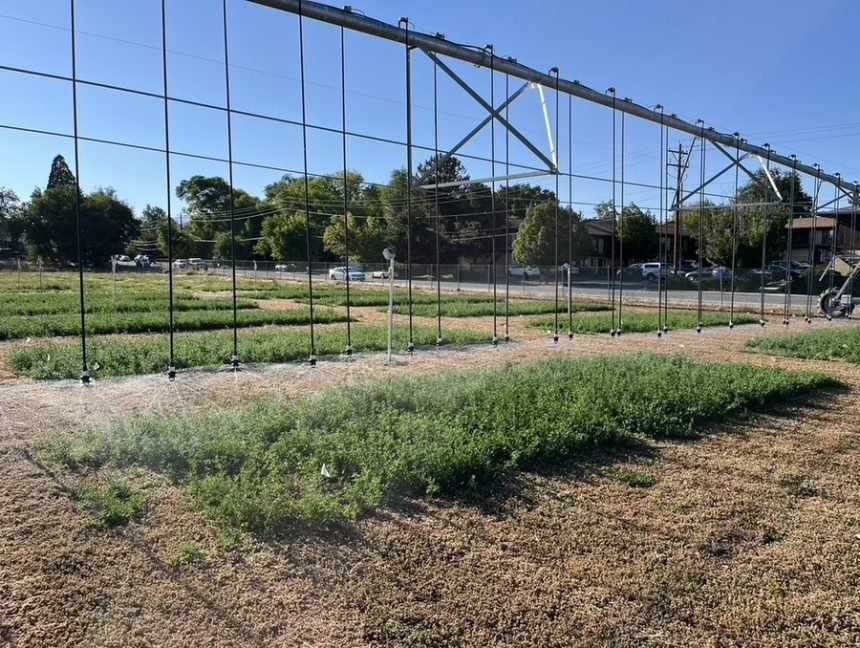
As the world is faced with the challenge of feeding more people with less resources and more difficult climatic conditions, the agriculture industry is increasingly looking to innovation and technology to help meet the challenge. The University of Nevada, Reno conducts a variety of research projects aimed at finding solutions to farming and ranching in arid climates. Now, the University’s College of Agriculture, Biotechnology & Natural Resources is partnering with private industry and other educational institutions globally to support the “START AgriTech Scale-Up” program, and will host its culminating “Expo and Pitch” event this year on May 14 at the University’s Extension office in Las Vegas.
The program is run by Frontier RNG, a global innovation center for desert agriculture and climate solutions, leveraging 250 acres of applied research and global resources to support climate-focused agricultural ventures. Frontier RNG has now launched its fourth cohort, led by Arieli Innovate, the innovation arm of Arieli Group, which is a global investment firm. Ventures are selected through an online application process. Selected ventures will be joining a packed week of curated business meetings culminating in an Expo and business meetings attracting global participation on May 13-14.
Selected startups work across a variety of solutions, many of which the University’s researchers are also working on, including those involving desert crops, regenerative soils, agrivoltaics, precision agriculture and AI, water and irrigation, sustainable inputs, postharvest solutions, and genetics and climate control. The AgriTech Scale-Up program will provide participating companies with one-on-one business meetings and VIP events that connect them with targeted international investors and global corporations as potential partners, investors and clients.
“Our College is extremely pleased to support the AgriTech Scale-Up program,” said Bill Payne, dean of the University’s College of Agriculture, Biotechnology & Natural Resources. “Collaboration among higher education and our researchers, industry and government is essential if we are to meet the global challenges we face to produce food in various parts of the world in increasingly challenging conditions. Clearly, we must tap into new technologies as they become available to help promote sustainable agricultural operations.”
The program is powered by Arieli Innovate, the innovation arm of Arieli Group. It is in collaboration with World Trade Center Utah; Utah Tech University; Haifa Group; and the Ramat HaNegev Regional Council and Ramat HaNegev R&D Center; together with the College of Agriculture, Biotechnology & Natural Resources at the University of Nevada, Reno; with support from leading financial, academic and public-sector partners including JPMorgan, the Nevada Governor’s Office of Economic Development’s (GOED), LVGEA, UNLV, Nucleus Fund, the St. George Area Chamber of Commerce, the NSF Futures Engine in the Southwest, KittyHawk, HESY Aquaculture B.V. and Zero Labs.
Partnering with the program aligns with the vision of GOED, according to Karsten Heise, GOED’s Senior Director of Strategic Programs and Innovation.
“This new fourth cohort will continue strengthening our Nevada entrepreneurial ecosystems while providing new solutions for the agricultural technology industry. START AgriTech Cohort 4 highlights our state clearly as a destination for local, national and international entrepreneurs to build their tech-companies here in Nevada.”
After three successful cohorts, Frontier has supported 24 companies that have collectively raised approximately $11 million. Two graduates, Solarwine and Bioleaf, have joined Frontier RNG as portfolio companies through its value creation model. Among the program’s graduates, Agrilight, a patented agrivoltaics solution designed to improve orchard and vineyard yields, initiated a pilot with a Washington State apple grower. Arugga deployed its farm robots for pollination, tomato trellising, and crop management in the “Greenhouse of the Future” project in Ramat HaNegev, enabling farmers to significantly reduce labor requirements.
The fourth cohort brings together a growing group of AgriTech ventures developing solutions designed for arid and climate-stressed regions. AgriPass is developing an AI-driven robotic solution for sustainable weed control, designed to help farmers reduce labor costs while protecting soil health and boosting sustainability. Clean Soil focuses on soil disinfection using Pulsed Electric Field (PEF) technology, enabling growers to eliminate soil-borne pathogens without chemicals and plant immediately after treatment. Proscout is building AI-powered smart spraying analytics for greenhouse and indoor farms, bringing measurable impact to spray coverage optimization through real-time sensors and computer vision that reduce waste and improve yield.
The fourth cohort’s return to Nevada comes as agritech commercialization priorities sharpen globally. With agriculture consuming 70% of global freshwater withdrawals and climate volatility accelerating adoption of precision technologies, START AgriTech is positioned to help founders close the execution gap between technical validation and commercial deployment through structured market access and partner-led engagement.
“Across three cohorts, we have supported early stage companies as they transition from pilots to real commercial footholds across the U.S. Southwest, reflecting the strength of a deliberately built consortium that brings together academia, government and industry to align research, capital and market demand in a way that creates durable economic value,” said Haviv, partner at Arieli Group and Head of Arieli Innovate. “At Arieli Group, we focus on building pathways where innovation is shaped by future demand, from precision agriculture projected to reach $24.09 billion by 2030 to smart irrigation expected to grow to $2.65 billion, forming a foundation for sustained commercial collaboration and long-term impact.”
“In 2026, agritech is becoming far more selective. Companies that can demonstrate revenue, capital efficiency, and demand-led growth are the ones attracting real interest, as the market converges around more profitable models and consolidation accelerates,” said Yariv Erez, CEO of Frontier RNG. “Our continued presence in the U.S. strengthens our ability to connect founders with the partners and field-relevant stakeholders to progress deployment, especially in desert and climate-stressed regions where the need for reliable, cost-effective solutions is immediate.”
Frontier RNG invites the agritech and climate-tech community, as well as the broader high-tech ecosystem, to attend the final Expo and Pitch event at the University of Nevada, Reno Extension office in Las Vegas on May 14.