Sunday, July 26, 2026 | 2 a.m.
Editor’s note: Este artículo está traducido al español.
Plans for a new home for UNLV’s Lee Business School are moving into high gear as university leaders press forward with design drafts and a major fundraising drive for an ultramodern, approximately $180 million facility.
Following green-light approval from the Nevada System of Higher Education Board of Regents, UNLV is working to match state backing for the four-story building on its main campus off Maryland Parkway. The state and university have committed roughly $75 million to the project, with the university setting out to raise at least $60 million in private funds by summer 2027.
Interim Dean Anjala Krishen and her team have launched the “Building Business Together” campaign to secure naming rights for departments, classrooms, tech labs and study spaces.
The effort has already secured $8.4 million in pledges and gift agreements, including a major donation from the family of developer Irwin Molasky, which led to the renaming of the Molasky Family Department of Economics and Real Estate.
“We are financially strong, we are prepared to move forward, (and) we will not let the money allocated by the Legislature go unused,” UNLV interim President Chris Heavey said. “That building will absolutely get built, and we could not be more excited by it.”
If fundraising targets are met, UNLV expects to break ground in late 2027 or early 2028, with a projected opening in 2030.
Outgrowing Beam Hall
The push comes as the Lee Business School bursts at the seams of its longtime home, Frank and Estella Beam Hall. More than 4,700 undergraduate and graduate students are enrolled in the business school, making it one of UNLV’s largest and fastest-growing academic units.
University officials can’t predict exactly how many students they’ll have in the next few years, but they’re preparing to serve around 5,000 business majors by 2030 — with no plans of curbing that growth.
The five-story Beam Hall was built in 1983 and lacked many modern features that other buildings on campus — like the William F. Harrah College of Hospitality just north — have.
Krishen said the business school has grown so large partially because of expanded course offerings, adding new traditional degree programs and integrating new ones that utilize online learning to fit more nontraditional students that may only be able to take courses online or at night.
And the school is still creating more.
In September, the Board of Regents will decide whether the business school can launch its first doctorate program in business, focused on marketing, finance and information systems, Krishen said. If it wins approval, the program will launch in fall 2027.
Creating a new building for the Lee Business School has been discussed for more than a decade, starting with a campaign led by former Dean Brent Hathaway, who oversaw the business school from October 2013 through January 2020, and continuing with Krishen’s immediate predecessor, former Dean Gerry Sanders, who announced a vision for a new building in 2023.
A greater push to turn those conversations into action came after Dec. 6, 2023, when a lone gunman walked onto campus and into Beam Hall, where he shot four professors, killing three.
After the shooting, Beam Hall was shuttered for about eight months. Offices and classes were moved to other buildings until Aug. 26, 2024, when Beam Hall was reopened with $2.5 million in security upgrades including additional security cameras, a security stand in the building’s atrium with an officer present and limited access to floors where professor offices are.
The Legislature approved funding allocations for campus safety improvements at UNLV and other institutions within the higher education system.
Still, enhancing security measures in the aging building could only go so far, and the allocations couldn’t solve the issue of business classes outgrowing the older classrooms.
A building designed around community
Unlike Beam Hall, which has few open meeting areas and separated offices for professors, the new business building is being designed with community in mind, Krishen said.
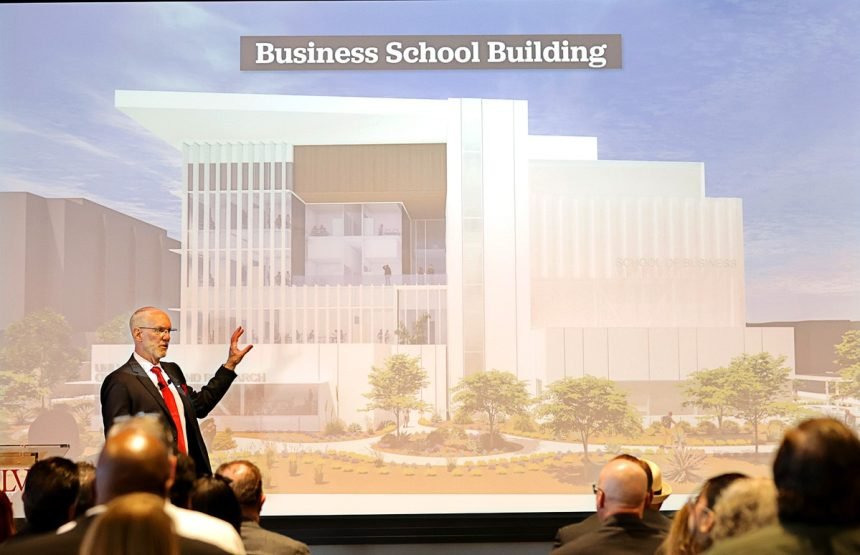
Several outdoor decks, where students and faculty will have ample seating and tables for group study sessions and meetings, are included in the design drafts. The building entrance will lead onto Maryland Parkway, with additional walkways on the side connecting students to other popular spots like the Student Union.
Krishen said one of the features she’s most looking forward to is the building’s “huddle spaces,” or “nooks and crannies,” where students can host smaller study sessions. Those spaces will be outfitted with advanced technology, such as smart whiteboards and digital screens.
The building will also have several medium and large classrooms, a spacious atrium area for events, several laboratories filled with modern technology and professor offices grouped together by their department to facilitate more opportunities for collaborations on everything from research to class assignments.
There will even be a cafe inside so students and faculty don’t have to walk to Starbucks in the Student Union for a cup of coffee, Krishen added.
All these spaces will have a common theme: an emphasis on networking and creating community.
“We’ve taken a big hit over the past five-six years between COVID and December 6, and so we need a feeling of belonging, inclusion and a warm, safe feeling,” Krishen said. “I think I’m just excited about having the ability to go into a new space and have all of these full technology pieces, but then also have this sort of community feel just from the way it’s laid out. I want this to uplift us.”
Since her appointment last year, it’s been Krishen’s goal to raise enough money for the business school to get its own new building, and she can’t wait for opening day.
Krishen has been at UNLV for almost 20 years, serving in a number of roles and working her way up to interim dean. The day she started in her current post, Heavey told her the university needed to raise $60 million for the building’s construction.
“I don’t see us stopping with growth,” Krishen said. “We’re going to build a building … which is huge, coming from where we are, what we need and what we’ve gone through over the past six years. We should have had this building a long time ago, so I’m excited that I could do this.”