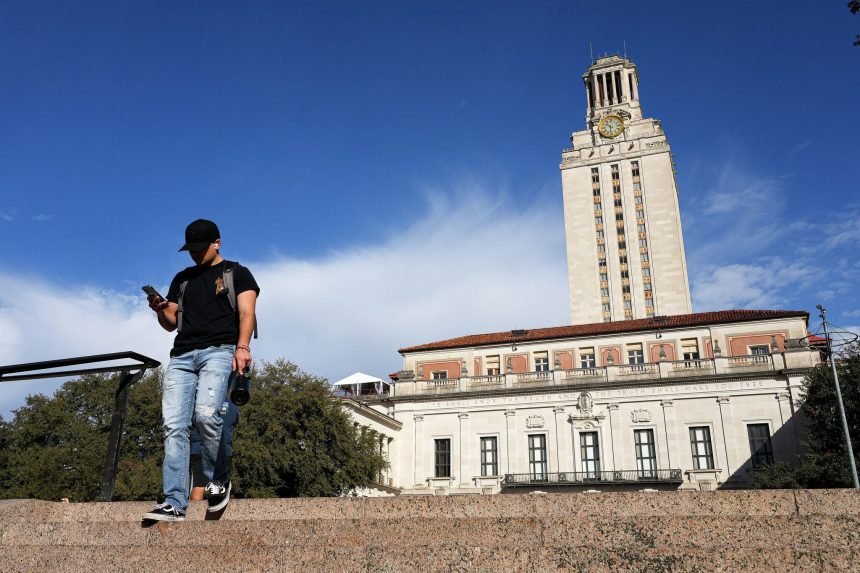
A student walks through the University of Texas campus in 2023. A recent announcement to effectively end Mexican American Studies and related fields of study at UT came without meaningful discussion with those most affected, Alicia Perez-Hodge writes.
In South Texas public schools, I learned about Robert E. Lee and George Washington and the histories of the United States and Texas. Yet not a single lesson addressed Mexican American history — our Indigenous and African roots or the men and women who shaped this country. It was as if only Anglos made history.

It was only when I took an ethnic studies course in college that I discovered Mexican Americans have a history — one deeply intertwined with that of other communities. Later, when a career move took me to New England, that education proved invaluable. That knowledge shaped my professional life and prepared me to work with diverse communities.
Article continues below this ad
I share this experience because the University of Texas now risks denying today’s students the same opportunity. UT President Jim Davis recently announced a proposal that will effectively end Mexican American Studies and related fields of study at the university. The proposal consolidates the Department of Mexican American and Latina/o Studies (MALS), the Department of African and African Diaspora Studies, the Department of American Studies, and the Department of Women’s, Gender, and Sexuality Studies into a single department called the Department of Social and Cultural Analysis.
In practical terms, the restructuring will result in funding cuts for staffing and research as well as the elimination of programs, threatening decades of academic achievement that made UT a leading center for the study of Mexican Americans and Latino communities. Davis has framed the restructuring as necessary to maintain public trust and fulfill the university’s mission.
For Latino and African American communities, the consolidation has the opposite effect. It neither builds trust nor fulfills the university’s responsibility to serve a state where communities of color are the majority. Among those most affected are MALS and its affiliates, including the Latino Research Institute (LRI) and the Center for Mexican American Studies (CMAS).
Article continues below this ad
CMAS, established more than 50 years ago in response to student and community advocacy, plays a crucial role in advancing research and public understanding of Mexican American and Latino histories, cultures and contributions. MALS, founded 15 years ago, has a national reputation as a high-caliber academic department that brings distinction to the university. These programs are not redundant or fragmented. They are the result of decades of scholarship, community engagement and institutional development.
Equally troubling is the lack of meaningful consultation with those most affected by this proposal. Davis has disregarded public input from major stakeholder communities. Two months ago, the Latino Coalition for Excellence in Higher Education — a consortium that includes the League of United Latin American Citizens (LULAC), Hispanic Advocates and Business Leaders of Austin (HABLA), the Latino Texas Policy Center and the Texas Association of Mexican American Chambers of Commerce — formally requested dialogue.
Both groups expressed a willingness to collaborate with university leadership to ensure the continued vitality of Latino Studies. To date, these communications have been ignored, signaling a troubling lack of engagement with communities that have long supported and invested in UT.
This consolidation appears politically motivated, aligning with state and national efforts to restrict diversity, equity and inclusion. Gov. Greg Abbott, Lt. Gov. Dan Patrick and President Donald Trump have all advocated eliminating what they label “divisive” academic programs. These efforts disproportionately target the study of Mexican Americans, Latinos and other minority communities.
Article continues below this ad
SIGN UP FOR THE AUSTIN ANGLE and get Statesman commentaries in your inbox
Consolidating or diluting departments centered on communities of color — while leaving other academic fields intact — sends a message about whose histories are valued.

Davis’ announcement raises serious questions about process, transparency and accountability. Who conducted the review cited in his memo? What evidence supports claims of “fragmentation” and “inconsistency”? Why have affected faculty, students, alumni and community organizations been excluded from meaningful participation?
Article continues below this ad
The proposed consolidation threatens not only specific departments, but the university’s commitment to academic excellence and public service. Community organizations, alumni and advocates urge university leadership to halt the consolidation, engage with stakeholders and uphold the integrity of programs that reflect and serve the people of Texas. Only through open dialogue and accountability can the university maintain public trust and fulfill its mission to all Texans.
Alicia Perez-Hodge is a long time community advocate, co-founder of HABLA and district VII director of LULAC in Austin.