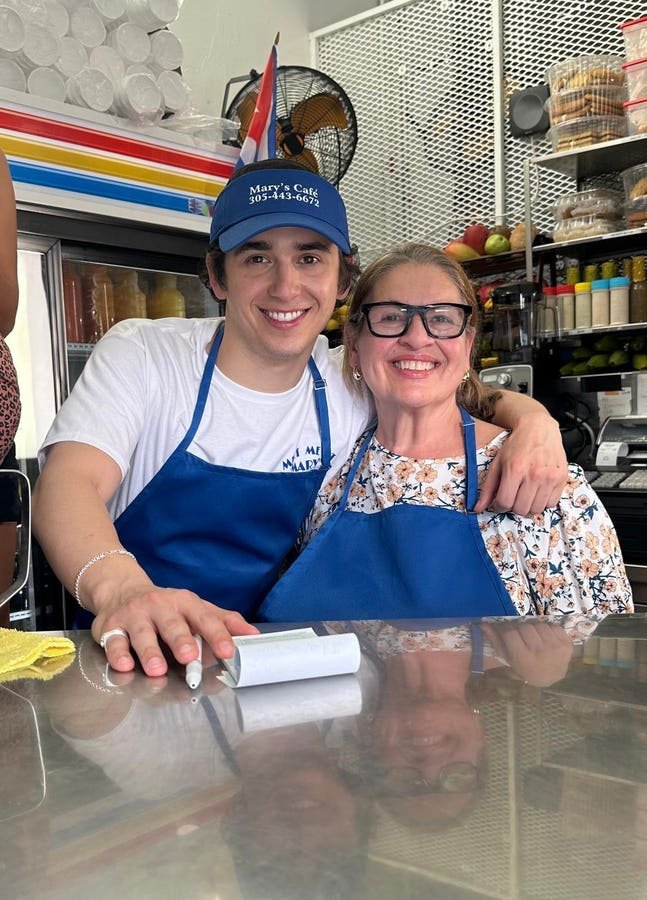
Marcello Hernández with María Caridad Sánchez at Mary’s Café & Coin Laundry in Miami.
Photo courtesy of business owner. Used with permission.
Anyone can access the more than twenty high-capacity washers and dryers at Mary’s Cafe & Coin Laundry on Miami’s key driveway, 27th Avenue, connecting MIA with the once mostly Bahamian neighborhood, now Coconut Grove.
One way to go in is through the back; if parked in their parking lot, one can conveniently move their pounds of dirty clothes onto the wheeled metal baskets and into the building.
The other two entrances, which are sidewalk entrances, provide the interior where the washers and dryers are with an incredibly comfortable breeze in Miami’s average 30-degree weather and often times high dew point.
The building’s openings have changed over time as new washing machines and dryers were added to the laundromat, and also to improve another very important access point to the locale: the cafeteria. At Mary’s, people can order their coladas and cafés con leche through their ventanita (from the sidewalk), from where Marcello Hernández served customers during Miami’s World Cup games, or from the inside counter, which is easily accessible for clients while they wait for their laundry.
How This One Ventanita Came About
Since 1988, it has served as a gathering place and helped build community, becoming exactly the kind of fixed point that a booming city in the 2020s could struggle to keep.
The Morales family, owners of this establishment of about 2000 square feet, did not come to Miami to sell coffee.
Eumelia Morales Fernández arrived from Santa Clara, located 282 km from Havana, in the heart of the island of Cuba, around 1970. A decade had passed since the Cuban Revolution; this was a time when, as a Cuban national, even crossing the U.S. border through the backyard of a smuggler’s house would automatically make one eligible for residency.
Eumelia Morales during an interview at Mary’s Café & Coin Laundry in Miami
Photo by the author. Used with permission of Vicky Sanchez, business owner.
Like a great many immigrant women of her generation, she began working at a sewing factory, making children’s dresses, before taking a job in a shoe factory. Her husband started to make shoes as soon as he crossed the border.
The pattern is bigger than one family. Roughly one in five Floridians is foreign-born, and immigrants make up close to half the workforce in the industries the state runs on. And many of them become entrepreneurs.
The Morales story began as a small grocery, then a supermarket with a butcher counter, and a cafeteria. They knew there was a market. In the 1980s Miami’s population of Cuban ancestry was more than twice as large as any other foreign-born group and at least three times larger than the populations arriving from individual Spanish-speaking Latin American countries.
When the family finally bought the lot where Mary’s stands, which they say was as a wooden house that had been a plant nursery, they did not only open to serve café cubano. They opened seven businesses at once, says Eumelia’s son, Claudio Morales, “ it was a pizzeria, an ice-cream counter, a cafeteria, a lottery window, laundry by the pound, a dry cleaner, and a Chinese takeout run by other Cuban emigres.”
From Neighborhood Everything Corner To Mary’s Cafe & Coin Laundry
Vicky Sanchez, Eumelia’s granddaughter and the business’ manager today, tells me about her mother, María Caridad Sánchez, who came into the business in the late 1990s and rebuilt it into what it is now, a small kitchen space with a coffee maker, laundry detergent, and tobacco, and it has barely changed ever since.
María Caridad Sánchez around the time she began working full-time at Mary’s Café and Coin Laundry.
Photo courtesy of her daughter Vicky Sanchez. Used with permission.
What brings it all together has also changed little.
Vicky describes the kitchen as a place so small and filled with so many things, yet everything is where it is for a reason. The ham they use in their famous sandwiches has always come from a local factory called El Tigre, themselves in business since the 1970s. The cigars, also sourced by one only vendor for over 30 years. The washing machines are Speed Queens, from a vendor the family has used since the beginning.
The coffee has come from Café Bustelo since Mary’s opened, a relationship now handed down through three generations on both sides. “We’re practically family,” Claudio says. “When the espresso machine died last year (2020s), the Bustelo rep refused to let them settle for a substitute and had the exact model shipped in from Chicago, because the coffee could not be allowed to taste different.”
The latest in management, Vicky mentions, is that she has moved ordering onto spreadsheets, put card readers in the windows so customers can tap to pay, and she is weighing whether Uber Eats’ thirty-percent cut is worth the reach.
Mary’s Will Stay As Is
Vicky and Claudio get offers to make Mary’s a franchise or even to sell it; they have certainly got where the business needs to be, but neither of them are willing to change much of it.
Mary’s may now become a landmark international destination, but nobody in the neighborhood is discovering it. It is cultural infrastructure what they have built as well, “when you’re here so much, this is also your social life, your circle,” Vicky says. And they own the building, which means they are protected from rapidly rising rents. “That’s a salvation,” Claudio emphasized. The laundromat was considered essential business during COVID, and it never shut down: “I didn’t close. I kept washing clothes,” Claudio said.
Mary’s Café and Coin Laundry most recent exterior appearance. The building has been painted several different color combinations throughout its history.
Photo courtesy of Vicky Sánchez, business owner. Used with permission.
The same shielding has allowed the business to survive Walmart, inflation, and tariffs. In this regard Claudio reflects that this was his father’s legacy. When he opened the supermarket between a Publix and a Winn-Dixie, everyone told him he was crazy. Claudio remembers his father saying: “that won’t affect me because I am open from 6 am to 10 pm.” Later, the laundromat and cafeteria began operating 24 hours, and the continued to do so today.
Mary’s Cafe & Coin Laundry turns forty in 2028, certainly an accomplishment worthy of another World Cup campaign, while also rightfully celebrating a space that tells so much about how business evolves through resilience and community.