



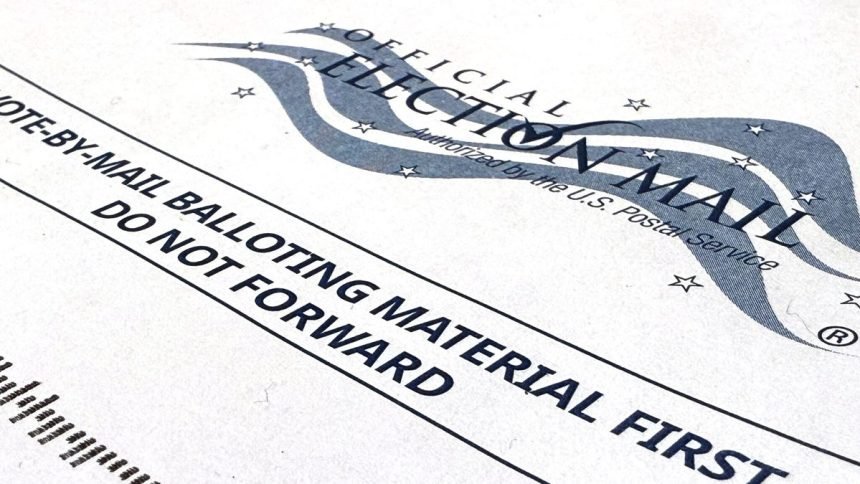
Florida voters are already seeing those big, familiar envelopes in their mailboxes, letting them know the primary election is getting closer. Voters will be choosing their candidates for governor, a U.S. senator, some U.S. representatives, the state’s chief financial officer and commissioner of agriculture, some circuit court judges, and various local races.
If you plan to vote by mail and haven’t requested your ballot yet, you’re running out of time. And the U.S. Post Office clarified this year that just getting your request in the mail by the Aug. 6 deadline might not be fast enough. Thousands have already been sent out around the state.
Requests for vote-by-mail ballots, formerly called absentee ballots, must be made through your local Supervisor of Elections. You can print out a request and mail it in (get it manually postmarked at the post office), hand it in at the local elections office, or do it online.
Shop Election 2026 merch at Amazon

Florida Gov. DeSantis signs SAVE Act to bolster election integrity
Florida Gov. Ron DeSantis holds press conference to announce signing the SAVE Act to bolster election integrity across the state
Florida Governor’s Office
Here’s what to know about voting by mail in Florida, and what’s changing.
When is the 2026 primary election in Florida?
The primary election day is Tuesday, Aug. 18.
When is the deadline to register to vote in Florida’s primary?
The deadline to register to vote or change your party affiliation is Monday, July 20.
Note that with recent clarifications to U.S. Post Office policy, your mail may not be postmarked the same day you drop it in the box. To ensure you don’t miss any election deadlines because your envelope wasn’t processed right away, send in your requests and your ballots as early as possible or ask for a manual postmark when you drop them off at your local post office.
When is the deadline to request a mail-in ballot for Florida’s primary?
The deadline to request a mail-in ballot is Thursday, Aug. 6.
Did President Trump change vote-by-mail rules? Will my ballot be delivered?

Supreme Court allows late-arriving mail-in ballots
The Supreme Court is upholding Mississippi’s rule to count mail-in ballots received within five days after Election Day, halting Trump’s attack on voting by mail.
President Donald Trump has attempted to exert more federal control over state elections, but many of his efforts have been blocked in the courts.
In March, Trump issued an executive order requiring states to submit voting records to be compared against federal data. The results would be compiled into a list of confirmed U.S. citizens eligible to vote in each state, with severe penalties for anyone ineligible who tries to vote, and any officials or volunteers who help them.
The order also directed the U.S. Post Office not to deliver ballots to anyone on each state’s newly approved mail-in ballot list. Critics said the database was severely flawed and could prevent eligible Americans from voting.
A federal judge in Boston on June 25 blocked the order. A few days later, the U.S. Supreme Court dealt the president another blow by confirming that states could count late-arriving mail-in ballots, a process Trump has tried to stop.
When does early voting begin for the Florida 2026 primary election?
The mandatory early voting days will begin on Aug. 10. Some counties may allow voting to start earlier.
Voters may drop off vote-by-mail ballots at any early voting location during early voting hours and at any Supervisor of Elections office during business hours.
When is the 2026 general election in Florida?
The general election will be on Tuesday, Nov. 3. The mandatory early voting period runs from Oct. 24 – 31.
The deadline to register to vote for that election, if you haven’t registered yet, is Monday, Oct. 5.
The deadline to request a mail-in ballot is Thursday, Oct. 22.
Can Ron DeSantis run for governor again in 2026?
No.
DeSantis was first elected in 2018 and began his term in office on Jan. 8, 2019. He was re-elected by a landslide in 2022.
However, Florida law restricts governors to two consecutive terms, so DeSantis is ineligible to run again in this year’s gubernatorial election. He will leave office in Jan. 2027.
C. A. Bridges is a journalist for the USA TODAY Network-Florida’s service journalism Connect team. You can get all of Florida’s best content directly in your inbox each weekday by signing up for the free newsletter, Florida TODAY.