The Brewers don’t have an infield problem in the way most teams do. There are bodies. There’s versatility. There are multiple paths to a functional 26-man roster without needing a single external move.
But heading into 2026, Milwaukee’s infield feels like a classic “depth vs. clarity” situation. They’ve got eight infielders on the 40-man right now — Jake Bauers, Tyler Black, Caleb Durbin, Andruw Monasterio, Joey Ortiz, Anthony Seigler, Brice Turang, and Andrew Vaughn — and that’s before you get into any non-roster invites or spring surprises. The issue isn’t whether they can cover innings. It’s whether they can build a lineup that’s stable enough offensively to avoid turning every close game into a coin flip.
Let’s start with the easiest part: Brice Turang is a lineup fixture. The defensive floor is sky-high, the athleticism plays anywhere, and the Brewers have shown they’re comfortable letting the bat be “good enough” as long as everything else stays elite. With Milwaukee’s run prevention model, a glove-first middle infielder isn’t a luxury; it’s a roster requirement.
After that, the dominoes start to wobble.
First base is crowded, but is it decided?
Milwaukee’s current options at first base boil down to some combination of Andrew Vaughn and Jake Bauers, with Tyler Black looming as the upside play if the club decides he’s ready for more than just a cup of coffee.
Vaughn is the name that jumps out because he carries the clearest “this guy is a first baseman” profile of the group. If the Brewers want a steady, traditional first base look with regular at-bats and less lineup gymnastics, Vaughn is the obvious bet. Bauers, on the other hand, is the classic Milwaukee type: roster flexibility, multiple positions, and the ability to patch holes as they pop up over a long season — he played 40 games at first base and 26 in the outfield in 2025.
Black is where it gets interesting. While he’s struggled in the majors to this point (.211/.357/.263 line with 12 hits in 57 at-bats), the new automated ball-strike (ABS) system may benefit nobody more than him. This is a guy whose career OBP over 1,408 minor league at-bats is .399. Black will need to show some offensive prowess in spring training and early in the season if he wants any chance at playing time, as he plays below-average defense. Assuming Bauers and Vaughn both have good springs, Black seems like a trade candidate for a team looking for an infield bat.
The left side of the infield
If you’re looking for a player who could quietly swing the shape of the infield, it’s Joey Ortiz. He’s the guy who can make the whole thing make sense… or make it feel redundant.
Ortiz can credibly handle multiple spots, but his offense left something to be desired in 2025. After he hit .239/.329/.398 with 11 homers, 60 RBIs, and 58 runs in his rookie season, he took a big step back, slashing .230/.276/.317 with seven homers, 45 RBIs, and 62 runs. The only area he really improved was on the basepaths (14-for-17 in steals) and strikeout rate (14.6% in 2025 after a 20.2% rate in 2024).
Status quo says he’ll remain the shortstop heading into 2026, but don’t be surprised if he’s on a short leash, especially with so many other options on the roster.
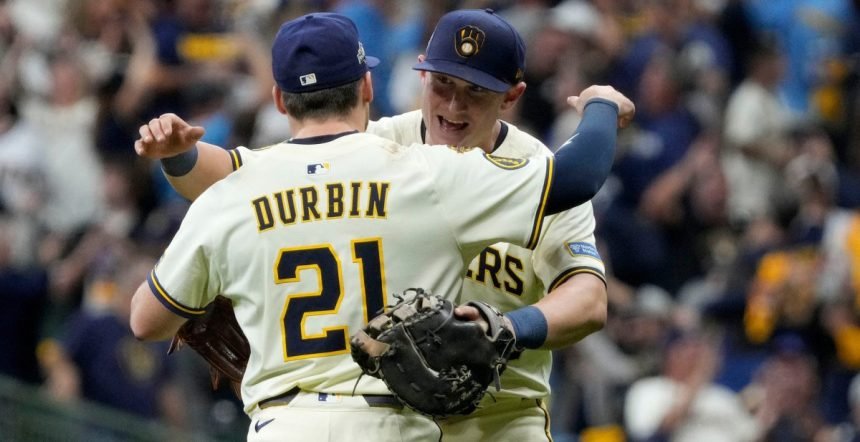
That’s where Caleb Durbin and Andruw Monasterio come in. Both fit the mold of the modern Brewers infielder: versatile, useful, and capable of giving you competent innings at more than one position. Durbin will start the year as the everyday third baseman, but Monasterio will fill in around the diamond as needed. Does Ortiz have a bounce-back season in him?
The quiet wild cards: Seigler and the bench math
Anthony Seigler is on the 40-man roster as yet another versatile player who can play just about anywhere (including catcher). Pat Murphy showed that he was a big fan of Seigler down the stretch, platooning him with Durbin at third base even as he didn’t produce at the plate (.194/.292/.210 line with just 12 hits in 62 at-bats). Even so, don’t be surprised if Seigler starts the season at Triple-A but gets a chance in the majors if Monasterio or Ortiz struggle early in the season.
What this really comes down to
The Brewers can absolutely go into 2026 with this infield group and win the NL Central again. The floor is solid, especially defensively. But if they’re serious about widening the gap and making October less matchup-dependent, they need one of two things to happen:
- A clear everyday infield emerges (with Vaughn/Bauers settled at 1B and Ortiz bouncing back at shortstop), or
- They add one dependable bat who decreases the potential for inconsistency.
Right now, Milwaukee has answers for coverage. What they still need are answers for certainty.