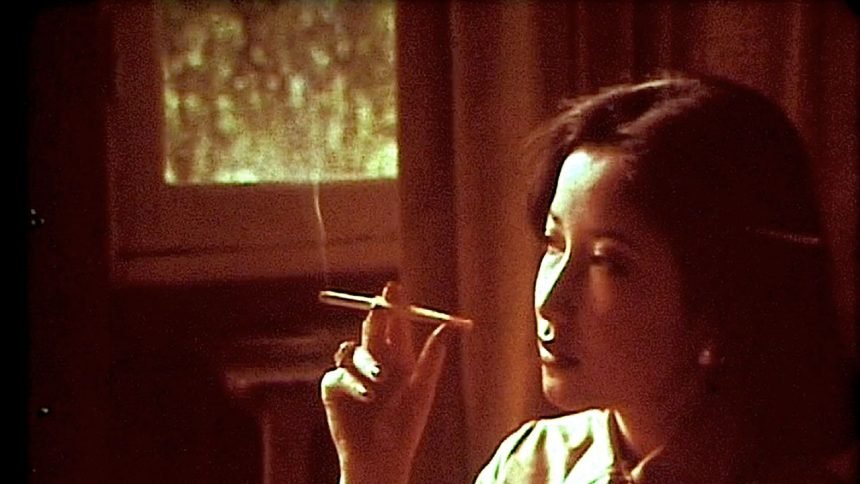
When I’m looking at what’s on offer in the Revivals section of the New York Film Festival—and, for that matter, whenever I see a noteworthy retrospective coming to one of the city’s repertory houses—I think of these screenings not as conserving cinema’s past but, rather, as safeguarding its future. The vital thing about the history of this art form is its creative power, its ability to energize filmmakers of later generations and inspire movies to come. In that regard, one of the major events of this year’s festival is the world première of a restoration of Mary Stephen’s film “Ombres de Soie” (“Shades of Silk”), from 1978.
“Shades of Silk” was Stephen’s first feature, and it remains a tour de force of form, style, and historical imagination. In her mid-twenties when she made the film, Stephen was born in Hong Kong to a Chinese family who immigrated to Montreal in 1967. She made a few short films in Canada and then, in the mid-seventies, got a grant to study film in Paris, where she made “Shades.” The film was shot cheaply—in 16-mm., with a tiny crew and Stephen herself playing one of the main characters. But the result could not be further from the familiar rawness of independent filmmaking. In a spare sixty-two minutes of sinuously elegant images and alluring surfaces, it unfolds a narrative that spans continents and decades.
The story is one of impossible love, centering on two young Chinese women, high-school best friends in Shanghai in the nineteen-twenties whose relationship has an intense erotic current continuing into adulthood. In 1934, Lysanne (played by Alexandria Brouwer) is living in Paris and writes to her friend Marlène (played by Stephen), who’s studying at Wellesley, imploring her to transfer to a university in Paris. There are glimpses of the life they shared, but Lysanne’s pleas are in vain. Desperate for Marlène, she has a nervous breakdown, and goes to stay with her mother, who now lives in the colony of French Indochina. Once there, Lysanne marries a rich young man. Marlène is invited to the wedding, attends, and puts up a good front for as long as she can, until the sociable façade shatters, with tragic consequences.
A crucial aspect of modern cinema is that, pace so-called experimental filmmaking, it doesn’t reject stories but explicitly foregrounds the ways that stories are told—often by way of a daringly oblique or distant connection between a narrative and the images and performances that conjure it. “Shades” opens with an epigram taken from Marguerite Duras’s script for Alain Resnais’s “Hiroshima Mon Amour” (1959), and Duras gradually emerges as a presence looming over Stephen’s film. Although best known as a novelist, Duras achieved prominence as a filmmaker in the nineteen-seventies, and her 1975 film “India Song” was Stephen’s key inspiration for “Shades,” which is in conspicuous dialogue with the earlier film. Common to both are a depiction of romance in colonial settings, ballroom-dance scenes, and a plot set forth largely in voice-over—including, in “Shades,” the letters the women write and an omniscient narrator. But Stephen’s film, while seeming to partake of Duras’s world, also reënvisions that world. Duras was born in French Indochina, near what is now Ho Chi Minh City, in 1914, and spent much of her youth there, not moving to France permanently until 1933, to attend university there. Stephen—unlike Duras, whose family was white and from France—grew up experiencing the tensions of colonialism from the other side, as an ethnically Chinese subject of British rule. In “Shades,” the restlessness, the sense of a home that’s merely conditional, suggests the social and political pressures of living in a land that both is and isn’t one’s own—of living with cultural hierarchies both public and internalized and negotiating relationships (including romantic ones) with the colonizers.
Stephen evokes life among the colonized not only in the film’s story but also in its form. The action is largely desynchronized, the activities onscreen contrasting with the voice-over narrations, with the effect of destabilizing the present tense of the movie, imbuing it with nostalgia and with longing for possible futures. Stephen depicts the women’s schooltime bond in hypnotic flashbacks, and their separation largely through absence itself, with gliding, pensive shots of places—rooms, buildings, streets—where the women have been and may be again but which, onscreen, are vacant. Stephen, despite filming in Paris on a minuscule budget, achieves an uncanny evocation of Asia and of the past. She even bounces the time frame of the story off the time in which she made the film: Lysanne’s wedding banquet, shown in dramatic fragments, is amplified with a series of still photographs of a contemporary banquet that visually echoes the one in the story while also wrenching it out of its fictional framework. There’s something timeless about “Shades”: it’s anchored in the mid-nineteen-thirties, it shows the twenties, it was made in 1978; it harmonizes stylistically with several masterworks of its own time but is so evocative of the past and so aesthetically and thematically advanced that it seems to inhabit a zone outside chronology. It is as if the film is somehow displaced and distant from itself.
It makes sense that Stephen, as a filmmaker of absences, has made a major career as a film editor—notably, on the films of Éric Rohmer, with whom she worked briefly soon after making “Shades,” and then steadily from 1991 until his last film, in 2007. Editors are the cinema’s taker-outers, and they create several kinds of absence: some removals merely eliminate, whereas others generate, organizing what’s there to conjure all the more powerfully what isn’t. With “Shades,” Stephen extends and expands the connection of drama and form in ways that offer exemplary lessons to filmmakers today.