In the high-tech center of the world, technology and capital are moving from merely lobbying Washington to reshaping it, a trend that poses ongoing challenges to the structure of political power in the United States.
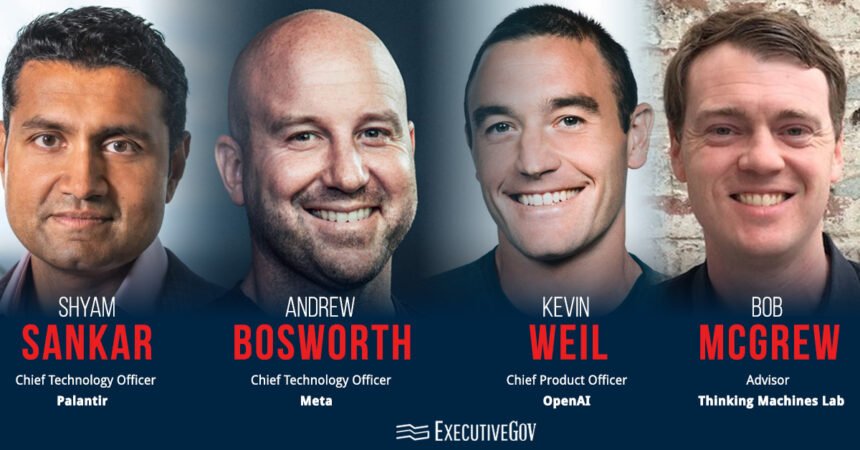
The U.S. Army is establishing Detachment 201: The Army’s Executive Innovation Corps, a new initiative designed to fuse cutting-edge tech expertise with military innovation. On June 13, 2025, the Army officially swear in four Silicon Valley tech leaders.
A notable feature of the 2024 U.S. presidential election was Silicon Valley’s shift to support the Republican Party. Elon Musk and other big names played a major role. And since Donald Trump’s return to the White House, the tech industry has forged close ties with Washington, and reports have even emerged highlighting deepening cooperation between Silicon Valley and the U.S. military.
Many observers believe that the Republicans and Silicon Valley share a growing ideological affinity. The Trump administration has created a more relaxed regulatory environment for tech companies than they had during the Biden era, especially by championing the development and commercialization of artificial intelligence and cryptocurrencies. Trump himself is a heavy user of social media and shows marked enthusiasm for the new currencies. Artificial intelligence, platform technology, blockchain, data analysis, advanced chips and other technologies dominated by Silicon Valley companies are not only central to the future competitiveness of the United States but are also indispensable for the U.S. military, intelligence community and some law enforcement agencies as they seek to strengthen their capabilities.
This centrality is evident in a large number of defense and government procurement contracts and in the rise of many new defense-related startups in Silicon Valley in recent years. High-tech and the military are increasingly integrated, so it is no surprise that many tech leaders, who in the past mostly served as advisers to the government, now attend congressional hearings and try to influence policies through public discourse. For example, Andrew Bosworth, Meta’s former chief technology officer, joined the U.S. Army Reserve as a lieutenant colonel in the newly formed Detachment 201 — the Executive Innovation Corps, a group designed to fuse cutting-edge technical expertise with military operations.
At a deeper level, this wave of technological and industrial capability is rather different from the previous IT revolution and electrification. Technologies such as artificial intelligence have evolved beyond mere tools of efficiency: They are becoming sources of political power. In this sense, the current transformation bears close resemblance to the Industrial Revolution, which profoundly reshaped social and political structures.
The convergence of Silicon Valley and politics, however, will probably not stop. The profound impact of technological innovation on the political ecosystem is just beginning to unfold. As the global leader in both technological innovation and commercialization, the United States could be headed for seismic shifts in its political landscape.
Artificial intelligence, cryptocurrencies and social media platforms are arguably the most representative technologies at present. Behind AI lie computing power, algorithms and data. In a sense, computing power is power. Without it, one cannot gain control. Without algorithms and data, it is difficult to steer. The massive hardware infrastructure and energy consumption of today are visible symbols of power from a more intuitive perspective.
Cryptocurrencies are built on blockchain technology, whose decentralized and tamper-resistant nature enables the creation of new rules that challenge and disrupt the operational logic of traditional politics at its root. Social media platforms represent influence: They shape cognition and enable large-scale mobilization. While they integrate functions from multiple realms — social, communication, data, finance, shopping and logistics — they also have a strong ability to mobilize resources.
In the United States, these technologies largely rest in the hands of big tech companies and venture capitalists. Traditional political forces can seek to regulate them through strict antitrust measures, technology and capital supervision, as former president Joe Biden’s Democratic Party did, but to harness the power of artificial intelligence, cryptocurrencies and social media platforms it is essential to combine them, as shown by Trump’s Republican Party. Trump’s first run for office was successful thanks to his huge influence on Twitter. His second run was closely related to the support he gained on social media after Musk acquired Twitter. Vice-President J.D. Vance also has roots in Silicon Valley’s world of technology and capital.
These shifts indicate that in Silicon Valley, technology and capital are moving from merely lobbying Washington to reshaping it — a trend that poses an ongoing challenge to the structure of political power in the United States. Historically, political power has been gained through elections and is governed by legal procedures. But today’s tech giants can become new centers of power through technology control, monopolies in the market and vast social influence. They directly, and even recklessly, steer the trajectory of national affairs and political processes, at times challenging the legitimacy and effectiveness of the presidency, Congress and administrative agencies.
If cryptocurrencies continue to develop, they may erode the long-held authority of countries over currency issuance, financial regulation and law enforcement, striking at the very foundations of modern political structures.
Of course, these changes will unfold over the long term, and their trajectory has a high level of uncertainty. It’s possible that American politics may find more effective ways to regulate technological power and resolve potential challenges.
The United States is in a transitional stage, marked by the growing political influence of Elon Musk both before and after his parting of ways with Trump. When he was allied with Trump, he reflected a moment in which the tech industry had leveraged traditional channels to influence domestic politics, shape a favorable policy environment and secure procurement contracts. Then he came to realize that a Trump presidency could not override the entrenched power of bureaucrats, that the provisions of the One Big Beautiful Bill were not aligned with his aspirations, and that the ideologies of traditional politicians persisted. Consequently, Musk had to wield the emerging technological power at his disposal to push back. In a sense, the American Party he founded is a technology power party.
That said, not everyone in the tech industry shares Musk’s radicalism, strong technological and financial power or strong political desire. The U.S. model of technological innovation — a tight integration of industry, academia and research — is highly dependent on venture capital. For venture capitalists, seizing political power is less attractive than gaining handsome returns on investment, and this sentiment will be the biggest constraint on the U.S. technology industry, ultimately preventing it from stepping to the center of the political stage.