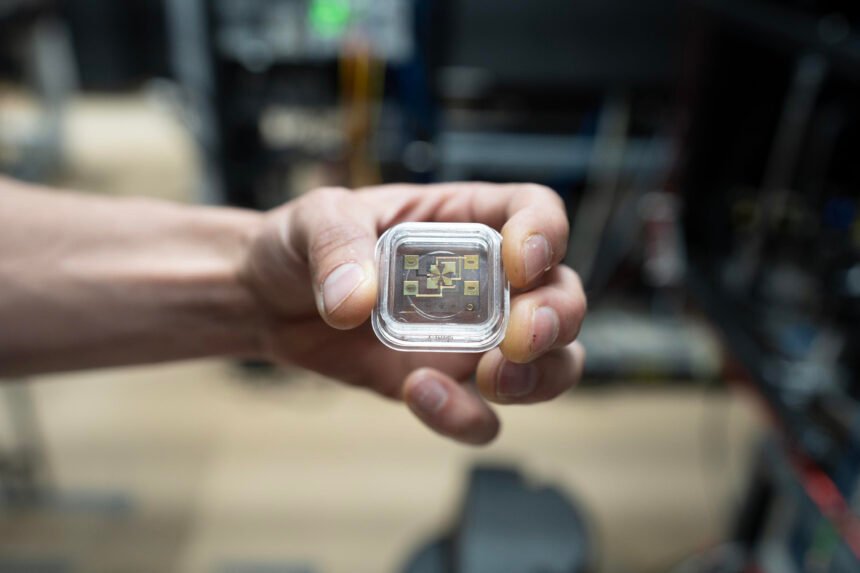
There’s a new record holder for the most accurate clock in the world. Researchers at the National Institute of Standards and Technology (NIST) have improved their atomic clock based on a trapped aluminum ion. Part of the latest wave of optical atomic clocks, it can perform timekeeping with 19 decimal places of accuracy.
Optical clocks are typically evaluated on two levels—accuracy (how close a clock comes to measuring the ideal “true” time, also known as systematic uncertainty) and stability (how efficiently a clock can measure time, related to statistical uncertainty). This new record in accuracy comes out of 20 years of continuous improvement of the aluminum ion clock.
Beyond its world-best accuracy, 41% greater than the previous record, this new clock is also 2.6 times more stable than any other ion clock. Reaching these levels has meant carefully improving every aspect of the clock, from the laser to the trap and the vacuum chamber.
The team has published its results in Physical Review Letters.
“It’s exciting to work on the most accurate clock ever,” said Mason Marshall, NIST researcher and first author on the paper. “At NIST we get to carry out these long-term plans in precision measurement that can push the field of physics and our understanding of the world around us.”
The aluminum ion makes an exceptionally good clock, with an extremely steady, high-frequency “ticking” rate. Its ticks are more stable than those of cesium, which provides the current scientific definition of the second, said David Hume, the NIST physicist leading the aluminum ion clock project. And the aluminum ion isn’t as sensitive to some environmental conditions, like temperature and magnetic fields.
But the aluminum ion is kind of shy, Marshall explained. Aluminum is difficult to probe and cool with lasers, both necessary techniques for atomic clocks. The research group therefore paired the aluminum ion with magnesium. Magnesium doesn’t have the beautiful ticking properties of aluminum, but it can be easily controlled with lasers.
“This ‘buddy system’ for ions is called quantum logic spectroscopy,” said Willa Arthur-Dworschack, a graduate student on the project. The magnesium ion cools the aluminum ion, slowing it down. It also moves in tandem with its aluminum partner, and the state of the clock can be read out via the magnesium ion’s motion, making this a “quantum logic” clock.
Even with this coordination, there was still an array of physical effects to characterize, said Daniel Rodriguez Castillo, also a graduate student on the project.
“It’s a big, complex challenge, because every part of the clock’s design affects the clock,” Rodriguez Castillo said.
One challenge was the design of the trap where the ions are held, which was causing tiny movements of the ions, called excess micromotion, that were lowering the clock’s accuracy. That excess micromotion throws off the ions’ tick rate. Electrical imbalances at opposite sides of the trap were creating extra fields that disturbed the ions. The team redesigned the trap, putting it on a thicker diamond wafer and modifying the gold coatings on the electrodes to fix the imbalance of the electric field.
They also made the gold coatings thicker to reduce resistance. Refining the trap this way slowed the ions’ motion and let them “tick” unperturbed.
The vacuum system in which the trap must operate was also causing problems. Hydrogen diffuses out of the steel body of a typical vacuum chamber, Marshall said. Traces of hydrogen gas collided with the ions, interrupting the clock’s operation. That limited how long the experiment could run before the ions needed to be reloaded. The team redesigned the vacuum chamber and had it rebuilt out of titanium, which lowered the background hydrogen gas by 150 times. That meant they could go days without reloading the trap, rather than reloading every 30 minutes.
There was still one more ingredient they needed: a more stable laser to probe the ions and count their ticks. The 2019 version of the clock had to be run for weeks to average out quantum fluctuations—temporary random changes in the ions’ energy state—caused by its laser. To reduce that time, the team turned to NIST’s own Jun Ye, whose lab at JILA (a joint institute of NIST and the University of Colorado Boulder) hosts one of the most stable lasers in the world. Ye’s strontium lattice clock, Strontium 1, held the previous record for accuracy.
This was a team effort. Using fiber links under the street, Ye’s group at JILA sent the ultrastable laser beam 3.6 kilometers (a little more than 2 miles) to the frequency comb in the lab of Tara Fortier at NIST. The frequency comb, which acts as a “ruler for light,” allowed the aluminum ion clock group to compare its laser with Ye’s ultrastable one. This process enabled the Ye lab’s laser to transfer its stability to the aluminum clock laser.
With this improvement, the researchers could probe the ions for a full second compared to their previous record of 150 milliseconds. This improves the clock’s stability, reducing the time required to measure down to the 19th decimal place from three weeks to a day and a half.
With this new record, the aluminum ion clock contributes to the international effort to redefine the second to much greater levels of accuracy than before, facilitating new scientific and technological advances. The upgrades also drastically improve its use as a quantum logic testbed, exploring new concepts in quantum physics and building the tools needed for quantum technology, an exciting prospect for those involved.
More importantly, by cutting down the averaging time from weeks to days, this clock can be a tool to make new measurements of Earth’s geodesy and explore physics beyond the Standard Model, such as the possibility that the fundamental constants of nature are not fixed values but actually changing.
“With this platform, we’re poised to explore new clock architectures—like scaling up the number of clock ions and even entangling them—further improving our measurement capabilities,” Arthur-Dworschack said.
More information:
Mason C. Marshall et al, High-Stability Single-Ion Clock with 5.5×10⁻¹⁹ Systematic Uncertainty, Physical Review Letters (2025). DOI: 10.1103/hb3c-dk28
Provided by
National Institute of Standards and Technology
This story is republished courtesy of NIST. Read the original story here.
Citation:
World’s most precise clock achieves 19-decimal accuracy with aluminum ion technology (2025, July 14)
retrieved 14 July 2025
from https://phys.org/news/2025-07-world-precise-clock-decimal-accuracy.html
This document is subject to copyright. Apart from any fair dealing for the purpose of private study or research, no
part may be reproduced without the written permission. The content is provided for information purposes only.