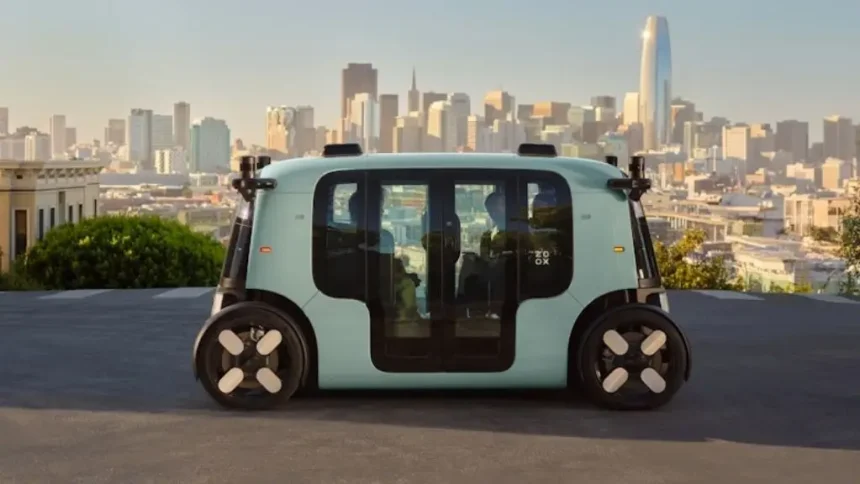
Amazon-owned Zoox will deploy retrofitted SUVs with safety drivers to map roads and test autonomous systems before launching its purpose-built robotaxis.
On the Dash:
- Zoox will begin autonomous vehicle testing in Dallas and Phoenix using retrofitted Toyota Highlander SUVs with safety drivers.
- The expansion increases Zoox’s testing footprint to 10 U.S. cities as it scales its robotaxi program.
- Amazon-owned Zoox is competing with Waymo, Tesla, and several Chinese developers in the growing robotaxi market.
Zoox, the autonomous vehicle subsidiary of Amazon, plans to begin testing its self-driving technology in Dallas and Phoenix, the company announced Monday, marking the latest expansion of its robotaxi testing footprint across the United States.
The company will initially deploy a small number of retrofitted Toyota Highlander SUVs equipped with autonomous technology and a human safety driver. These vehicles will be used to map roads and collect operational data before Zoox introduces its purpose-built robotaxis in the two markets.
Dallas and Phoenix were selected in part because they present different driving environments than the dense urban areas where Zoox has primarily tested its technology so far. The company said Phoenix provides an opportunity to evaluate sensor and battery performance in extreme heat and dust, as well as on high-speed roads. Dallas offers varied weather conditions and complex road networks that can help refine the company’s artificial intelligence systems.
Zoox said it has served more than 300,000 riders since launching robotaxi operations in Las Vegas and San Francisco. The company began offering free rides in parts of San Francisco last November, several months after opening its robotaxi service to the public in Las Vegas.
The expansion will bring Zoox’s autonomous vehicle testing operations to 10 U.S. markets. In addition to Dallas and Phoenix, the company is testing its technology in Seattle, Austin, Miami, Los Angeles, Atlanta, and Washington, D.C.
Amazon acquired Zoox for $1.3 billion in 2020 as part of its push into autonomous transportation. Since then, the company has expanded testing while preparing to scale production of its purpose-built robotaxis. Zoox recently opened a 220,000-square-foot manufacturing facility in the San Francisco Bay Area designed to produce up to 10,000 vehicles annually once fully operational.
The company also plans to open a new “fusion center” in Scottsdale to support fleet operations, including teleguidance, mission control, and rider support, as competition intensifies in the rapidly evolving robotaxi market.