by David Moreno, Fort Worth Report
April 10, 2026
Fort Worth leaders need to fundraise $25 million to $65 million if they want to establish and sustain the proposed Latino Cultural Museum de Fort Worth, according to a feasibility study conducted last year.
The scope of funds needed is based on four models that museum leaders will explore for the project: a 15,000-square-foot or 30,000-square-foot institution with either a mid-level or world-class size budget.
A mid-level budget focuses on tighter operating margins and smaller staff while a world-class budget allows for larger endowments and teams, according to the American Association for State and Local History.
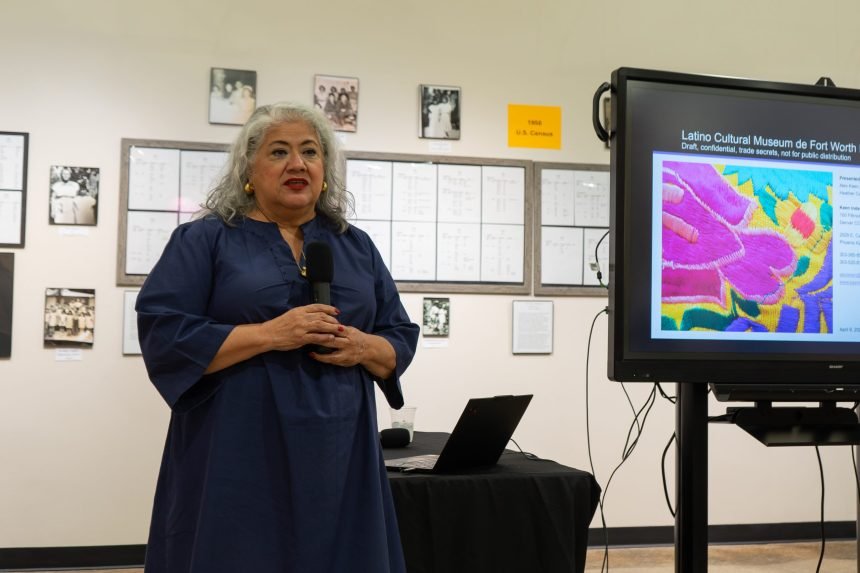
The fundraising goals ensure the museum could fully operate for at least five to seven years after opening, said Alex Keen, managing principal with Arizona-based Keen Independent Research. The consulting firm presented its findings to community members at Artes de la Rosa in the Northside on April 9.
Breakdown of possible fundraising campaign goals:
- 15,000-square-foot mid-level museum: $25 million
- 15,000-square-foot world-class museum: $35 million
- 30,000-square-foot mid-level museum: $50 million
- 30,000-square-foot world-class museum: $65 million
Possible locations include the Northside, downtown or south Fort Worth near La Gran Plaza. Survey results show Latino residents are divided about the best place to establish the museum, said Heather Calvin, the firm’s associate principal.
From April to December, researchers with Keen Independent examined the city’s demographic and market demand, relevant regional cultural assets and collected feedback from community members and stakeholders.
“Fort Worth is huge and the (Latino) communities here are quite dispersed, and it becomes a tricky conversation when choosing a location in a way that avoids feeling like you’re picking winners,” Calvin said.
Rosa Navejar, chair of the museum’s executive committee, said project leaders will spend the next year building community support, securing initial funders and partnering with local organizations before deciding which area and facility size is the most attainable.
“Yes, we’re a nonprofit, but we have to run like a business,” she said. “It’s not just opening doors. How do we maintain them open? When people entrust us with their family history, we need to make sure we take care of it properly.”
Interested in learning about the feasibility study?
Keen Independent Research will present their findings at a second community session from 10:30 a.m.-noon on April 11 at Artes de la Rosa, 1440 N. Main St. RSVP here.
The Latino Cultural Museum de Fort Worth has been in the works since at least 2023, with a goal to honor the histories of Hispanic communities in the city. The presence of Latinos dates back to the city’s founding in 1849, but immigration from Mexico boomed in the early 20th century.
Latino barrios, or neighborhoods, sprouted across employment sites on the northeast and south sides of downtown Fort Worth. Today, residents identifying as Latino make up roughly 35% of the city’s population, according to census figures.
Researchers at the consulting firm studied various Latino-focused museums across the U.S., including the Cheech Marin Center for Chicano Art and Culture in California, the Emma S. Barrientos Mexican American Cultural Center in Austin and the Latino Cultural Arts Center in Colorado.
The only North Texas museum similar to what Fort Worth leaders hope to establish is the Latino Cultural Center in downtown Dallas. The 27,000-square-foot facility opened in 2003 with public and private funding. It houses theater companies, art exhibitions, youth and senior programs and free activities.
Committee members for the Fort Worth museum need to rely on some level of public funding to successfully launch, Keen said. He believes the project could open doors as early as 2031 if leaders build off the momentum from the study and hire an executive director within the next few months.
“It’s up to you all to champion the work moving forward,” Keen told community members at Artes de la Rosa. “It’s not 10 people, it’s not 15 people, it’s 150 people going and telling the story of what this can be.”
Sana Syed, chief spokesperson for the city of Fort Worth, said elected officials have been briefed on the project, but the museum committee needs to meet with the city manager’s office next. An exact date has not been determined.
If the Latino museum becomes a reality, it would be the latest in a string of cultural facilities in the works across Fort Worth.
The nonprofit Transform 1012 is leading efforts to transform a former Ku Klux Klan hall in the Northside into a community arts center named for a Black man lynched by a white mob in 1921. The center is slated to open in 2028.
The long-proposed African American Museum and Cultural Center received $40,000 from city officials in January to finish renovations at its building in the Polytechnic Heights neighborhood. An exact opening date has not been announced, but museum leaders previously said sometime in 2026.
Nearby, the National Juneteenth Museum is expected to be built on the property where the Southside Community Center currently stands once museum leaders secure the final funds needed in their $70 million campaign.
Disclosure: Rosa Navejar is mother of Fort Worth Report Board of Directors member Rachel Navejar Phillips. The Report’s director of membership Ayesha Ganguly is board chair for Transform 1012.
David Moreno is the arts and culture reporter for the Fort Worth Report. Contact him at david.moreno@fortworthreport.org or @davidmreports.
The Fort Worth Report’s arts and culture coverage is supported in part by the Meta Alice Keith Bratten Foundation and the Virginia Hobbs Charitable Trust. At the Report, news decisions are made independently of our board members and financial supporters. Read more about our editorial independence policy here.
This <a target=”_blank” href=”https://fortworthreport.org/2026/04/10/25m-to-65m-needed-to-establish-latino-cultural-museum-in-fort-worth-study-finds/”>article</a> first appeared on <a target=”_blank” href=”https://fortworthreport.org”>Fort Worth Report</a> and is republished here under a <a target=”_blank” href=”https://creativecommons.org/licenses/by-nd/4.0/”>Creative Commons Attribution-NoDerivatives 4.0 International License</a>.<img src=”https://i0.wp.com/fortworthreport.org/wp-content/uploads/2021/04/cropped-favicon.png?resize=150%2C150&quality=80&ssl=1″ style=”width:1em;height:1em;margin-left:10px;”>
<img id=”republication-tracker-tool-source” src=”https://fortworthreport.org/?republication-pixel=true&post=482223&ga4=2820184429″ style=”width:1px;height:1px;”><script> PARSELY = { autotrack: false, onload: function() { PARSELY.beacon.trackPageView({ url: “https://fortworthreport.org/2026/04/10/25m-to-65m-needed-to-establish-latino-cultural-museum-in-fort-worth-study-finds/”, urlref: window.location.href }); } } </script> <script id=”parsely-cfg” src=”//cdn.parsely.com/keys/fortworthreport.org/p.js”></script>