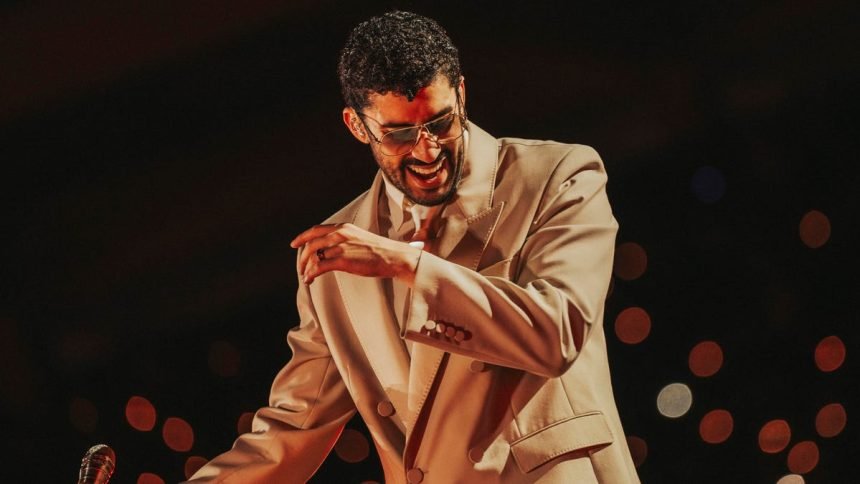
At a pivotal moment for Latin music, the NFL’s efforts to globalize a traditionally American sport and a critical political moment, what does it mean for Bad Bunny to hit the Super Bowl stage?

Why did the NFL pick Bad Bunny for the Super Bowl?
The NFL’s Bad Bunny pick for the Super Bowl halftime show was likely not politically motivated. USA TODAY’s Pamela Avila explains.
If the NFL’s goal is to go global, then who should be on the world’s biggest stage? One of the world’s biggest musicians.
“The world’s biggest artist happens to be a proud Puerto Rican who speaks Spanish, who performs in Spanish, who represents for his culture and who makes other people proud to be Puerto Rican, to be Latino and to be themselves,” says Vanessa Díaz, a Loyola Marymount University professor who has taught courses on 2026’s Super Bowl halftime show headliner Bad Bunny.
As the countdown to the Big Game on Feb. 8 winds down, it’s clear just how politicized Bad Bunny’s upcoming performance has become.
“The best decision in terms of superstar status also happened to be a really politicized musical figure, and that’s the tension … those two things don’t always coincide, but in this moment, they did,” says Díaz, coauthor of “P FKN R: How Bad Bunny Became the Global Voice of Puerto Rican Resistance.”
‘If you understand business,’ then Bad Bunny as Super Bowl headliner makes sense − and money
The NFL’s push for international growth has been in place long before Bad Bunny, who made Grammys history Feb. 1 when his “Debí Tirar Más Fotos” became the first Spanish-language album of the year winner, was announced as the halftime headliner.
Its International Series has been bringing select regular-season games to cities in England, Mexico, Germany and Brazil, among others, for almost 20 years. NFL Commissioner Roger Goodell has said the league wants to expand to new countries and eventually have each team play a game abroad every season.
President Donald Trump and a slew of conservative politicians have questioned or outright opposed the NFL’s decision to pick Bad Bunny. Trump called the choice “absolutely ridiculous.”
Secretary of Homeland Security Kristi Noem said U.S. Immigration and Customs Enforcement officers “will be all over” the event. Conservative commentator Tomi Lahren claimed Bad Bunny was “not an American artist” despite Puerto Ricans being American citizens.
Turning Point USA, founded by late conservative activist Charlie Kirk, is putting on “The All American Halftime Show” as counterprogramming to Bad Bunny. On Feb. 2, the organization announced Kid Rock, Brantley Gilbert, Lee Brice and Gabby Barrett will perform, with spokesman Andrew Kolvet saying in a press release, “The All-American Halftime Show is an opportunity for all Americans to enjoy a halftime show with no agenda other than to celebrate faith, family, and freedom.”
Kid Rock took a more confrontational approach, saying: “We’re approaching this show like David and Goliath. Competing with the pro football machine and a global pop superstar is almost impossible… or is it? He’s said he’s having a dance party, wearing a dress, and singing in Spanish? Cool. We plan to play great songs for folks who love America.”
Díaz says, “You can be against it, but if you understand business, then you would understand why they made this choice. It’s historically significant, and it is something that Latinos need, that Spanish speakers need, that migrants and young people need.”
According to an October survey by Quinnipiac University, 48% of Americans approve of the NFL’s headliner decision, while 29% dissaprove and 24% did not offer an opinion. Nearly 3 in 4 Democrats said they approve, and more than 3 in 5 Republicans oppose the choice. Black and Hispanic adults favored Bad Bunny as the headliner vs. White respondents, the survey adds.
Bad Bunny then becomes “this target for everything that’s happening politically right now,” Díaz adds. “It’s an incredibly complicated and interesting moment that we will be talking about forever.”
Latinos are the fastest-growing fan base for the NFL
In recent years, Latinos have also become the fastest-growing fan base in the NFL, according to NPR, citing that today’s league has grown its market in Mexico and Latin America enormously, with the two largest international markets being Mexico and Brazil.
For its first exclusive YouTube broadcast from Brazil, the NFL tapped Karol G to perform at halftime. The Colombian star has also risen to global stardom and will be the first Latina artist to headline at Coachella in April.
So, the “quickest way” for the NFL to “expand their consumer base as much as possible, is to, I don’t know, get the No. 1 global artist right now to perform at your game,” says award-winning KCRW podcast host Sam Sanders.
The NFL’s choice to put Bad Bunny on the halftime show stage then becomes, if not above all, a business-savvy gamble for the multibillion-dollar industry. “We’re hitting that critical mass of 20% of the population being Latino with $4.1 trillion spending power, and Bad Bunny is such a household name that it’s kind of a hole-in-one moment,” says Darlene Lopez, Founder and Managing Director of Evoke Creative. “Ultimately, they’re being a little risky, and it’s going to pay off.”
It helps that Bad Bunny boasts countless partnerships with top brands, including Adidas, Gucci, Calvin Klein, Crocs, Cheetos, WWE and Hennessy.
Bad Bunny’s record-breaking history could boost NFL’s ratings
Since his 2018 debut album, Bad Bunny has reached peaks in his career time and time again. He’s broken records with his 31-date historic Puerto Rico residency, is the first artist with an all-Spanish album win the prestigious Grammy album of the year and for the fourth time, has been named Spotify’s Global Top Artist, beating out Taylor Swift in 2025.
Despite calls to replace him as headliner, though, the NFL doubled down and backed Bad Bunny as one of the “leading and most popular entertainers in the world.” Ultimately, it’s about top visibility for the NFL, says President of Apex Marketing, Eric Smallwood, whose company evaluates sponsorships, brand partnerships and campaigns for corporate brands.
The NFL cares for “viewers that tune in specifically for the halftime show and may not tune in for the game because it’s about drawing eyeballs and bringing in as many people as possible,” Smallwood says. “You’ll see a lift at halftime [because] the average viewer doesn’t turn the halftime show off regardless if they know who [the artist] is or not.”
Kendrick Lamar’s 2025 halftime show performance became the most-watched of all time with 133.5 million viewers. The actual football game between the Philadelphia Eagles and the Kansas City Chiefs also rounded out one of the NFL’s most successful ratings with an average of 126 million viewers. Per Fox, viewership peaked during the second quarter of the game.
Since the NFL partnered with Jay-Z and Roc Nation to produce the Apple Music Halftime Show in 2019, artists including Shakira, Jennifer Lopez, The Weeknd, Usher, Rihanna, to name a few, have hit the stage.
“There’s been this narrative that makes it seem as if so many of the halftime shows since then have been problems because they’re too political, or it’s a cultural mess and a landmine for the NFL,” Sanders says. “But the ratings have never dropped, and by booking Bad Bunny, they’re proving that their intentions are bigger than whatever the political chatter around [the halftime show] is in America.”