
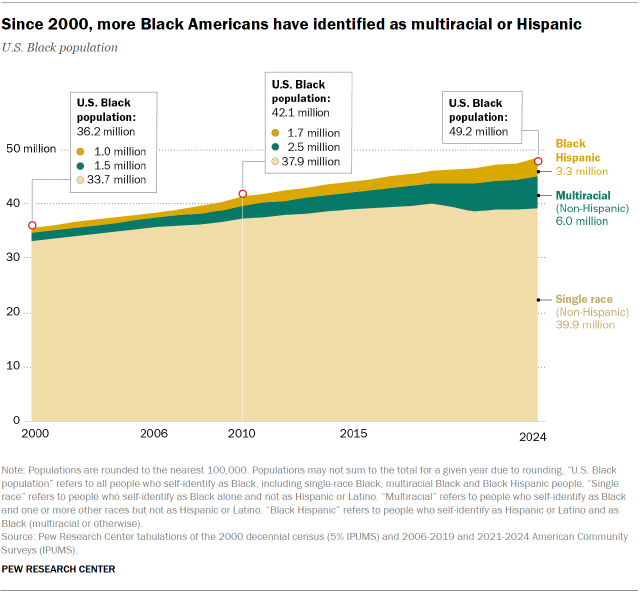
The number of Black people living in the United States reached a new high of 49.2 million in 2024. That’s up 36% since 2000, according to a Pew Research Center analysis of government data. This group is diverse, with an increasing number who say they are of two or more races.
Here are key facts about the nation’s Black population. This analysis includes three main groups: Americans who say their race is only Black and they are not Hispanic; those who say Black is one of two or more races in their identity and they are not Hispanic; and those who say they are Black alone or with other races and are also Hispanic or Latino.
The Black population in the U.S. has grown from 36.2 million in 2000 to 49.2 million in 2024. Notably, the number of Black people who are multiracial and not Hispanic has increased 295%, and the number who say they are Black and Hispanic has risen by 232%. This increase in racial diversity among Black Americans reflects broader growth in the number of multiracial Americans.
The arrival of immigrants from Africa, the Caribbean and elsewhere has also contributed to Black population growth.
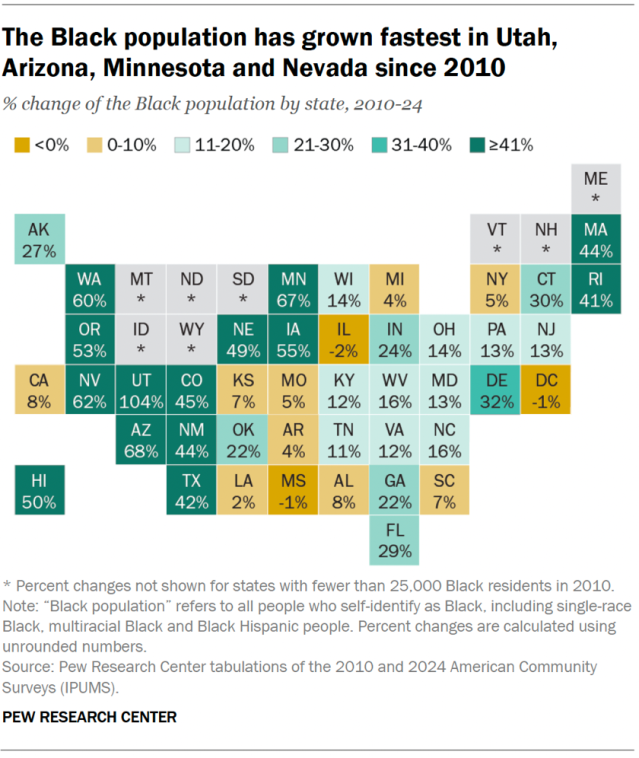
The Black population has grown fastest in states that historically have not had many Black residents. Utah saw the fastest growth in its Black population between 2010 and 2024, with an increase of 104%. The Black populations in Arizona (68%), Minnesota (67%) and Nevada (62%) also increased substantially during that span. Those were the next-fastest growth rates among states that had at least 25,000 Black residents in 2010.
The states that experienced the largest numerical increases in Black residents between 2010 and 2024 are also those with the largest Black populations: Texas (up 1.3 million), Florida (up 910,000) and Georgia (up 680,000).
Meanwhile, the Black population declined in Illinois (-2%), Mississippi (-1%) and the District of Columbia (-1%).
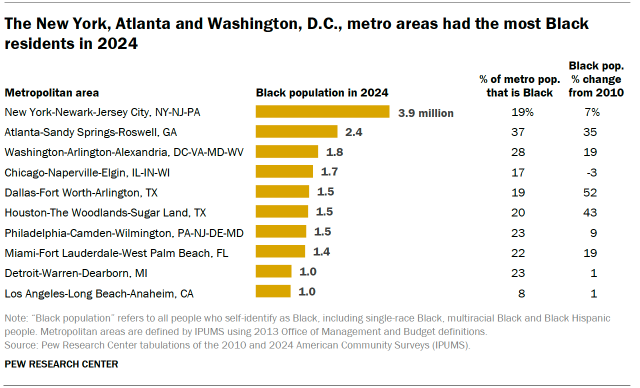
The New York City metropolitan area had more Black residents than any other metro area in 2024. About 3.9 million Black Americans lived in New York City that year. The metro areas with the next largest Black populations were Atlanta (2.4 million), Washington, D.C. (1.8 million) and Chicago (1.7 million).
The Atlanta area had a higher share of Black residents than any other metro area with at least 1 million Black residents. Nearly four-in-ten Atlanta metro area residents (37%) were Black.
Between 2010 and 2024, the metro areas with the largest percentage increases in Black residents were in Texas: Dallas (52%) and Houston (43%). In contrast, the Chicago area’s Black population declined by 3%.
The Black population tends to be younger than those who aren’t Black. In 2024, the median age of Black Americans was 33.7 years. That means half of the nation’s Black population was younger than that and half was older. By comparison, the median age of Americans who don’t identify as Black was 40.2.
In addition, 27% of all Black Americans were under 18. That was a higher share than among non-Black Americans (21%).
The median age varied somewhat among different groups of Black Americans:
- Single-race, non-Hispanic: 36.7 years
- Hispanic: 22.4
- Multiracial, non-Hispanic: 21.1
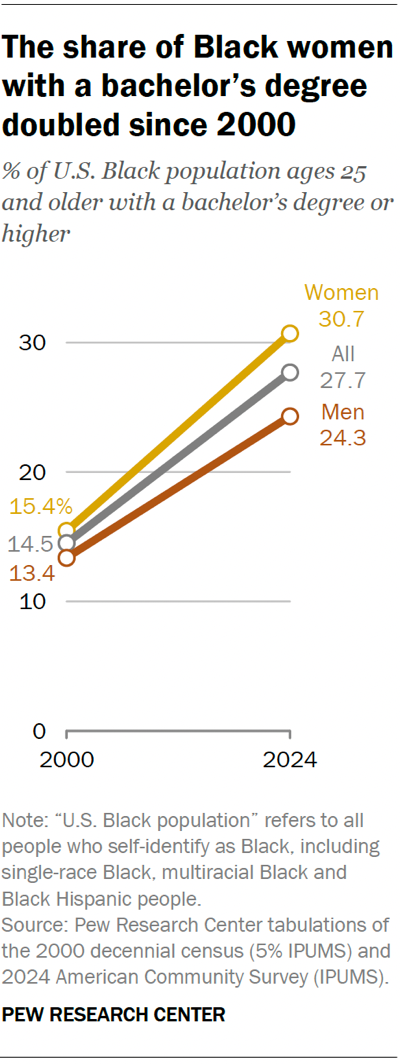
Educational attainment among Black Americans continues to rise. In 2024, 27.7% of Black adults ages 25 and older – 8.6 million people – had earned at least a bachelor’s degree. That was up from 14.5% in 2000.
Growing shares of Black women and men alike have earned at least a bachelor’s degree. But Black women have made greater gains.
- In 2024, 30.7% of Black women ages 25 and older had earned at least a bachelor’s degree. That was about double the share in 2000 (15.4%).
- 24.3% of Black men in the same age range had earned at least a bachelor’s degree in 2024, up from 13.4% in 2000.
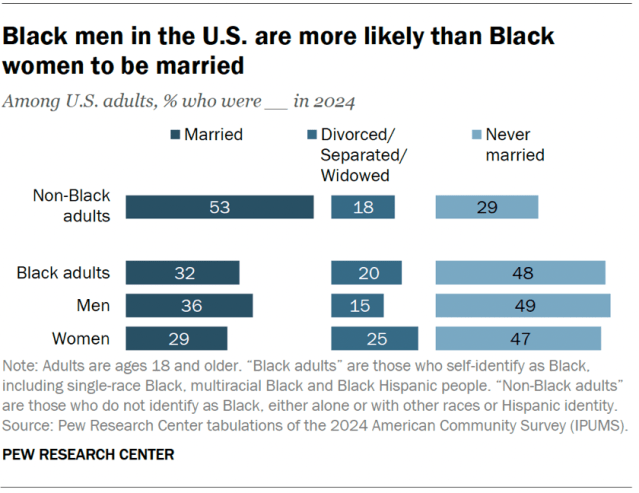
Black Americans are less likely than other Americans to be married. As of 2024, 48% of Black adults had never married, compared with 29% of non-Black adults.
Black men were more likely than Black women to be married (36% vs. 29%). In turn, Black women were more likely than Black men to be divorced, separated or widowed (25% vs. 15%).
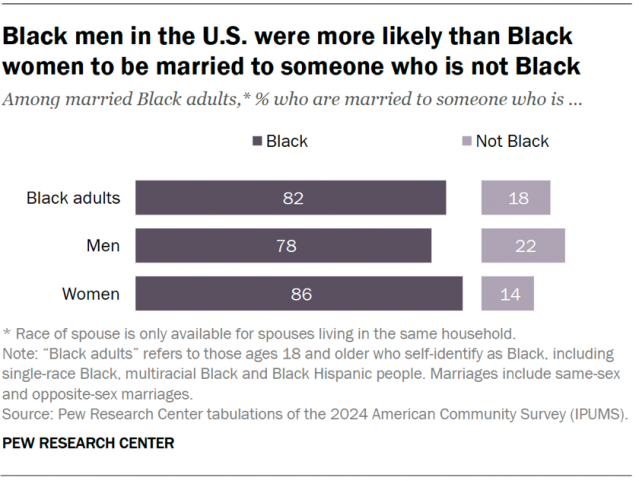
About two-in-ten married Black adults (18%) are married to someone who is not Black. This includes 22% of married Black men and 14% of married Black women. These shares only include those whose spouses live in the same households.
Married Black women were more likely than married Black men to have a Black spouse (86% vs. 78%). This includes spouses who are single-race Black, multiracial Black and Black Hispanic.
Black households had a median annual income of $57,200 in 2024. But income varied by group:
- Single-race, non-Hispanic households: $56,000
- Black Hispanic households: $63,300
- Multiracial Black households: $67,000
Note: This is an update of a post originally published Feb. 10, 2023. That post was written by Director of Race and Ethnicity Research Mark Hugo Lopez, former Research Analyst Mohamad Moslimani, and former Research Assistant Gracie Martinez.