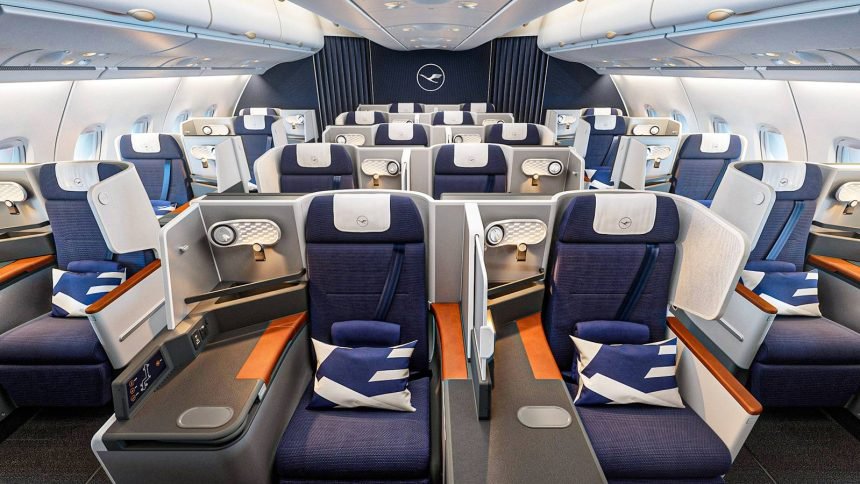
Lufthansa has officially commenced a significant cabin overhaul for its entire remaining fleet of eight Airbus A380 aircraft, marking a surprising turnaround for a jet once destined for permanent retirement. This guide provides a detailed look at the new business class product that will replace the outdated paired seating, explaining why the German flag carrier chose a pragmatic retrofit over its flagship Allegris cabin.
The return of the A380 represents more than just a temporary fix. Originally parked in 2020 with the intent of being scrapped or sold, the A380 has been reactivated to bridge a critical capacity gap that modern twin-engine jets have yet to fill. As these 500-plus-seat giants return to service, Lufthansa is investing millions to ensure the onboard experience meets current premium standards.
An Unexpected Return

The revival of the Lufthansa Airbus A380 fleet is a story of moving from total obsolescence back to front-line service in just three years. In 2020, the airline officially moved its 14 superjumbos into long-term storage, with leadership stating that the aircraft would only be reactivated in the event of an unusually strong recovery. By 2023, that recovery arrived with such force that the airline had no choice but to pull eight of the remaining aircraft out of the Spanish desert to meet the soaring demand for transcontinental travel.
This reactivation was initially viewed by many industry analysts as a short-term stopgap, but it has evolved into a long-term commitment that requires a complete reimagining of the interior space. The decision to invest in a full business class retrofit across all eight aircraft demonstrates that Lufthansa no longer views the A380 as a temporary visitor but as a vital asset for high-density routes to North America and East Asia.
The financial commitment to this fleet is substantial, with the retrofit process beginning in February 2026 at the Elbe Flugzeugwerke facility in Dresden. This location specializes in heavy maintenance and cabin conversions, ensuring that each of the eight aircraft undergoes a rigorous inspection and hardware installation process that will take them through 2027. With each aircraft costing millions to reactivate and upgrade, the unlikely survival of the A380 has transformed from a desperate measure into a cornerstone of the Lufthansa Group’s premium growth strategy.
The Delay Savior?

The primary driver behind the long-term commitment to the Airbus A380 is the systemic delay in the widebody production programs of  Boeing. Lufthansa is still positioned as the launch customer for the Boeing 777X, a twin-engine jet intended to provide the high-capacity efficiency needed to replace four-engine giants. However, persistent certification hurdles and production issues have pushed the 777X’s entry-into-service date to 2027, representing a delay of at least seven years from the original schedule.
This multi-year vacuum in the fleet plan meant the projected capacity for high-demand routes simply disappeared from the airline’s future planning. Lufthansa also faced significant delivery delays with the Boeing 787, further compounding the shortage of long-haul hulls needed to retire older, less efficient aircraft. Without the 777X available to provide the necessary seat-mile volume, the airline was left with a choice between losing market share or reinvesting in the only high-capacity airframe it already owned, the A380.
|
Metric |
Original 2026 Strategy |
Current 2026 Reality |
Impact on Strategy |
|
Primary High-Capacity Jet |
Boeing 777X |
Airbus A380 |
Full cabin retrofit required |
|
777X Delivery Status |
In-Service (Post-2020) |
Expected 2027 |
7-year delay |
|
A380 Fleet Status |
Permanently Retired |
8 Aircraft Active |
Long-term investment |
|
787 Dreamliner Status |
Full Fleet Integration |
Ongoing Delays |
Hull shortage |
The delay has forced a massive logistical shift in how the primary hubs in Frankfurt and Munich are scheduled. Large-capacity aircraft are essential for maintaining the hub-and-spoke model, especially when airport slots are capped and cannot be easily expanded. Using the A380 to handle the bulk of passenger volume on key flagship routes, the airline can deploy its smaller, more efficient twin-jets on thinner routes that would otherwise be underserved. This strategic flexibility is the only way to maintain the current growth trajectory while waiting for the elusive 777X to finally clear its regulatory hurdles.

Revealed: Lufthansa’s New A380 Cabins To Debut On These Four Routes In April
Lufthansa’s upgraded A380 cabins will debut in April 2026 on flights from Munich to Boston, Los Angeles, Washington Dulles, and Delhi.
Removing The Business Staple

Lufthansa’s decision to bypass its premier Allegris business class product for the A380 retrofit is a move designed to avoid the regulatory certification trap that has plagued its other aircraft types. The Allegris cabin requires extensive certification for every unique airframe it is installed upon, a process that has already contributed to significant delays for the Boeing 787 and Airbus A350 fleets. Rather than risking a similar bottleneck that could keep the superjumbos grounded for months, Lufthansa opted for a seat produced by Thompson Aero Seating that is already certified for use on the A380.
This pragmatic choice allows the airline to maintain a swift turnaround from the hangar to revenue service, ensuring that the upgraded capacity is available as quickly as possible. Selecting an existing, off-the-shelf solution means that Lufthansa significantly reduces the technical risks associated with a first-of-type cabin installation. The Thompson product is effectively a tried and tested model, which minimizes the potential for the seat manufacturer delays that have become a hallmark of the post-pandemic supply chain.
This decision highlights a shift in Lufthansa’s priorities, where operational reliability and immediate cabin improvements are valued more highly than the brand consistency of a single flagship product across the entire fleet. The Allegris seats offer more than just a lie-flat bed, but the airline determined that the passengers on its largest aircraft could not wait for the multi-year certification cycle that the flagship product would require. Consequently, the A380 will serve as a unique sub-brand within the Lufthansa network, offering a modern, world-class experience tailored to the geometry of the double-decker aircraft.
An Ambitious Rollout

The engineering phase of the A380’s transformation is currently underway, where the intricate process of stripping and refitting the upper deck is handled by specialized technicians. Unlike the previous cabin, which utilized a dated structure, the new installation centers on a bespoke version of the Thompson business class seat. This hardware is designed to maximize the unique curvature of the A380’s upper deck, ensuring that the heavy composite shells fit seamlessly into the existing floor tracks without requiring a total structural redesign of the aircraft’s electrical or ventilation systems.
Each of the new seats is engineered for extreme comfort, offering a width of 22.8 inches (58 cm) and converting into a fully flat bed that extends to at least 6.5 feet (two meters). This ensures that even the tallest passengers can rest comfortably during long-haul flights to destinations like Los Angeles or Singapore. The hardware features, modern digital integration such as Bluetooth audio connectivity for wireless headphones, and flexible privacy partitions that allow passengers to toggle between a social environment and a private suite experience.
The full fleet rollout is an ambitious engineering feat, with all eight aircraft scheduled to receive the upgrade by mid-2027. The Thompson seat is manufactured with modular components, which allows for faster maintenance and easier replacement of parts compared to more bespoke, integrated cabin designs. This focus on durability ensures that the new interiors will withstand another ten years of heavy use, providing a high-fidelity experience that rivals that of the newest twin-engine jets in the Lufthansa long-haul fleet.
Revealed: Lufthansa’s New A380 Cabins To Debut On These Four Routes In April
Lufthansa’s upgraded A380 cabins will debut in April 2026 on flights from Munich to Boston, Los Angeles, Washington Dulles, and Delhi.
A New Value Proposition For The A380

The most significant improvement for the frequent traveler is the total elimination of the 2-2-2 seating arrangement that had become the primary complaint for Lufthansa’s premium passengers. Under the old configuration, travelers in window seats were forced to climb over their neighbors to reach the aisle, a design flaw that had fallen far behind the global industry standard. By shifting to a staggered 1-2-1 layout, the airline ensures that every individual in the business class cabin now enjoys direct aisle access, removing physical barriers to mobility.
To achieve this level of accessibility, Lufthansa has accepted a reduction in total cabin density, shrinking the business class section on the upper deck from 78 seats down to 68. This loss of ten seats is a strategic trade-off, as the airline prioritizes the quality of the individual passenger experience over raw volume to remain competitive with rival carriers. This move brings the A380 in line with modern international expectations, where privacy and unrestricted movement are considered paramount for those paying premium fares on flights lasting ten hours or more.
The staggered nature of the Thompson seats also creates a unique variety of choice within the cabin, offering throne seats with extra surface area for solo travelers and paired center seats for those flying with a companion. Each unit acts as a self-contained environment, providing significantly more personal storage and workspace than the previous paired model. This upgrade really modernizes the A380’s value proposition, ensuring that even as the aircraft ages, its interior remains a viable and attractive option compared to the latest generation of widebody jets.
Still Going Strong

The decision to overhaul the entire eight-aircraft fleet confirms that the Airbus A380 will remain a high-capacity anchor for Lufthansa well into the next decade. Committing to this comprehensive retrofit, the airline has aligned its heavy maintenance cycles to ensure these aircraft can operate reliably through 2030 and potentially beyond. This long-term operational commitment is supported by the reality that the A380 remains the most efficient tool for Lufthansa to transport massive volumes of passengers between its primary hub in Munich and slot-constrained global gateways. Many other carriers have transitioned toward smaller twinjets. However, the superjumbo’s unique ability to consolidate two smaller flights into one large departure allows the airline to maintain its market presence without requiring additional airport slots.
Following the start of the retrofit program in February 2026, more A380 aircraft will now feature the 1-2-1 configuration. These aircraft are predominantly based in Munich, serving flagship routes to North America and East Asia, with a specific focus on high-demand markets. By the time the program concludes in mid-2027, the entire eight-jet fleet will offer a standardized, high-fidelity business class experience that finally provides the direct aisle access and privacy that modern passengers demand.
The A380’s role within Lufthansa serves as a case study for the entire aviation industry regarding the value of fleet flexibility. While the eventual arrival of the Boeing 777X in 2027 or later will eventually modernize the long-haul fleet, the A380 has proven its worth as a necessary insurance policy against manufacturing delays and sudden spikes in travel demand. The jet’s presence in the sky for the next ten years ensures that the spaciousness and passenger comfort of the double-decker era remain available to the public, offering an experience that no twin-engine aircraft can truly replicate.