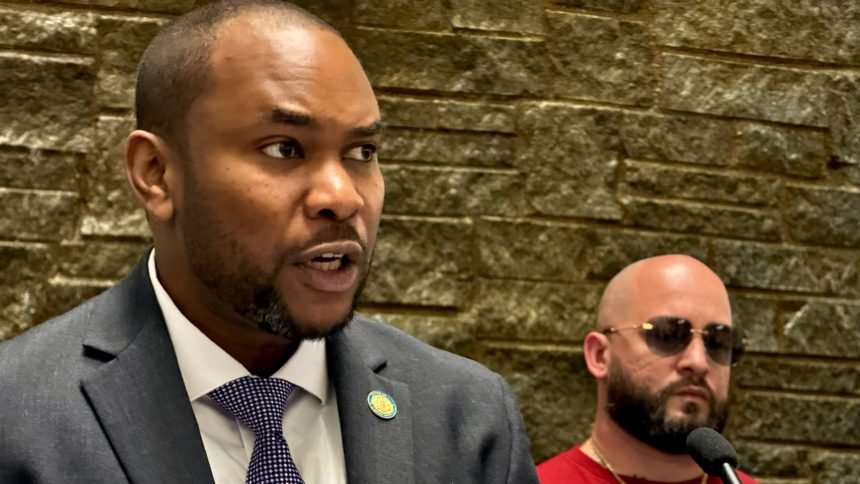
“New York has an opportunity not only to lead in market size and growth, but to become a national model for how cannabis data, cannabis policy, public health, and industry collaboration can work together to support a mature and sustainable regulatory market,” said John Kagia, acting executive director for the state Office of Cannabis Management. (Alexander MacDougall/Times Union)
ALBANY — Every major New York cannabis trade organization stood shoulder to shoulder in Albany this week behind a single message: the legal market the state spent five years building is still being undercut by illicit products, and regulators, lawmakers and licensees need to close that gap together.

The news conference, hosted alongside acting Office of Cannabis Management Executive Director John Kagia, celebrated the launch of New York’s seed-to-sale tracking system and a pending budget proposal that would put $10 million behind track-and-trace enforcement. It also served as a rare show of unity among cultivators, processors, retailers, medical operators and equity businesses who often disagree on the details of how the state’s nascent market should be run.
Article continues below this ad
New York has issued more than 2,000 cannabis licenses and seen roughly 660 stores open since recreational sales began. Legal sales have surpassed $3 billion, Kagia said. But operators say a parallel illicit market continues to siphon customers, and out-of-state product is being laundered into licensed shelves through a practice the industry calls inversion.
Assemblyman Landon Dais, who is sponsoring an anti-inversion bill, said outdoor harvests from states like Oklahoma, Ohio and Michigan tend to surge into New York in the fall, often carrying contaminants that failed testing where they were grown.
“We have to keep our supply chain safe and accounted for,” he told the crowd, arguing that unregulated product “delegitimizes our supply chain” and exposes consumers, including young people, to untested cannabis.
Assemblyman John Zaccaro Jr., who represents part of the Bronx, said the threat is not abstract. City marshals serving an eviction in his district last week uncovered an illegal grow house with hundreds of plants and more than 200 pounds of flower inside an apartment building.
Article continues below this ad
“This is exactly why cannabis enforcement matters,” he said, while cautioning that “enforcement is not enough” without continued investment in licensed operators.
Kagia framed seed-to-sale tracking as the spine of the state’s compliance strategy. “What doesn’t get measured can’t be improved,” he said, describing the system as a way to follow every plant from cultivation to the consumer counter and give regulators the data forensics to spot bad actors.
The unity on display at the Capitol Tuesday extended across the supply chain.
Don Williams, chair of the New York Medical Cannabis Industry Association, called the tracking rollout a milestone for patient safety and urged the state to partner on a “buy legal” public education campaign. Damien Cornwell of the Cannabis Association of New York said market integrity is what allows small operators “to have a successful market and grow our businesses like any other business anywhere.”
Article continues below this ad
For equity retailers, though, the conversation cut deeper. Dasheeda Dawson of CAURD Inc. said the state’s own data shows only 47% of cannabis businesses are profitable, and the figure drops to about 20% among microbusinesses. Equity operators face an even steeper climb, she said, citing restrictive financing, exploitative management agreements and creeping consolidation.
“Equity was never meant to be symbolic,” Dawson said. “It was meant to survive.”
The news conference was cast largely a celebration, and several speakers acknowledged the state budget remains under negotiation in the final weeks of the legislative session. The proposed elimination of the medical cannabis excise tax, a priority for patient advocates, has not been finalized, and the Cannabis Supply Chain Integrity and Anti-Inversion Act still needs to clear both chambers. Industry leaders also conceded that seed-to-sale tracking alone cannot fix a thriving illicit market that David Nicponski of the New York Cannabis Retail Association said is roughly three times the size it was two and a half years ago in parts of the Bronx.
Article continues below this ad
What the event produced, instead, was a snapshot of an industry trying to grow up in public. Or, as Jeremy Rivera, who heads the Cannabis Retail Alliance of New York and spent years in prison for nonviolent cannabis offenses, put it: “For so long, we’ve been afraid of each other’s shadows,” he said. “Today is the first step.”