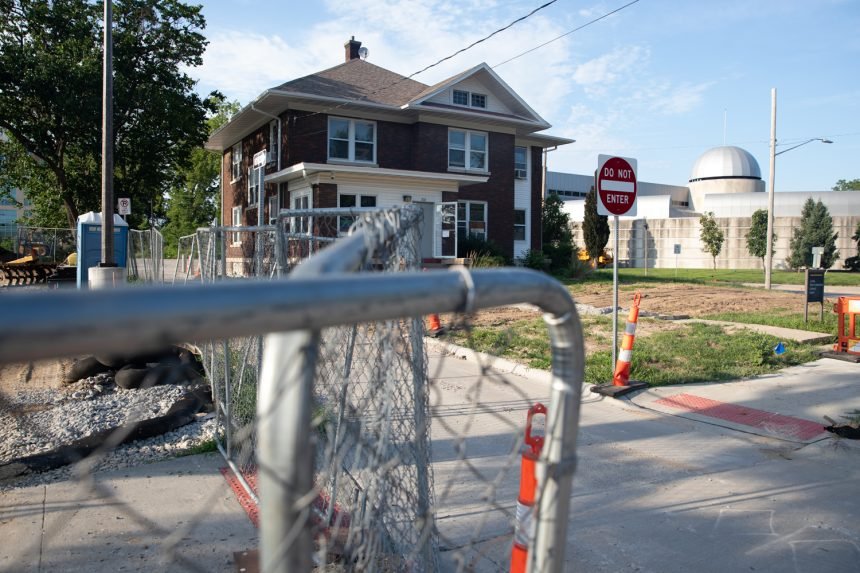
Iowa City officials have confirmed that the Latino Native American Cultural Center house will be demolished to make way for road construction on Melrose Avenue as part of the Burlington Street Bridge project. Students and the university are currently looking to relocate the center. The African American Cultural Center will remain on Melrose Avenue despite potential challenges.
The project, estimated to cost the city $30 million, was originally announced in 2024 after the bridge was deemed to be in “poor condition.” The goal of the project is to replace and modernize the Burlington Street Bridge with a new, safer structure. The project also entails extensive construction on Melrose Avenue.
The need for demolition stems from the city’s plan to convert that stretch of Melrose Avenue into a two-way street and, with that, to widen the lanes, which will overlap with the Latino Native American Cultural Center.
Justin Harland, the city’s senior engineer, said the city has been working with the university on the project, and the plan is to demolish the Latino Native American Cultural Center at 308 Melrose Ave.
“Our preferred concept shows that building being removed,” Harland said.
RELATED: Service begins for new UI water tower
Since the Latino Native American Cultural Center is owned by the university, it was not the city’s decision to demolish the building, but rather the University of Iowa’s.
In alignment with the city’s preferred concept, university officials confirmed that the building would be demolished. However, David Kieft, the senior director of university business and real estate, said the university has been working with members to find a new university-owned home.
“We’re going to find them a new home,” Kieft said. “They’ve got a couple of options we’re exploring with them.”
Kieft said the plan is to establish a new Latino Native American Cultural Center, most likely in 2028, before the current house is demolished.
Keniese Evans, the assistant dean of leadership and engagement, said she has worked with the students to help research their options for a new house.
“We’re able to finally narrow down on the space that we were able to take to the university as our first choice and our possibility,” Evans said. “Now we’re running that past all of the proper channels, and once we have the go-ahead from there, we will start the process of what updates need to be made.”
Evans said the renovation project is projected to begin in 2029, and there should be “no interruption of service” for the Latino Native American Cultural Center.
“The hope is that we will far beat their 2029 deadline and be moved into our new space before they even start their project,” Evans said.
Also located on the same street, at 303 Melrose Ave., is the African American Cultural Center, built in 1909. According to Evans and Kieft, there are no plans to demolish that house.
“There is no impact in the sense that the center needs to be moved,” Evans said.
While there is no plan to demolish the African American Cultural Center, Evans said she has heard concerns from students about the house’s future. According to Evans, the concerns seem to stem from the plan to demolish and relocate the Latino Native American Cultural Center, as well as from construction on the street where the African American Cultural Center is located.
“I don’t want folks to think that space is going away from them,” Evans said. “I know how important it is, and we want to keep preserving the space as much as we can.”
With the house located in a central area of the project, Evans said she is unsure how road construction will affect accessibility to the house during the project because of how far out it is.
“We know we’ll have to make some accommodations,” Evans said. “We’re prepared to cross that bridge when we get there.”