On August 5, 2026 the U.S. Food and Drug Administration (FDA) approved the first-ever messenger RNA (mRNA) flu vaccine for adults 50 and older. Manufactured by Moderna, the vaccine is expected to be available for the 2026-2027 season. The new vaccine was found to be safe following a trial of roughly 40,000 people, with results indicating the new shots could offer more protection than prior flu vaccines. The COVID-19 vaccines were the first publicly available vaccines in the U.S. to rely on mRNA, and while studies have demonstrated that vaccines using the technology are safe and effective, mRNA technology has long been the subject of attacks and criticism by anti-vaccine groups. Last year, HHS Secretary Robert F. Kennedy Jr. announced the cancellation of $500 million in federal funding for mRNA research.
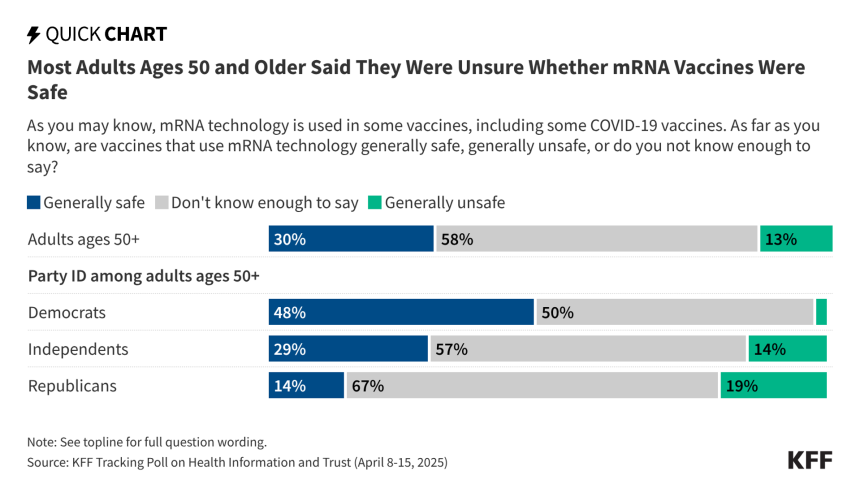
KFF polling in April 2025 found that most adults ages 50 and older (the age group that will be eligible for the new mRNA flu vaccine) were uncertain whether mRNA vaccines are safe. Views on the safety of mRNA technology differ by partisanship, with Democrats about three times as likely as Republicans to see it as safe; however, at least half of adults 50 and older across partisans said they were unsure whether mRNA vaccines are safe or not.